
 AU
AU
 UK
UK
 CA
CA
 NZ
NZ
 IND
IND

 US
US

 Share
Share
 X (Formerly Twitter)
 Whatsapp
 Facebook
 LinkedIn
 Telegram
 Email This Article
 Copy Link
 Summarize with AI
 Chat GPT
 Perplexity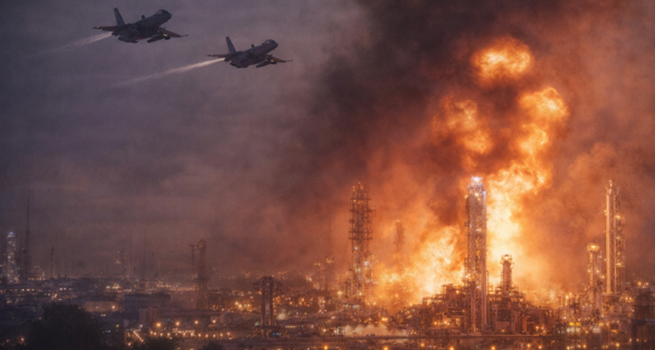
Key Highlights
- U.S. and Israel have struck Iran’s South Pars gas field.
- The site accounts for about 75 percent of Iran’s gas output.
- Iran signals retaliation targeting regional energy infrastructure.
- Civilian energy systems are now central to the conflict.
- Global energy markets face rising geopolitical risk.
A Sudden Shift in the Rules of Engagement
In a move that signals a sharp escalation in Middle East tensions, the United States and Israel have launched a coordinated strike on Iran’s South Pars gas field, the largest in the world and the backbone of Iran’s energy system.
The attack represents a decisive shift in the nature of the conflict. What had largely remained within the realm of military and proxy engagements has now expanded into direct strikes on critical civilian infrastructure. South Pars is not only a strategic asset but a lifeline for Iran’s economy and electricity supply.
Strategic Significance: Why South Pars Matters
South Pars plays a central role in Iran’s domestic stability. The field contributes roughly three quarters of the country’s natural gas production and fuels approximately 85 percent of its electricity generation.
Any disruption to operations at this scale has immediate implications. Power generation, industrial activity, and household energy supply are all linked to the field. The strike therefore goes beyond military calculus and enters the domain of systemic economic disruption.
Analysts note that targeting such infrastructure raises the stakes significantly, as it directly affects civilian populations and economic continuity.
Iran’s Response: Direct Threats to Regional Energy Hubs
Iran has responded swiftly and with unusual clarity. Authorities have ordered evacuations at four major energy facilities across Saudi Arabia, Qatar, and the United Arab Emirates. In parallel, Tehran has indicated potential strikes on refinery infrastructure in Haifa, Israel.
The messaging marks a departure from ambiguity. Iran has explicitly warned that any attack on its energy infrastructure will be met with reciprocal actions targeting regional and international energy assets.
The signal is unambiguous. If its domestic grid is disrupted, Iran intends to extend the impact across the broader energy network that supports U.S. and allied operations in the region.
Market Reaction: Energy Risk Premium Begins to Rise
Financial markets are beginning to reflect the shift. Oil and gas prices are expected to respond to heightened geopolitical risk, particularly given the central role of the Gulf region in global supply.
Energy infrastructure has historically been a sensitive point in conflict scenarios, but direct targeting of a facility as significant as South Pars introduces a new level of uncertainty. Traders are likely to factor in potential supply disruptions and retaliatory strikes that could affect multiple production and export nodes.
Beyond commodities, equity markets may also see volatility. Energy intensive sectors and regional assets could face pressure, while defence and infrastructure protection segments may attract increased investor interest.
A New Phase: Infrastructure as the Battlefield
The strike on South Pars underscores a broader transformation in modern conflict. Energy systems, once considered secondary or collateral targets, are now central to strategic calculations.
Electricity grids, gas fields, and refineries are not only economic assets but instruments of leverage. Disrupting them can create immediate pressure on governments by affecting daily life, industrial output, and public sentiment.
With both sides now openly signalling intent to target such infrastructure, the conflict risks entering a cycle of reciprocal escalation that extends beyond traditional military boundaries.
Strategic Outlook: Escalation Risks and Global Implications
The coming days will be critical in determining whether the situation stabilises or escalates further. Much will depend on the scale and timing of Iran’s response, as well as the posture of regional players such as Saudi Arabia and the United Arab Emirates.
The involvement of the United States adds a global dimension. Any further escalation could draw in additional actors and complicate efforts to contain the conflict.
For global markets, the key concern is the potential for sustained disruption. The Gulf region remains a cornerstone of energy supply, and instability at this scale could have far reaching economic consequences.
Conclusion: From Proxy Conflict to Systemic Risk
The strike on South Pars marks a turning point. It signals a transition from contained confrontation to direct attacks on the infrastructure that sustains modern economies.
For millions in the region, the implications are immediate. For global markets, the risks are only beginning to unfold. As energy systems become targets, the cost of conflict rises sharply, not just for those directly involved but for the broader global economy.
FAQ Section
- What is South Pars and why is it important?
South Pars is the largest natural gas field in the world and a critical source of Iran’s energy. It supports electricity generation and industrial activity, making it central to the country’s economic and social stability. - Why is this strike considered a major escalation?
The attack targets civilian energy infrastructure rather than traditional military assets. This broadens the scope of the conflict and increases the risk of widespread economic and humanitarian impact. - What has Iran threatened in response?
Iran has warned of retaliatory strikes on energy facilities in Saudi Arabia, Qatar, the UAE, and Israel. It has also ordered evacuations at key sites, signalling potential imminent action. - How could this affect global energy markets?
Disruptions in the Gulf region can tighten supply and increase prices. The escalation introduces uncertainty that may lead to higher volatility across oil and gas markets. - What should investors watch next?
Investors should monitor Iran’s response, regional diplomatic developments, and any signs of disruption to energy production or transport. These factors will shape market sentiment and risk pricing in the near term.


 Jun 13, 2026




 Please wait processing your request...