
 AU
AU
 UK
UK
 CA
CA
 NZ
NZ
 IND
IND

 US
US

 Share
Share
 X (Formerly Twitter)
 Whatsapp
 Facebook
 LinkedIn
 Telegram
 Email This Article
 Copy Link
 Summarize with AI
 Chat GPT
 Perplexity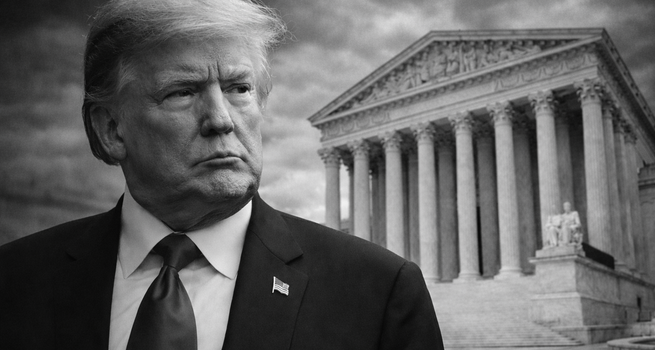
Key Highlights
- Supreme Court strikes down Trump’s global tariffs, easing trade policy risk.
- S&P 500, Nasdaq and Dow advance as volatility declines.
- Potential disinflation tailwind supports equity valuation multiples.
- Import-heavy sectors may see margin stabilisation.
- Policy uncertainty shifts to White House “backup plan”.
Markets React Swiftly to Trade Policy Reset
U.S. equity markets moved higher after the Supreme Court of the United States ruled that President Donald Trump’s global tariffs were unlawfully imposed under emergency powers. The decision effectively dismantles a broad-based trade regime that had shaped corporate cost structures and investor risk assessment for years.
Market pricing reflected an immediate recalibration of trade friction risk.
- The S&P 500 rose 0.63 percent to 6,905.19.
- The Nasdaq Composite advanced 1.02 percent to 25,051.18.
- The Dow Jones Industrial Average gained 0.24 percent to 49,513.40.
- The VIX volatility index declined 3.46 percent to 19.53.
The simultaneous rise in equity benchmarks and decline in implied volatility suggests investors interpreted the ruling as reducing policy uncertainty, at least in the near term.
A Structural Shift in Trade Risk Premium
The tariffs had covered imports from Canada, China, Mexico and most other trading partners. They were projected to generate roughly $1.5 trillion in federal revenue over a decade and were justified under national emergency declarations tied to fentanyl flows and trade imbalances.
Lower courts had questioned whether such measures constituted unauthorized taxation. The Supreme Court’s ruling not only invalidates the tariffs but narrows the scope of executive emergency authority in trade matters.
For equity markets, this represents a potential compression of the trade policy risk premium embedded in valuation multiples. Uncertainty around supply chain disruption, retaliatory tariffs and cost inflation had periodically weighed on forward earnings estimates. Judicial clarity may now reduce one variable in an already complex macroeconomic equation.
Inflation Dynamics and Valuation Implications
Tariffs function as a tax on imports, often passed through partially to consumers. Their removal introduces the possibility of lower input costs across industrial and consumer sectors.
If import prices decline, goods inflation could moderate. That dynamic would reinforce the broader disinflation narrative and potentially support higher equity valuation multiples through lower real yields.
Institutional investors will monitor inflation breakevens, Treasury yields and corporate earnings guidance to assess whether this shift meaningfully alters the interest rate outlook. A durable decline in inflation expectations tends to support growth-oriented equities, particularly technology and semiconductor names.
However, pass-through behaviour matters. Companies with pricing power may retain cost savings rather than reduce consumer prices, preserving margins without materially lowering inflation.
Sectoral Transmission
Industrials and Capital Goods
Industrials with significant imported intermediate inputs may benefit from lower procurement costs. Improved supply chain predictability could enhance operating leverage, particularly in capital-intensive businesses.
Consumer Discretionary and Retail
Retailers reliant on imported goods may experience gross margin expansion. Inventory recalibration and competitive pricing dynamics will determine the pace at which savings are reflected in earnings.
Technology and Semiconductors
Global technology supply chains are deeply integrated. Reduced tariff exposure lowers one layer of regulatory uncertainty. While geopolitical tensions remain, equity markets may assign a lower discount to earnings visibility in hardware and semiconductor segments.
Fiscal and Liquidity Considerations
The ruling also introduces fiscal complexity. During oral arguments, the administrative burden of refunding collected tariffs was described as substantial. If repayments prove material, federal deficits may widen in the short term.
Higher Treasury issuance could influence liquidity conditions and bond yields. For equity markets, the interplay between fiscal expansion, inflation expectations and monetary policy remains central to valuation sustainability.
Thus, while equities have responded positively, the broader macro transmission remains fluid.
Currency and Capital Flows
Tariffs influence trade balances by altering import demand and pricing. Their removal may modestly increase import volumes, potentially widening the current account deficit.
Yet currency markets respond to multiple variables, including growth differentials and policy credibility. If the ruling is perceived as enhancing institutional stability, capital inflows into U.S. risk assets could offset trade balance concerns.
Dollar stability remains critical for multinational earnings translation and global equity flows.
The White House Response
President Trump has announced that a “backup plan” for tariffs is under consideration. The durability of the current equity rally will depend partly on whether alternative statutory mechanisms are pursued.
Should new trade measures emerge under different legal authority, markets may reassess risk premiums. If, however, the decision ushers in a more rules-based trade framework requiring congressional approval, policy volatility may diminish over time.
Institutional investors will likely adopt probability-weighted positioning, balancing potential margin relief against renewed regulatory experimentation.
Relief, With Caution
The equity market response reflects a repricing of trade friction risk rather than a wholesale resolution of policy uncertainty. Higher index levels and a declining VIX signal improved sentiment, but structural questions remain.
Trade policy is only one component of the macroeconomic matrix that includes fiscal sustainability, monetary policy direction and global demand trends. While the Supreme Court’s decision reduces one layer of uncertainty, the broader regulatory environment will determine whether valuation support proves durable.
For now, equities are responding to clarity. Whether that clarity endures will shape the next phase of earnings expectations, capital allocation and institutional risk management.


 Jun 13, 2026




 Please wait processing your request...