
 AU
AU
 UK
UK
 CA
CA
 NZ
NZ
 IND
IND

 US
US

 Share
Share
 X (Formerly Twitter)
 Whatsapp
 Facebook
 LinkedIn
 Telegram
 Email This Article
 Copy Link
 Summarize with AI
 Chat GPT
 Perplexity
Advanced Micro Devices (NASDAQ: AMD) stock surprised markets by trading nearly 10% lower in pre-market hours despite delivering a record-breaking fourth-quarter performance. At first glance, the move appears counterintuitive. After all, AMD just posted its strongest quarter ever, with robust growth across data center earnings, expanding margins, and clear traction in AI chip growth.
Yet markets are forward-looking machines. The near-term pullback reflects a classic tension between extraordinary long-term opportunity and short-term execution expectations. For investors willing to look beyond quarterly noise, AMD’s results reinforce a deeper truth: the company is quietly transforming into a data center–led, AI infrastructure compounder.
Record Q4 Earnings Confirm AMD’s Scale Shift
AMD’s Q4 FY2025 earnings marked a structural step-up in the company’s operating model:
- Revenue of $10.3 billion, up 34% year-on-year
- Data Center revenue of $5.4 billion, up 39% YoY
- Non-GAAP gross margin of 57%
- Operating income of $2.9 billion, up 41% YoY
- Operating margin expanded to 28%
These numbers tell a simple story. AMD is no longer primarily a cyclical PC-chip company. It is increasingly a high-margin supplier of mission-critical compute silicon for cloud platforms, hyperscalers, and AI workloads. This shift in business mix is the foundation for sustained earnings compounding over the next several years.
The Market’s Worry: Guidance vs. Expectations
Despite the strong print, AMD guided Q1 FY2026 revenue of around $9.8 billion (±$300 million), implying sequential softness driven by seasonality in Client, Gaming, and Embedded segments.
While this still represents roughly 32% year-on-year growth, the market had built in expectations for even stronger near-term acceleration from AI. In today’s environment, anything short of “blowout guidance” can trigger profit-taking, particularly in high-beta semiconductor stocks.
Importantly, this guidance says little about AMD’s medium-term earnings power. It mainly reflects timing and seasonality rather than a weakening of structural demand.
EPYC CPUs: Quietly Winning the Data Center War
One of the most underappreciated elements of AMD’s story is the steady, relentless progress of EPYC server CPUs.
Management disclosed that 5th-generation EPYC “Turin” now accounts for more than 50% of server CPU revenue. This is significant. It indicates rapid customer migration to AMD’s latest architecture and deepening penetration inside hyperscaler data centers.
In parallel:
- Over 1,600 EPYC-powered cloud instances are now active
- 230+ new cloud instances were launched in Q4 alone
This level of deployment signals that EPYC has moved from “alternative option” to default choice in many enterprise and cloud environments. Such positioning tends to endure.
Instinct GPUs: From Experiment to Production
AMD’s Instinct accelerators are also crossing an important threshold. Management noted that 8 of the top 10 AI companies are now running production workloads on Instinct GPUs.
This matters more than headline benchmarks. In enterprise computing, production deployment equals trust. It implies stability, software maturity (via ROCm), and confidence in long-term roadmap support.
As AI training and inference workloads proliferate, AMD’s growing GPU footprint provides a second powerful growth engine alongside EPYC.
MI450 and Helios: Laying the Tracks for the Next Decade
The real inflection point lies ahead.
AMD expects MI450 AI accelerators to begin contributing revenue in Q3 FY2026, with a meaningful ramp in Q4. More importantly, MI450 will be delivered as part of the Helios rack-scale AI platform—a system-level approach optimized for dense AI clusters.
This strategic pivot is crucial. The future of AI computing is not about selling standalone chips. It is about delivering integrated platforms that solve power, cooling, networking, and software orchestration challenges.
Management has framed 2026 as a bridge year and sees 2027 as the period when AI revenue can scale into the tens of billions of dollars annually. If achieved, AMD’s earnings base would look fundamentally different from today.
Why a Falling Stock Price Can Coexist with a Rising Business?
Great businesses often experience uncomfortable periods in the market. Short-term volatility reflects uncertainty about timing. Long-term value is driven by direction of travel.
AMD’s direction is clear:
- Higher data center mix
- Expanding margins
- Platform-level AI solutions
- Deepening customer entrenchment
None of these have deteriorated because of one cautious quarter of guidance.
Technical Summary (Daily Chart View)
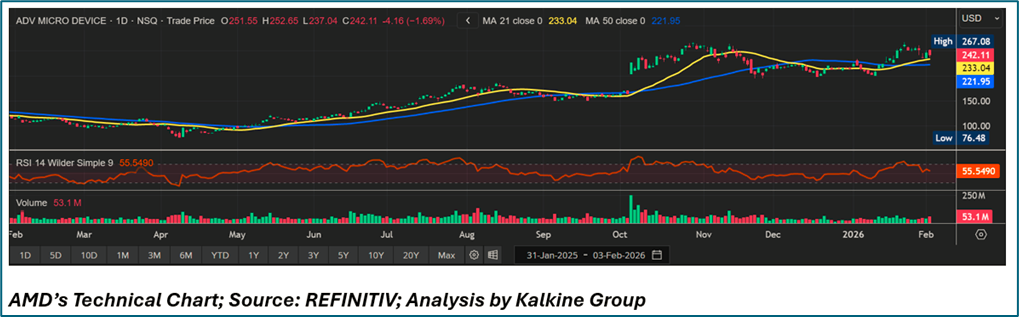
- Trend: Medium-term uptrend remains intact
- Structure: Recent price action resembles consolidation after a strong rally
- Moving Averages: Stock trades near rising medium-term averages, indicating support
- Momentum: RSI has cooled from overbought levels, suggesting healthy reset
Technically, the setup looks more like base-building than trend failure.
Conclusion: A Business That Is Quietly Becoming More Valuable
The market’s reaction to AMD’s results reflects short-term impatience. The company’s operating trajectory reflects something else entirely: a transition into a high-quality AI infrastructure franchise with growing competitive depth.
For investors who think in years rather than quarters, AMD’s record Q4, expanding data center footprint, and upcoming MI450/Helios platform point to a business whose earnings power is still in the early innings.
Sometimes, the best opportunities appear not when headlines are euphoric, but when a great business temporarily falls out of favor.


 Jun 13, 2026




 Please wait processing your request...