
 CA
 NZ
 UK
 AU
 IND

 US

 Share
 X (Formerly Twitter)
 Whatsapp
 Facebook
 LinkedIn
 Telegram
 Email This Article
 Copy Link
 Summarize with AI
 Chat GPT
 Perplexity
Key Highlights
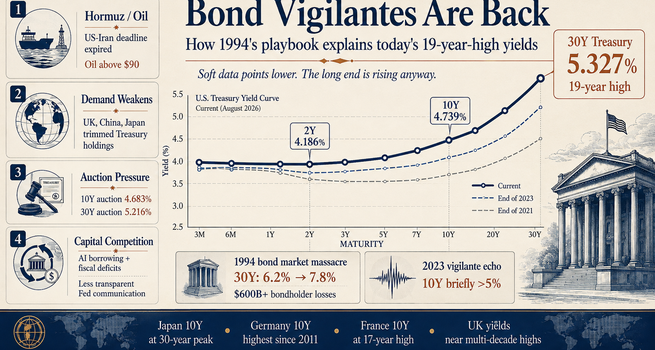
- The 30-year Treasury Yield climbed to 5.327 percent on Tuesday, its highest level in 19 years, as an expired US-Iran ceasefire deadline pushed oil above 90 dollars a barrel
- The move echoes the 1994 Bond Market shock and the 2023 return of so-called bond vigilantes, both episodes where yields rose despite policy expectations pointing the other way
- The selloff has gone global, with Japan's 10-year yield at a 30-year peak, Germany's Bund yield at its highest since 2011, and France's 10-year yield at a 17-year high
- Strategists point to AI-related corporate borrowing, rising fiscal deficits, and a shift toward less transparent Federal Reserve communication as compounding pressures on long-term rates
A Yield Spike That Breaks the Usual Script
The 30-year Treasury yield rose to 5.327 percent on Tuesday, its highest level in 19 years, extending a climb that has defied the usual relationship between economic data and bond prices. A run of soft US economic data has led traders to scale back rate hike expectations, exactly the kind of backdrop that would typically pull long-term yields lower. That has not happened. The 10-year Treasury yield rose to 4.739 percent, while the 2-year yield, which typically tracks near-term Fed policy more closely, stayed roughly flat at 4.186 percent, a gap that underscores how much of the move is concentrated at the long end rather than reflecting a shift in near-term rate expectations.
This is not the first time long-term rates have moved against what the incoming data seemed to suggest. Twice before, in 1994 and again in 2023, a similar divergence showed up, and in both cases it turned out to be an early signal rather than noise. That history is worth revisiting before looking at what is driving the current move.
When Yields Rise Against the Grain, History Has a Warning
The 1994 blueprint
The starkest precedent is 1994, still remembered on trading desks as the "bond market massacre." The Federal Reserve began raising short-term rates that February from historically low levels, and what started as a modest tightening cycle triggered a disorderly repricing across the entire bond market. The 30-year Treasury yield rose from roughly 6.2 percent in January to nearly 7.8 percent by September, and estimates of bondholder losses that year ran past 600 billion dollars. The episode is widely credited with cementing the term "bond vigilantes," coined a decade earlier by strategist Ed Yardeni to describe investors who use bond sales to discipline government spending and Monetary Policy they judge to be too loose. The 1994 experience also demonstrated how quickly leveraged positioning can amplify a yield move once it starts, turning a gradual policy shift into a rapid, Global Bond selloff that spread beyond US borders into markets including Japan.
2023's echo
A more recent echo came in October 2023, when the 10-year Treasury yield briefly touched just above 5 percent for the first time since 2007, a level it had not approached since the financial crisis. That episode was driven less by an active Fed tightening campaign and more by concerns over fiscal deficits and Treasury issuance, with strategists at the time explicitly invoking Yardeni's "bond vigilante" framing again. The move unsettled Equity markets and drew public comment from the Treasury Secretary, underscoring how sensitive risk assets remain to sharp swings at the long end of the curve even when the move originates in fiscal rather than monetary policy concerns.
Both episodes share a common thread with the current move: yields rising for reasons that have more to do with the structural appetite for holding long-duration government Debt than with the immediate path of short-term interest rates. That distinction has typically mattered for how long the pressure persists. In 1994, the repricing continued until the Fed's tightening cycle concluded and markets found a new equilibrium. In 2023, yields retreated only once fiscal and issuance concerns eased. Neither resolved quickly, and both argue against treating the current move as a short-lived reaction to any single data point.
The Strait of Hormuz Becomes the Immediate Trigger
The 60-day deadline for the United States and Iran to secure a peace deal expired this week, and Iran has ruled out an extension, according to state media. A senior Iranian official said Tehran would shift to a fully offensive military posture if diplomacy with the US fails, and oil prices rose above 90 dollars a barrel as investors priced in a more extended closure of the Strait of Hormuz. Market commentary has described the past day's moves in bonds and equities as reflecting no single catalyst, but rather a steady accumulation of negative geopolitical headlines, with an extended Strait closure now treated as the base case rather than a worst-case scenario. Analysts note that a genuinely worst-case outcome would be a resumption of active military conflict.
A Weakening Bid for Long-Duration US Debt
Foreign holders step back
Part of today's divergence traces to a Demand problem. Treasury Department data released this week showed foreign holdings of US government debt fell in June, with the UK, China, and Japan, the three largest foreign holders, all reducing their positions. That matters because these holders have historically provided a stable base of demand for US long-term debt, and a simultaneous pullback across all three suggests the shift is broader than any single country's circumstances.
Auctions confirm the shift
Recent Treasury auctions have echoed the same theme. A sale of 10-year notes cleared at a yield of 4.683 percent, the highest in 19 years, while a 30-year bond auction stopped at 5.216 percent, a 25-year peak. Weak auction outcomes typically reflect softer investor appetite at prevailing prices, and results at these levels point to a sustained shift in how much compensation investors want for holding long-duration paper, rather than a one-off event tied to a single sale.
A Global Selloff, Not Just an American One
Rising Treasury yields are part of a broader global repricing of long-term government debt. Japan's benchmark 10-year government Bond Yield rose to a 30-year peak, while the country's longer-dated bonds hovered near the 40-year highs reached earlier this year. Germany's 10-year Bund yield touched its highest level since May 2011, and France's 10-year yield hit a 17-year high, with both countries' long bond futures slipping as well. Britain's long-dated yields have also approached multi-decade highs, reinforcing that this is not a story about US fiscal or monetary policy alone.
What's Driving Yields Beyond the Headlines
Strategists have pointed to several structural forces compounding the immediate geopolitical trigger. Competition for Capital from AI-related corporate borrowing has emerged as a leading Factor pushing up yields, as buyers demand higher returns to keep absorbing the flood of both government and corporate bonds hitting markets at once. A rising US budget Deficit continues to weigh on investor sentiment toward longer-dated Treasury issuance. A shift in Federal Reserve communication toward a less transparent policy stance has also been cited as a contributing factor behind higher long-term yields, adding a layer of policy uncertainty on top of the fiscal and geopolitical pressures already in play.
One general observation from market strategists is that after roughly 15 years in which stable to falling interest rates consistently supported higher stock prices, recent auction results signal that landscape is shifting, with investors increasingly focused on the scale of US debt and fiscal discipline. Investors managing this risk have been advised to favor shorter-duration bonds given the scale of the moves at the long end.
Outlook: Convergence, Not Coincidence
The pressures on long-dated Treasury yields are not isolated risks that happen to be occurring at the same time. An unresolved Strait of Hormuz standoff, weakening foreign and auction demand, a synchronized global bond selloff, and structural competition for capital from AI-related borrowing are compounding each other. That convergence is what makes the current move in long-dated yields look structural rather than a temporary reaction to a single data release or headline. History suggests these episodes resolve only once the underlying imbalance, whether in monetary policy, fiscal policy, or geopolitical risk, is addressed directly, and current conditions leave little Margin for error in the meantime.


 Nov 13, 2026





 Please wait processing your request...