
 AU
AU
 UK
UK
 CA
CA
 NZ
NZ
 IND
IND

 US
US

 Share
Share
 X (Formerly Twitter)
 Whatsapp
 Facebook
 LinkedIn
 Telegram
 Email This Article
 Copy Link
 Summarize with AI
 Chat GPT
 Perplexity
Index Update: U.S. stock futures linked to the S&P 500, Dow, and Nasdaq 100 declined about 0.3% as oil prices continued rising despite the IEA’s release of 400 million barrels from strategic reserves amid escalating strikes involving Iran, Israel, and Gulf countries that disrupted Persian Gulf energy supplies. Higher Treasury yields across the curve pressured credit-sensitive sectors, while financial stocks faced added scrutiny after Morgan Stanley and Cliffwater limited withdrawals from private credit funds, raising concerns over potential loan stress; Morgan Stanley, Bank of America, and JPMorgan each fell more than 1% in premarket trading, while Adobe traded slightly lower ahead of its earnings.
Market Movers: On Wednesday, the top gainers were Acurx Pharmaceuticals, Inc. (+107.93%), followed by 60 Degrees Pharmaceuticals, Inc. (+71.28%). On the contrary, Innovation Beverage Group Limited. (-36.16%), and Co-Diagnostics, Inc. (-26.36%) declined the most the same day.
Commodities Update: WTI crude futures briefly rose above USD 95 per barrel and Brent crude topped USD 100 on Thursday before easing slightly, marking a second consecutive session of gains as escalating tensions surrounding the Iran conflict heightened supply concerns. Iraq suspended operations at its oil terminals after two tankers were targeted in its waters, while the Strait of Hormuz remains effectively closed following attacks on commercial vessels near Iran, prompting several Middle Eastern producers to curb output and tightening global supply. Although the International Energy Agency approved a record release of 400 million barrels from emergency reserves to stabilize markets, geopolitical risks and potential disruptions to tanker traffic continued to support oil prices. Gold traded near USD 5,180 per ounce on Thursday while silver slipped toward USD 84 per ounce, both extending recent losses as rising oil prices intensified inflation concerns and reduced expectations for central bank rate cuts. Oil continued to rally despite a record 400-million-barrel strategic reserve release by the IEA, as geopolitical tensions linked to the Iran conflict sustained supply fears. Higher Treasury yields and a stronger US dollar further pressured non-yielding metals, while markets now expect the Federal Reserve to hold rates in the near term with only one potential rate cut this year, despite relatively stable US inflation data.
Macro Updates: U.S. Building Permits Decline in January 2026
U.S. building permits fell 5.4% month-on-month to a seasonally adjusted annualized rate of 1.376 million in January 2026, missing market expectations of 1.41 million and marking the lowest level since August 2025. The decline was mainly driven by a 13.4% drop in permits for multi-family buildings, while single-family permits edged down 0.9%. Regionally, permits decreased in the Northeast, South, and West, whereas the Midwest recorded a 9% increase.
U.S. Trade Deficit Narrows Sharply as Exports Reach Record High
The U.S. trade deficit narrowed significantly to USD 54.5 billion in January 2026 from a revised USD 72.9 billion in December, marking the lowest level since October and beating expectations of a USD 66.6 billion gap. The improvement was driven by a 5.5% rise in exports to a record USD 302.1 billion, supported by strong shipments of nonmonetary gold, other precious metals, computers, and civilian aircraft, while pharmaceutical exports declined. Imports edged down 0.7% to USD 356.6 billion due to lower purchases of pharmaceuticals, vehicles, and nonmonetary gold, partially offset by higher imports of computers and telecommunications equipment. The goods trade deficit also narrowed to USD 80.8 billion as exports rose and imports fell, with major trade gaps recorded with Vietnam, Taiwan, Mexico, and China, while the deficit with the European Union narrowed sharply.
Bonds Commentary: The yield on the U.S. 10-year Treasury rose to around 4.24%, reaching a five-week high as surging oil prices heightened inflation concerns and reduced expectations for Federal Reserve rate cuts. Oil extended its rally amid escalating tensions related to the Iran conflict despite the IEA approving a record 400-million-barrel strategic reserve release. Iraq also suspended operations at its oil terminals following tanker attacks, underscoring supply risks. Meanwhile, February inflation data met forecasts but remained above target, with markets expecting the Fed to keep rates unchanged in the near term and pricing in only one 25-basis-point rate cut later this year.
Futures Update: U.S. stock futures declined on Thursday as crude oil prices briefly surged above USD 100 per barrel. The increase came despite global efforts to release record strategic crude reserves, as investors remained concerned about tanker traffic disruptions linked to the Iran conflict. Dow futures fell 0.8%, while S&P 500 and Nasdaq 100 futures each declined 0.7%.
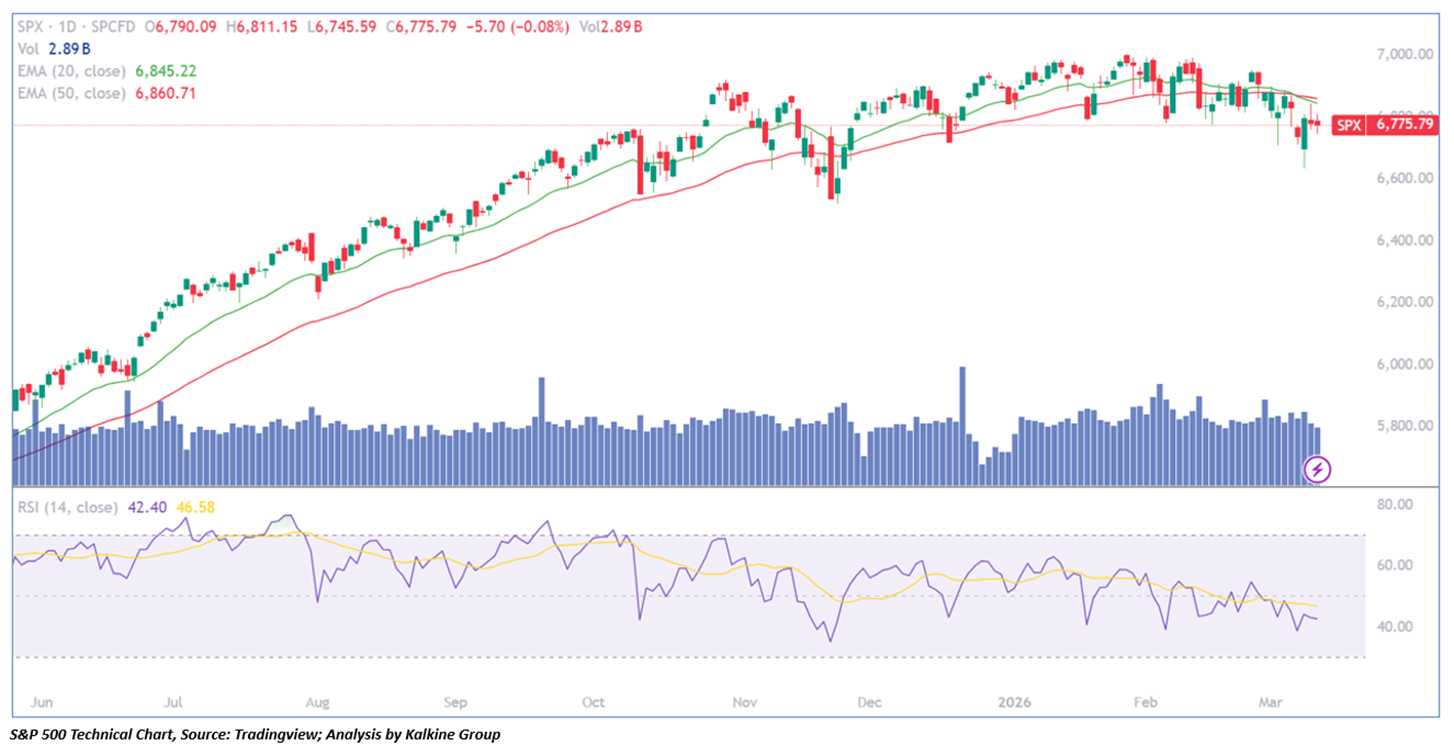
Stocks lacked clear direction during Wednesday’s trading session, continuing the subdued performance from the previous day. The S&P 500 slipped 5.70 points, or 0.08%, to close at 6,745.59. From a technical perspective, the index is currently trading near key resistance levels. The 50-period Exponential Moving Average (EMA), which had been trending upward, has recently started to turn downward, suggesting a possible shift in momentum following a prolonged rally. Meanwhile, the 14-day Relative Strength Index (RSI) has fallen below its midpoint, pointing to a more cautious short-term outlook. In terms of key levels, immediate support is seen around 6,666, which could act as a potential bounce area, while near-term resistance is located near 6,855.


 Jun 05, 2026




 Please wait processing your request...