
 AU
AU
 UK
UK
 CA
CA
 NZ
NZ
 IND
IND

 US
US

 Share
Share
 X (Formerly Twitter)
 Whatsapp
 Facebook
 LinkedIn
 Telegram
 Email This Article
 Copy Link
 Summarize with AI
 Chat GPT
 Perplexity
Index Update: U.S. equity markets sold off sharply on Tuesday amid renewed geopolitical and trade tensions, triggered by President Trump’s threat of additional tariffs on European countries linked to demands over U.S. ownership of Greenland. The Dow fell nearly 1.8%, the S&P 500 dropped 2.1%, and the Nasdaq slid 2.4%, marking their worst single-day declines since October 10. On Wednesday, U.S. equity futures remained subdued near one-month lows, as investors stayed cautious ahead of President Trump’s address at the World Economic Forum. Pre-market trading was mixed, with weakness across technology stocks, a sharp decline in Netflix on spending concerns, a drop in Johnson & Johnson despite higher guidance, and strength in United Airlines following its results.
Market Movers: On Tuesday, the top gainers were INVO Fertility, Inc. (+191.73%), followed Corvus Pharmaceuticals, Inc. (+165.96%). On the contrary, NovaBay Pharmaceuticals, Inc. (-55.99%), and Linkhome Holdings Inc. (-44.77%) declined the most the same day.
Commodities Update: WTI crude futures fell below USD 60 per barrel on Wednesday, reversing prior gains amid geopolitical uncertainty and expectations of rising U.S. oil and gasoline inventories. Market sentiment was pressured by President Trump’s renewed Greenland stance and tariff threats toward Europe, which raised concerns over global growth. Losses were partly offset by a temporary production halt in Kazakhstan and continued U.S. enforcement actions against Venezuela’s oil trade. Precious and industrial metals advanced on Wednesday amid heightened geopolitical tensions and investor demand for real and safe-haven assets. Gold surged to a record above USD 4,870 per ounce, while silver remained near historic highs around USD 95, supported by escalating Greenland-related tensions, bond market stress, and persistent physical shortages. Copper rebounded above USD 5.8 per pound, aided by a weaker dollar and renewed trade risks, with supply dynamics mixed as higher output from Rio Tinto was partly offset by declining production at Chile’s Escondida mine.
Macro Updates: U.S. Mortgage Applications Surge on Lower Interest Rates
U.S. mortgage application volumes rose 14.1% in the week ending January 16, extending the prior week’s sharp 28.5% increase, as declining mortgage rates stimulated demand. The average 30-year fixed mortgage rate fell for a third straight week to a 16-month low of 6.16%, prompting a strong rebound in refinancing activity, which climbed about 20%, while home purchase applications increased around 5%. Refinancing accounted for over 60% of total applications, marking the strongest refinance activity since September 2025, as lower rates encouraged borrowers to act despite lingering volatility in longer-term Treasury yields.
Dollar Weakens on Rising U.S.–Europe Trade and Geopolitical Tensions
The U.S. dollar index fell to around 98.5, extending its decline for a third straight session as escalating tensions between the U.S. and Europe over President Trump’s Greenland-related threats undermined confidence in American assets. Concerns intensified amid potential retaliatory tariffs from the European Union, risks of European divestment from U.S. securities, and uncertainty ahead of a Supreme Court ruling on U.S. trade policies. The dollar weakened against most major currencies, though it remained relatively stable versus the Japanese yen.
Bonds Commentary: The US 10-year Treasury yield edged down to 4.27% on Wednesday after hitting a multi-month high, as the global bond sell-off showed signs of stabilising following reassurances and bond-buying measures in Japan. Investor focus remained on renewed US tariff threats toward Europe, geopolitical risks surrounding Greenland, and President Trump’s upcoming remarks at the World Economic Forum for guidance on future policy direction.
Futures Update: U.S. stock index futures ticked higher on Wednesday, recovering modestly after steep losses in the prior session, as markets looked ahead to President Donald Trump’s forthcoming address at the World Economic Forum in Switzerland. Dow Jones futures advanced 46 points (0.1%), S&P 500 futures rose 13 points (0.2%), and Nasdaq 100 futures added 35 points (0.1%).
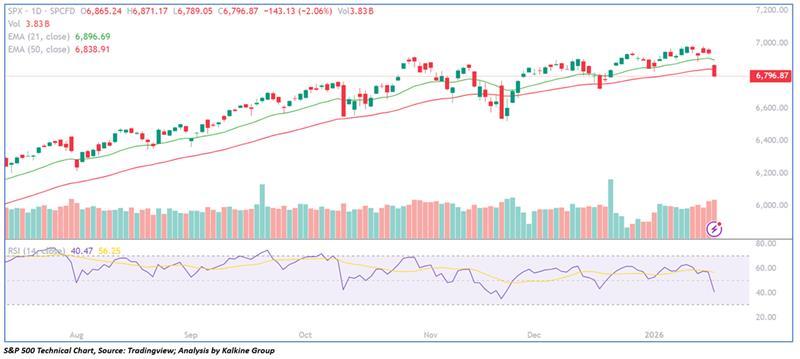
Following a sharp decline at the opening, stocks continued to weaken throughout Tuesday's trading session. Major indices all moved lower, adding to the losses posted last week. The S&P 500 dropped by 143.13 points, or 2.06%, closing at 6,796.87. From a technical perspective, the index encountered resistance at key levels and gradually drifted downward, indicating the possibility of a near-term decline. However, there may also be a short-term upward move to fill the price imbalance. The 14-day Relative Strength Index (RSI) dipped slightly below the midpoint, suggesting that a further move below this level could trigger increased selling pressure. Key support is observed around 6,677—an important level that might trigger a rebound—while resistance is expected near 6,855.


 Jun 05, 2026




 Please wait processing your request...