
 AU
AU
 UK
UK
 CA
CA
 NZ
NZ
 IND
IND

 US
US

 Share
Share
 X (Formerly Twitter)
 Whatsapp
 Facebook
 LinkedIn
 Telegram
 Email This Article
 Copy Link
 Summarize with AI
 Chat GPT
 Perplexity
Index Update: U.S. stock futures declined on Wednesday, extending the prior session’s losses as valuation concerns in the AI sector deepened. S&P 500 futures fell 0.3%, Nasdaq 100 dropped 0.6%, and Dow Jones slipped about 40 points. Tech weakness led the decline after AMD issued a lackluster revenue forecast and Super Micro Computer warned of soft earnings, sending their shares down 5% and 9%, respectively. Nvidia and Qualcomm also edged lower ahead of Qualcomm’s results, while McDonald’s fell 1.2% on weaker earnings. Investors awaited the ADP jobs report for labor market insights amid the longest U.S. government shutdown in history.
Market Movers: On Tuesday, the top gainers were Evoke Pharma, Inc. (+132.24%), followed by Davis Commodities Limited. (+63.46%). On the contrary AsiaStrategy (-37.15%), and Sarepta Therapeutics, Inc. (-33.74%) declined the most the same day.
Commodities Update: Crude oil prices held steady on Wednesday, with WTI around $60.6 and Brent near $64.5 per barrel, as traders balanced surging U.S. inventories against signs that U.S. sanctions on Russia are curbing its exports. Russian seaborne shipments fell sharply, hitting the lowest revenue since August, while China, India, and Turkey reduced purchases of sanctioned oil. The API reported a 6.5 million-barrel U.S. inventory build, far above expectations, weighing on prices alongside a stronger dollar and a broader market selloff. Meanwhile, OPEC+ announced a modest December output hike and a pause in further increases through Q1 2026 due to surplus expectations. Gold prices rose to around $3,980 per ounce, supported by risk-off sentiment amid equity market weakness, though gains were capped by reduced expectations of further U.S. rate cuts. Markets now see a 69% chance of a December rate cut, down from 90% pre-FOMC, while focus shifts to labor data and easing trade tensions.
Macro Updates: U.S. mortgage applications fell 1.9% in the final week of October, reversing part of the prior week’s 7.1% gain, according to the Mortgage Bankers Association. The decline came as the average 30-year fixed mortgage rate inched up to 6.31% from 6.3%, following hawkish Fed signals. Refinance applications dropped 2.8%, while home purchase applications slipped around 0.7%, reflecting the impact of slightly higher borrowing costs and cautious market sentiment.
Bonds Commentary: The U.S. 10-year Treasury yield fell to around 4.07%, marking its second consecutive decline as investors moved to safe-haven assets amid a global risk-off sentiment. Concerns over inflated AI valuations and cautious remarks from major bank CEOs fueled market anxiety. Meanwhile, uncertainty over a potential Fed rate cut in December persisted, with the probability of a 25 bps cut easing to 69% from 90% pre-FOMC. The ongoing government shutdown, now the longest in U.S. history, has delayed key economic data, though focus remains on the upcoming ADP jobs report. The Treasury also trimmed its Q4 borrowing estimate to $569 billion, citing a higher cash balance.
Futures Updat: U.S. stock futures traded mixed on Wednesday, with continued pressure on the tech sector amid concerns over high valuations. Dow futures rose 0.1%, while S&P 500 and Nasdaq 100 futures declined 0.3% and 0.5%, respectively. This follows Tuesday’s broad market decline, where the S&P 500 fell 1.2%, the Dow dropped 0.5%, and the Nasdaq slid 2%.
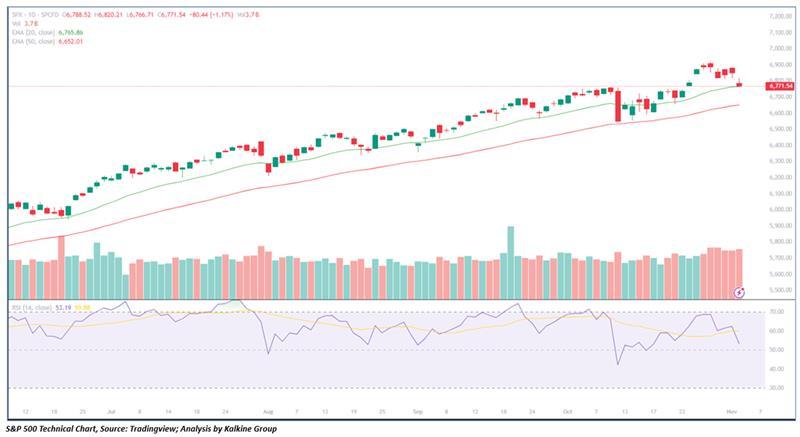
Stocks attempted a recovery early on Tuesday, experiencing an initial uptick, but ultimately moved lower throughout the trading session. The S&P 500 declined by 80.44 points, or 1.17%, and closed at 6,771.54. From a technical standpoint, the index faced resistance at key levels and drifted downward, indicating the potential for a near-term decline. Additionally, the 14-day Relative Strength Index (RSI) is trending downward, further supporting a negative outlook. Key support levels are around 6,700, while resistance is expected near 6,880.


 Jun 05, 2026



 Please wait processing your request...