
 AU
AU
 UK
UK
 CA
CA
 NZ
NZ
 IND
IND

 US
US

 Share
Share
 X (Formerly Twitter)
 Whatsapp
 Facebook
 LinkedIn
 Telegram
 Email This Article
 Copy Link
 Summarize with AI
 Chat GPT
 Perplexity
Index Update: Ongoing tensions between Iran and the United States kept concerns high over potential disruptions to Persian Gulf energy exports, supporting elevated oil prices despite the IEA’s coordinated reserve release and the U.S. easing some sanctions on Russia. Meanwhile, rising Treasury yields continued to pressure credit-sensitive equities, while semiconductor stocks extended their weekly outperformance following strong results from Oracle and TSMC, and asset managers rebounded in premarket trading after the previous session’s declines tied to Morgan Stanley’s limits on private credit fund redemptions.
Market Movers: On Thursday, the top gainers were Tilly's, Inc. (+47.24%), followed by Lightwave Logic, Inc. (+41.04%). On the contrary, Incannex Healthcare Inc. (-48.41%), and Resolute Holdings Management. (-25.07%) declined the most the same day.
Commodities Update: WTI crude futures eased to below USD 95 per barrel and Brent crude slipped under USD 100 per barrel on Friday, pausing after strong weekly gains of around 5% and 8%, respectively. Markets continue to assess the escalating Iran conflict and persistent supply disruptions, including air strikes in the Middle East and the closure of the Strait of Hormuz. Efforts by the U.S. administration to stabilize prices include allowing limited purchases of stranded Russian oil and proposing an international coalition to escort tankers, while the IEA’s release of 400 million barrels from strategic reserves has so far had limited impact on easing prices.
Gold rose above USD 5,080 per ounce on Friday but remained on track for a second consecutive weekly decline as surging oil prices and escalating U.S.–Iran tensions heightened inflation concerns and reduced expectations for near-term Federal Reserve rate cuts. Strong rhetoric from President Donald Trump and Iran’s leader Mojtaba Khamenei, including threats to keep the Strait of Hormuz closed, pushed energy prices higher and strengthened the U.S. dollar, which pressured silver below USD 83 per ounce for a third straight session. Meanwhile, weak demand in India led to deep gold discounts, while China extended its gold purchases for a 16th consecutive month.
Macro Updates: U.S. Personal Income and Spending Show Steady Growth in January 2026
U.S. personal spending rose 0.4% month-over-month in January 2026, or USD 81.1 billion, matching December’s pace and slightly exceeding expectations of 0.3%, driven mainly by stronger services spending, particularly in healthcare, housing and utilities, financial services, and nonprofit expenditures, while goods spending declined due to weaker purchases of motor vehicles, energy products, and apparel. Meanwhile, personal income increased 0.4% following a 0.3% rise in December, supported primarily by higher compensation and wages, along with gains in dividend income and social security benefits. Disposable personal income climbed 0.9%, with real disposable income rising 0.7%, indicating improved household purchasing power despite mixed consumption trends.
U.S. Inflation Remains Elevated as Economic Growth Slows
The U.S. core PCE price index, the Federal Reserve’s preferred measure of underlying inflation, rose 0.4% month-over-month in January 2026, matching December’s 10-month high and meeting market expectations, while the annual rate eased slightly to 2.8% from 2.9% but remained above the Fed’s 2% target. Meanwhile, the U.S. economy grew at an annualized rate of 0.7% in Q4 2025, sharply lower than the initial 1.4% estimate and marking the weakest expansion since the Q1 2025 contraction, reflecting downward revisions to exports, consumer spending, government spending, and investment, while imports declined less than previously estimated.
Bonds Commentary: U.S. 10-year Treasury yields hovered near five-week highs around 4.26% as escalating Middle East tensions and rising oil prices heightened inflation concerns, reinforcing expectations that the Federal Reserve will keep interest rates higher for longer. Markets anticipate the Fed will hold rates steady next week, with attention shifting to updated policy projections, while expectations for the next rate cut have been pushed back from July to September amid persistent inflation risks.
Futures Update: U.S. stock index futures moved higher on Friday, recovering earlier losses despite oil prices remaining above USD 100 per barrel amid ongoing fighting in Iran. Dow futures rose 0.3% or 122 points, while S&P 500 and Nasdaq 100 futures gained around 0.2%.
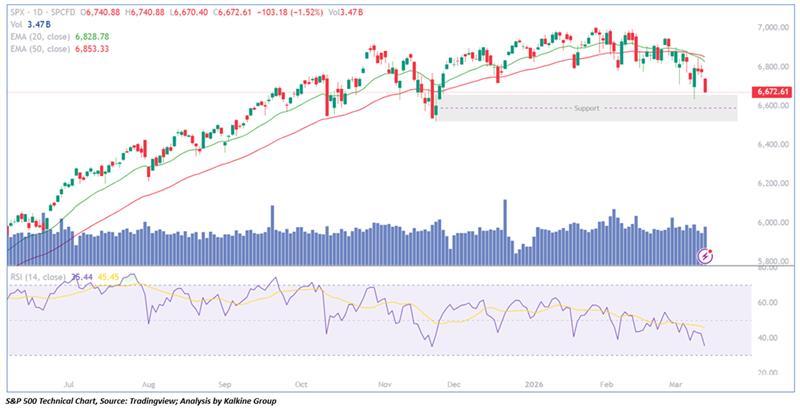
After closing nearly unchanged for two consecutive sessions, stocks moved sharply lower during Thursday’s trading session. The S&P 500 fell 103.18 points, or 1.52%, to close at 6,672.61. From a technical perspective, the index is currently trading near key support levels and will need to show resilience around these zones, which are highlighted by the boxed area on the chart. The 50-period Exponential Moving Average (EMA), which had been trending upward, has recently started to turn downward, suggesting a potential shift in momentum following the prolonged rally—a possibility we have been highlighting since the start of the week. Meanwhile, the 14-day Relative Strength Index (RSI) has dropped below its midpoint, indicating a more cautious short-term outlook. In terms of key levels, immediate support is seen around 6,590, which could act as a potential bounce area, while near-term resistance is located near 6,755.

 Jun 05, 2026
 Please wait processing your request...