
 AU
AU
 UK
UK
 CA
CA
 NZ
NZ
 IND
IND

 US
US

 Share
Share
 X (Formerly Twitter)
 Whatsapp
 Facebook
 LinkedIn
 Telegram
 Email This Article
 Copy Link
 Summarize with AI
 Chat GPT
 Perplexity
Index Update: Tech stocks traded mostly subdued in premarket activity, although Broadcom rose about 6% on strong forward guidance and Veeva gained amid renewed confidence in the software sector despite AI disruption concerns. Meanwhile, banks and asset managers edged lower due to worries over potential risks from private credit exposure to AI-related investments.
Market Movers: On Wednesday, the top gainers were Babcock & Wilcox Enterprises, Inc. (+45.68%), followed by Texxon Holding Limited. (+44.94%). On the contrary, TMD Energy Limited. (-45.30%), and Battalion Oil Corporation. (-32.91%) declined the most the same day.
Commodities Update: Oil prices extended their weekly rally amid escalating Middle East tensions and growing concerns over supply disruptions. Brent crude rose 1.7% to USD 82.80 per barrel, while WTI gained 2.2% to USD 76.31, after Iran targeted tankers in the Strait of Hormuz—a key transit route for roughly one-fifth of global oil and LNG flows. The disruption fears have pushed Brent to its highest level since July 2024 after five consecutive sessions of gains. Gold climbed to around USD 5,160 per ounce, extending recent gains as escalating U.S.–Iran tensions and continued military strikes across the region supported safe-haven demand, while rising oil and gas prices reinforced inflation concerns and pushed expectations for the Federal Reserve’s first rate cut to September. Meanwhile, silver traded near USD 83.5 per ounce with volatile movements as the dollar strengthened amid geopolitical uncertainty, including reports of a U.S. submarine sinking an Iranian warship and ongoing conflict risks in the Gulf, alongside policy developments such as the U.S. administration’s planned 15% global tariff set to take effect later this week.
Macro Updates: U.S. employers announced 48,307 job cuts in February 2026, down from 108,435 in January and 172,017 a year earlier, with the technology sector leading layoffs amid AI-driven restructuring, regulatory pressures, weaker digital advertising demand, and higher employment and funding costs. Education and industrial manufacturing also recorded notable cuts, while total layoffs for January–February reached 156,742, the lowest for the period since 2022, though rising geopolitical tensions and economic uncertainty may prompt additional workforce reductions later in the quarter.
Bonds Commentary; The U.S. 10-year Treasury yield rose to around 4.11%, marking a fourth straight session of gains as investors assessed escalating U.S.–Iran tensions and the risk of a prolonged conflict that could fuel inflation. Markets also reacted to the planned 15% global tariff announcement, while stronger U.S. economic data— including a more than 3½-year high in services activity and robust private-sector job growth—supported the upward move in yields.
Futures Update: U.S. stock index futures edged slightly lower on Thursday as investors remained cautious amid escalating tensions with Iran and concerns over potential inflationary pressures. Dow Jones futures declined about 55 points (0.1%), while S&P 500 and Nasdaq 100 futures traded largely flat following the previous session’s gains.
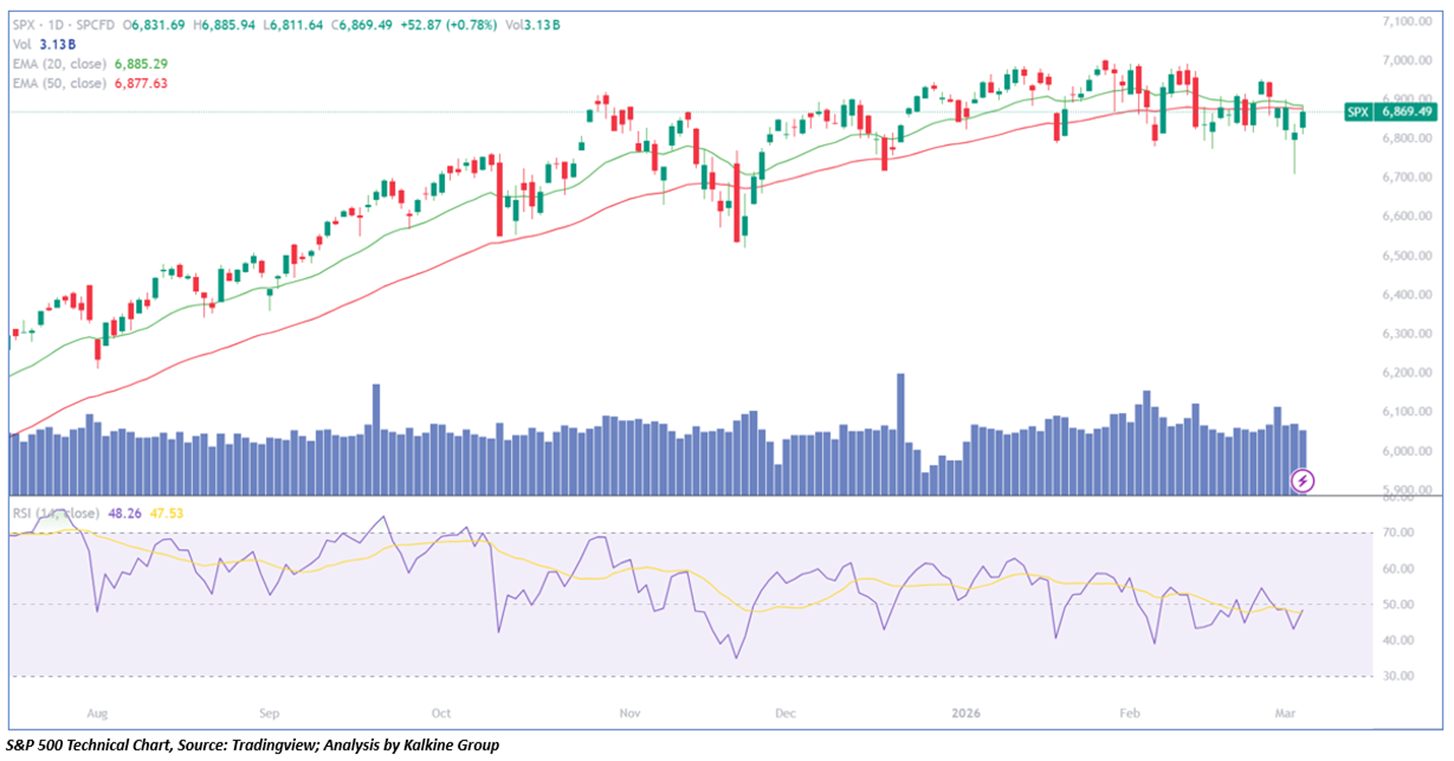
Stocks moved mostly higher during Wednesday’s trading session, partially recovering from the weakness observed in the previous session. The S&P 500 rose by 52.87 points, or 0.78%, to close at 6,869.49. From a technical standpoint, the index found support at lower levels and finished the day close to its intraday high. However, the key moving averages remain above the current price and have started to flatten after a prolonged uptrend, which may cap further upside momentum. At the same time, the 14-day Relative Strength Index (RSI) has dropped below the midpoint, suggesting a cautious short-term outlook. Immediate support is positioned around 6,770, which could act as a short-term bounce area, while near-term resistance is seen near 6,940.

 Jun 05, 2026
 Please wait processing your request...