
 AU
AU
 UK
UK
 CA
CA
 NZ
NZ
 IND
IND

 US
US

 Share
Share
 X (Formerly Twitter)
 Whatsapp
 Facebook
 LinkedIn
 Telegram
 Email This Article
 Copy Link
 Summarize with AI
 Chat GPT
 Perplexity
Index Update: U.S. equities closed higher on Tuesday, extending their rebound from recent lows as investors grew more optimistic that disruptions in Persian Gulf energy exports would not trigger stagflation. The S&P 500 rose 0.3%, Nasdaq 100 gained 0.5%, and the Dow added 0.1%, supported by strength in asset managers like KKR, Blackstone, BlackRock, and Blue Owl amid easing credit risk concerns. Qualcomm advanced on shareholder returns, while Nvidia dipped slightly despite strong long-term AI revenue projections. Markets now await the Federal Reserve’s policy decision, with expectations for steady rates and a broad outlook range due to energy-driven uncertainties.
Market Movers: On Tuesday, the top gainers were bioAffinity Technologies, Inc. (+43.46%). On the contrary, Decent Holding Inc. (-36.67%) and LENSAR, Inc (-32.85) declined the most the same day.
Commodities Update: WTI crude rebounded to around USD 97 per barrel and Brent rose above USD 105 per barrel after reports of US and Israeli strikes on Iran’s South Pars gas field—the first direct hit on upstream energy infrastructure in the conflict—intensifying supply disruption concerns. Escalating Iran–Israel tensions, including retaliatory attacks and high-profile casualties, further supported prices, although expectations of a potential near-term resolution signaled by President Trump and plans for limited Iraqi export resumption offered some offset. Meanwhile, bearish inventory data from the U.S., with crude stockpiles rising by 6.56 million barrels, tempered the upside momentum. Gold declined to around USD 4,980 per ounce, hovering near a one-month low, while silver traded near USD 79 per ounce, as investors remained cautious ahead of the Federal Reserve’s policy decision and assessed inflation risks stemming from volatile oil prices amid the Iran conflict. Markets widely expect the Fed to hold rates steady, with focus on guidance around energy-driven inflation and a cooling labor market, while other major central banks are also likely to maintain current policy settings.
Macro Updates: U.S. mortgage rates rose to 6.30% in the week ending March 13, 2026—the highest level since late December—driven by higher Treasury yields amid oil-driven inflation concerns linked to Middle East tensions. The increase in borrowing costs led to a sharp 10.9% decline in total mortgage applications, the steepest drop since September 2025, with refinancing activity plunging 18.5%, while home purchase applications saw a modest 0.9% uptick.
Bonds Commentary: The U.S. 10-year Treasury yield rose to around 4.2% as inflation concerns intensified, driven by higher oil prices following attacks on Iran’s energy infrastructure and stronger-than-expected February PPI data. Headline and core producer prices both exceeded forecasts, reinforcing persistent inflation pressures beyond energy. Investors are now focused on the Federal Reserve’s policy decision, with rates expected to remain unchanged but attention centered on guidance regarding the impact of geopolitical tensions on the outlook.
Futures Update: U.S. stock index futures turned lower on Wednesday after initially gaining, as stronger-than-expected producer price data reinforced inflation concerns amid rising oil prices linked to the Iran conflict. Investor sentiment remained cautious ahead of the Federal Reserve’s interest rate decision, with Dow, S&P 500, and Nasdaq 100 futures all posting modest declines.
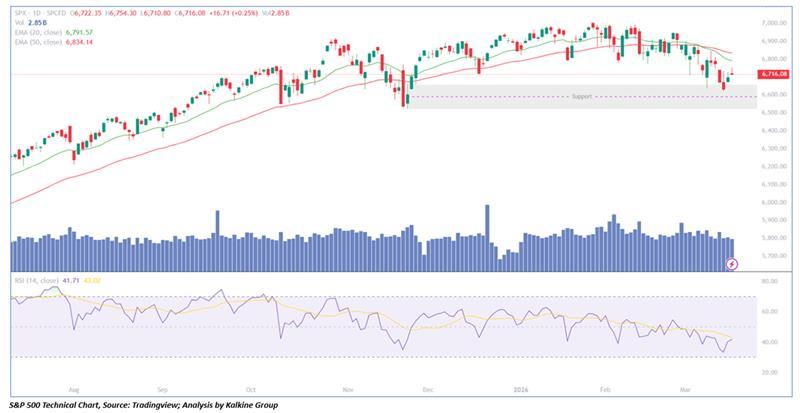
Stocks extended their rebound early Tuesday, building on the prior session’s gains, but lost momentum as the day progressed. Despite retreating from intraday highs, the major indices still ended in positive territory. The S&P 500 rose 16.71 points, or 0.25%, to close at 6,716.08. From a technical standpoint, the index held firm at key support levels and must continue to do so to sustain its footing, as indicated by the highlighted zone on the chart. However, the 50-period Exponential Moving Average (EMA), which had been trending higher, has started to tilt downward—hinting at a possible shift in momentum after the recent rally, something that has been under observation since early in the week. Meanwhile, the 14-day Relative Strength Index (RSI) has slipped below its midpoint, pointing to a more cautious short-term outlook. Important levels to monitor include immediate support near 6,640, which may act as a potential bounce area, and near-term resistance around 6,770.


 Jun 05, 2026




 Please wait processing your request...