
 AU
AU
 UK
UK
 CA
CA
 NZ
NZ
 IND
IND

 US
US

 Share
Share
 X (Formerly Twitter)
 Whatsapp
 Facebook
 LinkedIn
 Telegram
 Email This Article
 Copy Link
 Summarize with AI
 Chat GPT
 Perplexity
Index Update: U.S. equities trimmed earlier losses on Thursday, with the S&P 500 and Nasdaq falling 0.2% and the Dow down 0.3%, as easing oil prices and geopolitical developments reduced volatility and softened stagflation concerns. Sentiment improved after Israel signaled support for reopening the Strait of Hormuz, while diplomatic commentary from U.S. officials helped stabilize markets. In corporate news, Micron declined despite strong guidance due to spending concerns, and major tech stocks also traded lower, while Treasury yields rebounded from intraday lows.
Market Movers: On Wednesday, the top gainers were Serina Therapeutics, Inc. (+93.75%) and Duluth Holdings Inc. (44.70%). On the contrary, Solo Brands, Inc. (-43.95%) and Dawson Geophysical Company. (-38.46%) declined the most the same day.
Commodities Update: WTI crude hovered around USD 95 per barrel amid heightened volatility as markets reacted to escalating Middle East tensions, including continued Iranian attacks and ongoing regional strikes, despite signals from Israel to avoid energy infrastructure. While geopolitical risks kept prices elevated, easing factors such as a planned release of 400 million barrels from global reserves, including 172 million from the U.S. SPR, and rising inventories at Cushing weighed on WTI, which remains on track for a weekly decline. Meanwhile, Brent crude fell to around USD 107 per barrel but is still set for a weekly gain of about 4%, supported by supply concerns linked to the partial closure of the Strait of Hormuz, although potential U.S. sanction relief on Iranian crude and diplomatic efforts to reopen the waterway helped cap further upside. Gold and silver declined sharply, with gold holding below USD 4,700 per ounce and silver near USD 72, both heading for notable weekly losses as surging energy prices from the Middle East conflict intensified inflation concerns and reduced expectations for interest rate cuts. Investors rotated into the dollar and Treasuries amid rising yields, while a more hawkish stance from major central banks—including the Fed, ECB, BOJ, and BOE—further pressured precious metals, with markets now delaying Fed rate cut expectations to 2027 and pricing in additional rate hikes in Europe.
Macro Updates: Mortgage Rates Edge Higher Amid Inflation Concerns
The average 30-year fixed mortgage rate rose to 6.22% as of March 19, driven by higher Treasury yields amid inflation concerns linked to the Iran conflict and the Federal Reserve’s pause on rate cuts. Despite the uptick, rates remain lower than a year ago, supporting improved housing activity and positioning buyers for a relatively more affordable spring season.
Dollar Weakens as Global Central Banks Turn Hawkish
The dollar index hovered near 99 after a sharp decline, as relatively hawkish signals from major central banks—including the ECB, BOJ, and BOE—boosted their currencies against the dollar. While the Federal Reserve held rates steady and maintained a cautious stance on easing, rising global expectations for further tightening, alongside recent rate hikes in Australia and potential moves by New Zealand, pressured the dollar, which is on track for a weekly loss.
Bonds Commentary: U.S. Treasury yields moved higher, with the 10-year reaching around 4.3%—its highest level since August 2025—and the 2-year rising to 3.9%, as investors assessed inflation risks from the Iran conflict and anticipated a more hawkish Federal Reserve stance. Despite holding rates steady, the Fed flagged elevated inflation risks and uncertainty, while persistently high and volatile oil prices continued to influence market expectations.
Futures Update: U.S. stock futures traded lower on Friday as investors monitored volatile yet elevated oil prices alongside ongoing developments in the Iran conflict. Dow futures declined by 151 points, or 0.3%, S&P 500 futures fell by 30 points, or 0.4%, and Nasdaq 100 futures dropped by 150 points, or 0.6%..
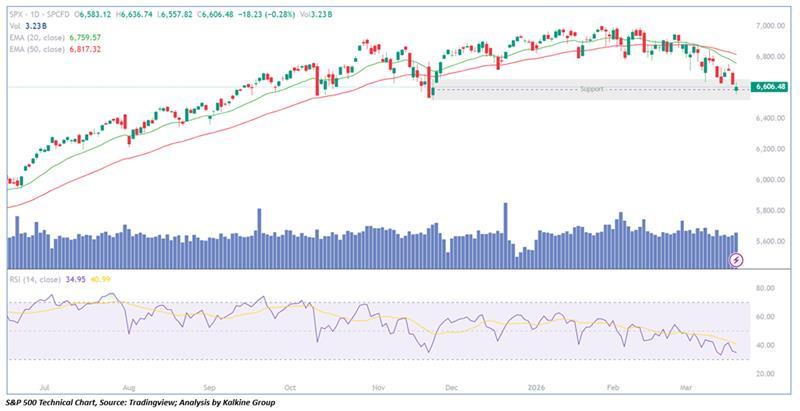
After showing notable weakness for most of Thursday’s session, stocks managed to recover some losses late in the day. However, the major indices remained in negative territory, with the S&P 500 declining 18.23 points, or 0.28%, to close at 6,606.48. From a technical standpoint, the index faced resistance at key levels and gradually moved lower, signaling the possibility of further near-term downside. The 21-period and 50-period Exponential Moving Averages (EMAs) have begun to slope downward, indicating a potential shift in momentum following the recent rally. These averages are likely to act as immediate resistance zones, reinforcing a “sell on rallies” strategy near these levels. Additionally, the 14-day Relative Strength Index (RSI) has slipped below the midpoint, supporting a bearish bias. Key levels to monitor include immediate support around 6,555, which may act as a short-term bounce zone, and resistance near 6,700 on the upside.


 Jun 05, 2026




 Please wait processing your request...