
 AU
AU
 UK
UK
 CA
CA
 NZ
NZ
 IND
IND

 US
US

 Share
Share
 X (Formerly Twitter)
 Whatsapp
 Facebook
 LinkedIn
 Telegram
 Email This Article
 Copy Link
 Summarize with AI
 Chat GPT
 Perplexity
Index Update: Global equities declined after U.S. strikes on Iran and subsequent regional retaliation heightened fears of a prolonged conflict. The escalation triggered a surge in energy prices, raising concerns about renewed inflation pressures and the possibility of tighter monetary policy from the Federal Reserve and other major central banks. Broad-based losses were seen across sectors, with major technology stocks and large banks trading lower premarket, while North American energy producers advanced sharply on higher oil prices.
Market Movers: On Friday, the top gainers were KORE Group Holdings, Inc. (+78.64%), followed by Applied Optoelectronics, Inc. (+56.88%). On the contrary, Atrium Therapeutics, Inc. (-79.74%), and Xponential Fitness, Inc. (-47.08%) declined the most the same day.
Commodities Update: Oil prices surged sharply on Monday as escalating Middle East tensions heightened fears of supply disruptions. WTI crude jumped more than 8% above USD 72 per barrel, while Brent climbed over 8% toward USD 79, both reaching multi-month highs. Concerns centered on potential disruptions in the Strait of Hormuz, through which roughly one-fifth of global oil flows, as shipping firms rerouted vessels and Saudi Aramco temporarily halted operations at its Ras Tanura refinery following a drone attack. Although OPEC+ agreed to raise April output by 206,000 barrels per day, the increase was smaller than previously considered levels, leaving markets on edge amid ongoing geopolitical uncertainty. Gold surged more than 2% toward USD 5,400 per ounce, reaching a one-month high as investors sought safe-haven assets following major U.S. and Israeli strikes on Iran and escalating regional retaliation. Heightened geopolitical tensions, disruption risks in the Strait of Hormuz, sustained central bank buying, and reduced appetite for sovereign bonds supported the rally, marking gold’s seventh consecutive monthly gain. Silver also climbed as much as 2.8% before trimming gains, reflecting similar safe-haven demand, while persistent U.S. inflation pressures continued to shape expectations for potential Federal Reserve rate cuts later this year.
Macro Updates: The dollar index rose above 98, reaching a five-week high as investors moved toward safe-haven assets amid escalating Middle East tensions following U.S. and Israeli strikes on Iran and subsequent regional retaliation. Stronger-than-expected U.S. producer price data added to inflation concerns, complicating the outlook for Federal Reserve rate cuts. Despite this, markets continue to price in two quarter-point rate reductions later this year, citing recent financial market volatility.
Bonds Commentary: The U.S. 10-year Treasury yield rose about 4 basis points to around 4%, reversing part of last week’s rally as escalating conflict with Iran drove energy prices higher and renewed inflation concerns. Although initial safe-haven demand briefly pushed yields lower, fears that elevated oil and gas prices could limit the Federal Reserve’s ability to ease policy led yields to edge up. Markets now expect the first rate cut no earlier than July, with reduced odds of an additional cut in October.
Futures Update: U.S. stock futures declined sharply early Monday after large-scale U.S. and Israeli airstrikes on Iran triggered a broad shift away from risk assets. Dow futures fell around 1.1%, S&P 500 futures dropped roughly 1%, and Nasdaq 100 futures slid about 1.4%. The weakness follows a negative Friday session, when AI-related concerns and persistent inflation worries had already dampened investor sentiment.
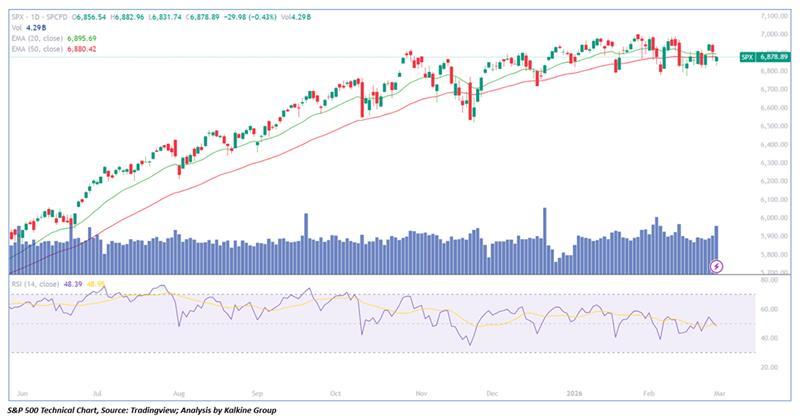
Stocks moved notably lower during trading on Friday, extending the pullback from the previous session. The major averages all finished in negative territory, with the tech-heavy Nasdaq adding to the steep losses recorded on Thursday. The S&P 500 fell 29.98 points, or 0.43%, closing at 6,878.89. From a technical perspective, the index is encountering resistance at key levels and has drifted lower, signaling the possibility of a near-term decline. Moreover, the key moving averages remain above the current price and have begun to flatten after trending higher, which could limit any upside momentum. The 14-day Relative Strength Index (RSI) is close to slipping below the midpoint, further reinforcing a negative bias. Immediate support is seen around 6,700, which could serve as a potential bounce zone, while near-term resistance is positioned near 6,900.

 Jun 05, 2026
 Please wait processing your request...