
 AU
AU
 UK
UK
 CA
CA
 NZ
NZ
 IND
IND

 US
US

 Share
Share
 X (Formerly Twitter)
 Whatsapp
 Facebook
 LinkedIn
 Telegram
 Email This Article
 Copy Link
 Summarize with AI
 Chat GPT
 Perplexity
Index Update: U.S. equities declined as the Fed held rates steady amid inflation concerns driven by rising energy prices, with the S&P 500 and Dow falling notably while the Nasdaq saw a milder drop. Hot PPI data, higher yields, and Middle East-driven oil price spikes weighed on sentiment, though a softer labor market provided some balance, with weakness in financials and defensives partially offset by gains in select tech stocks like Micron.
Market Movers: On Wednesday, the top gainers were Swarmer, Inc. (+77.42%) and Artelo Biosciences, Inc.(50.72%). On the contrary, Texxon Holding Limited. (-48.89%) and Cingulate Inc. (-31.05%) declined the most the same day.
Commodities Update: Gold and silver prices declined sharply, with gold falling to a six-week low near USD 4,710 and silver dropping below USD 74, as a hawkish Federal Reserve stance and elevated oil prices reduced the appeal of non-yielding assets. While escalating Middle East tensions supported safe-haven demand, stronger inflation signals and fading expectations of near-term rate cuts pressured precious metals, with gold still up year-to-date but losing momentum. Brent and WTI crude prices surged, with Brent nearing USD 117 and WTI holding above USD 97, as escalating Middle East attacks on critical energy infrastructure intensified fears of supply disruptions.
Macro Updates: Mixed Foreign Flows Amid Continued Demand for Long-Term U.S. Securities
The U.S. recorded a net TIC outflow of USD 25.0 billion in January 2026, driven by combined outflows from private and official foreign investors. Despite this, foreign demand for long-term U.S. securities remained strong with net purchases of USD 63.5 billion, while U.S. investors also increased exposure to foreign securities. Short-term flows were mixed, with a decline in Treasury bill holdings but a rise in broader dollar-denominated short-term assets.
Dollar Strength Supported by Hawkish Fed and Rising Oil Prices
The U.S. dollar index remained above 100, bolstered by a hawkish Federal Reserve stance and stronger-than-expected inflation data. Elevated oil prices amid Middle East tensions further supported the dollar, while markets await labor market signals for additional policy direction.
Bonds Commentary: The 10-year U.S. Treasury yield held above 4.2%, reflecting persistent inflation concerns as the Fed maintained rates while raising inflation and growth projections. Strong PPI data, rising energy prices, and divided rate-cut expectations kept yields elevated, with policymakers split between holding rates steady and modest easing later in the year.
Futures Update: U.S. stock futures declined modestly on Thursday, with the Dow, S&P 500, and Nasdaq 100 each falling around 0.2%–0.3%, as rising oil prices—driven by attacks on key Middle East energy infrastructure—weighed on market sentiment.
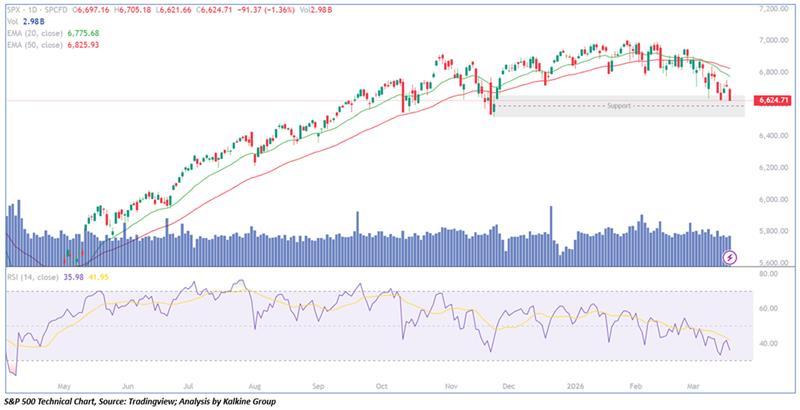
Stocks experienced a sharp decline throughout the trading session on Wednesday, largely offsetting the gains seen over the previous two days. All major averages showed significant downward movement, with the Dow and the S&P 500 approaching four-month lows. S&P 500 dropped 66.24 points, or 1.36%, closing at 6,624.71. From a technical perspective, the index encountered resistance at key levels and gradually declined, indicating the potential for a near-term decline. Additionally, the 21-period and 50-period Exponential Moving Averages (EMAs) have started to turn downward, suggesting a possible shift in momentum after the recent rally. These EMAs are expected to serve as immediate resistance levels and support the "sell on rallies" approach around these moving averages. Meanwhile, the 14-day Relative Strength Index (RSI) is falling below the midpoint, further supporting a negative bias. Important levels to watch include the immediate support near 6,575, which could serve as a potential bounce area, and near-term resistance around 6,700.

 Jun 05, 2026
 Please wait processing your request...