
 AU
AU
 UK
UK
 CA
CA
 NZ
NZ
 IND
IND

 US
US

 Share
Share
 X (Formerly Twitter)
 Whatsapp
 Facebook
 LinkedIn
 Telegram
 Email This Article
 Copy Link
 Summarize with AI
 Chat GPT
 Perplexity
Index Update: U.S. equities reversed earlier gains on Friday as the ongoing Iran conflict heightened concerns about prolonged elevated energy prices, pushing the S&P 500, Dow, and Nasdaq 100 to their lowest levels since November. Persistent tensions between the U.S. and Iran sustained fears of disruptions to Persian Gulf energy exports, keeping oil prices elevated despite the IEA’s coordinated reserve release and the U.S. easing sanctions on Russia. Meanwhile, rising Treasury yields and weaker-than-expected Q4 U.S. GDP pressured credit-sensitive sectors. Technology stocks led the decline, with Meta, Palantir, and Oracle falling around 2%, while Adobe dropped 6.5% after missing guidance and announcing its CEO’s departure, even as asset managers recovered slightly from earlier losses linked to private credit concerns.
Market Movers: On Friday, the top gainers were bioAffinity Technologies, Inc. (+98.13%), followed by Firefly Neuroscience, Inc. (+58.05%). On the contrary, Cardio Diagnostics Holdings Inc. (-38.6%), and FreeCast, Inc. (-38.13%) declined the most the same day.
Commodities Update: WTI crude oil futures eased toward USD 97 per barrel on Monday, pausing after a 17.4% three-day rally, although Brent remained above USD 100 per barrel, its highest level since July 2022. Oil markets remain volatile as supply risks in the Middle East intensify, following a second attack within three days on Fujairah, a key UAE oil export port near the Strait of Hormuz, which forced a temporary suspension of oil loading while damage assessments continue. Additional tensions emerged after the U.S. reportedly struck Iranian military sites on Kharg Island, a major oil export hub, though Iran indicated shipments were continuing. Meanwhile, shipping traffic through the Strait of Hormuz has slowed sharply, prompting calls from President Donald Trump for international support to secure the route, while the IEA coordinated a record 400 million-barrel strategic reserve release to stabilize global supply as markets await clearer signs of actual disruptions. Gold held near USD 5,000 per ounce on Monday after two consecutive weekly declines, while silver slipped toward USD 80 per ounce for a fourth straight session, as markets reacted to heightened geopolitical tensions following the U.S. strike on Iran’s Kharg Island oil export hub and subsequent retaliatory attacks by Tehran on Israel and regional energy infrastructure. The U.S.–Israeli conflict with Iran entering its third week has intensified supply risks and kept oil prices volatile, contributing to rising energy costs and inflation concerns. As a result, expectations for interest rate cuts by the U.S. Federal Reserve and other major central banks have diminished, creating headwinds for non-yielding precious metals, with the Fed and several global central banks widely expected to maintain policy rates at upcoming meetings while monitoring the evolving geopolitical and inflation outlook.
Macro Updates: U.S. Manufacturing Activity Shows Mixed Momentum in March
The NY Empire State Manufacturing Index declined to -0.2 in March 2026 from 7.1 in February, falling short of expectations of 3.2 and indicating broadly stable but subdued manufacturing activity in New York State. While new orders increased modestly and employment improved slightly, shipments declined, and delivery times lengthened, reflecting continued supply-chain pressures. Unfilled orders and inventories rose, while input price inflation eased but remained elevated, and selling prices were largely unchanged. Despite the mixed near-term indicators, business sentiment remained positive, with firms expressing optimism about future conditions and reporting stronger capital spending plans.
U.S. Dollar Eases as Hormuz Security Coalition Reduces Safe-Haven Demand
The U.S. Dollar Index edged lower toward 100 on Monday, trimming last week’s gains after reports that the U.S. may form a multinational coalition to escort ships through the Strait of Hormuz, easing immediate safe-haven demand. Markets are also assessing the possibility of U.S.–Iran negotiations as the Middle East conflict enters its third week. Although oil prices stabilized despite U.S. strikes on Iran’s Kharg Island export hub, the dollar remains near a ten-month high amid persistent energy-driven inflation concerns, which have reduced expectations of near-term Federal Reserve rate cuts, with the Fed widely expected to keep policy rates unchanged at its upcoming meeting.
Bonds Commentary: The U.S. 10-year Treasury yield eased about 4 bps to 4.24% on Monday, partially reversing last week’s 15 bps surge to a four-week high, as investors assessed the ongoing Iran conflict and its implications for inflation and fiscal conditions. Oil prices moderated after comments from U.S. Treasury Secretary Bessent indicating that Iranian oil tankers are being allowed to transit the Strait of Hormuz, while President Trump called on other nations to help secure the route. Despite this, geopolitical uncertainty remains elevated, with conflicting signals around potential U.S.–Iran talks. Meanwhile, markets are focused on the Federal Reserve’s upcoming policy decision, where rates are expected to remain unchanged, with investors currently pricing only one potential 25 bps rate cut later in the year, likely around December.
Futures Update: U.S. stock futures moved higher on Monday, with the Dow, S&P 500, and Nasdaq 100 futures rising between 0.5% and 0.8%, as investors monitored the ongoing U.S.–Israeli military operations against Iran entering their third week.
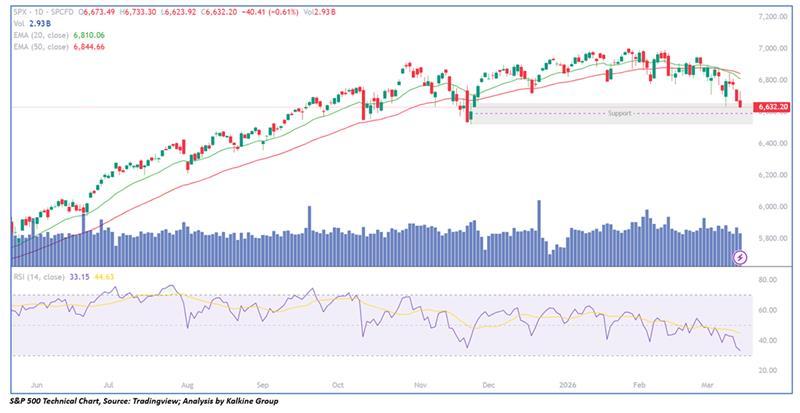
After Thursday’s sell-off, stocks bounced early on Friday but gradually turned lower as the session progressed. The major indexes erased their early gains and slipped into negative territory by the close. The S&P 500 declined 40.41 points, or 0.61%, ending the day at 6,672.61. From a technical standpoint, the index is trading close to important support levels and will need to hold firm around these areas, marked by the boxed region on the chart. The 50-period Exponential Moving Average (EMA), which had been trending upward, has recently started to slope downward—potentially signaling a shift in momentum after the extended rally, a scenario we have been noting since the beginning of the week. At the same time, the 14-day Relative Strength Index (RSI) has moved below its midpoint, pointing to a more cautious short-term outlook. Regarding key levels, immediate support is located around 6,590, which may provide a potential bounce zone, while near-term resistance is seen near 6,755.


 Jun 05, 2026

 Please wait processing your request...