
 AU
AU
 UK
UK
 CA
CA
 NZ
NZ
 IND
IND

 US
US

 Share
Share
 X (Formerly Twitter)
 Whatsapp
 Facebook
 LinkedIn
 Telegram
 Email This Article
 Copy Link
 Summarize with AI
 Chat GPT
 Perplexity
Index Update
U.S. index futures slipped up to 0.2%, with Nasdaq 100 contracts extending the prior session’s 2%+ decline due to heavy technology exposure. Investors are awaiting inflation data, with headline price growth expected to ease but core measures likely to remain firm, reinforcing expectations that the Federal Reserve will delay near-term rate cuts.
Technology stocks continued to pressure markets amid concerns over potentially unsustainable AI-related capital spending and renewed selling in software services. Oracle, Palantir, and Microsoft were subdued in premarket trading after sharp losses, while Micron trimmed earlier gains. In contrast, Applied Materials and Arista Networks surged around 10% each following strong earnings results.
Market Movers
On Thursday, the top gainers were Mega Fortune Company Limited (+112.39%), followed by Fastly, Inc. (+72.29%). On the contrary, Seres Therapeutics, Inc. (-41.66%), and ICON plc. (-39.85%) declined the most the same day.
Commodities Update
WTI crude fell to around USD 62.5 per barrel and Brent declined toward USD 67 on Friday, each extending nearly 3% losses from the previous session and heading for a second consecutive weekly drop. Prices were pressured by persistent oversupply concerns after the International Energy Agency projected a record average surplus of over 3.7 million barrels per day in 2026 and lowered its global demand outlook, while noting that inventories rose in 2025 at the fastest pace since 2020. Oil also faced additional pressure from easing geopolitical risks, as President Donald Trump signaled prolonged diplomatic talks with Iran, reducing the immediate threat of supply disruptions, alongside broader weakness across financial markets.
Gold rebounded to around USD 4,960 per ounce on Friday after tumbling more than 3% in the prior session, as heightened market volatility triggered broad-based selling and forced liquidation across asset classes. Despite the sharp drop, underlying support remains from concerns over currency debasement, continued central bank buying, and geopolitical tensions, though bullion is still on track for a modest weekly loss. Silver held near USD 76 per ounce but remained set for a third consecutive weekly decline, pressured by widespread market selloffs and reduced expectations for an early Federal Reserve rate cut following strong U.S. jobs data. Investors are now focused on upcoming U.S. inflation figures, which could further shape interest rate expectations and influence near-term price direction for precious metals.
Macro Updates
US Inflation Expected to Ease on Annual Basis, Core Pressures Remain Firm
U.S. annual inflation is projected to slow to 2.5% in January 2026, the lowest level since May, down from 2.7% in the prior two months, largely due to favorable base effects. On a monthly basis, headline CPI is expected to rise 0.3%, matching December’s pace, with higher food and electricity prices partly offset by lower gasoline costs.
Core inflation is also forecast to moderate to 2.5% year-on-year, its lowest since March 2021, compared with 2.6% previously. However, monthly core CPI is expected to edge up 0.3%, slightly above December’s 0.2%, suggesting underlying price pressures remain relatively firm, potentially influenced by tariff-related adjustments at the start of the year.
U.S.–Taiwan Trade Pact Cuts Tariffs and Expands Market Access
The United States and Taiwan have signed a new trade agreement reducing tariffs on Taiwanese exports to 15%, aligning them with rates applied to Japan and South Korea, while expanding access for American goods in Taiwan. Taipei will eliminate or reduce 99% of tariff barriers on U.S. products and grant preferential access for key industrial and agricultural exports, including autos, beef, and minerals.
Taiwan also committed to purchasing over USD 84 billion in U.S. goods between 2025 and 2029, spanning LNG, crude oil, aircraft, and power equipment. The agreement includes steps to address longstanding non-tariff barriers, such as recognizing U.S. vehicles built to federal safety standards. The deal builds on earlier commitments by Taiwanese semiconductor firms to invest at least USD 250 billion in U.S. manufacturing, backed by government credit support.
U.S. Pauses Tech-Security Curbs on China Ahead of Trump–Xi Meeting
The Trump administration has suspended several planned technology and security measures targeting China ahead of an anticipated April meeting between President Donald Trump and President Xi Jinping, according to Reuters. Delayed actions include a potential ban on China Telecom’s U.S. operations, restrictions on Chinese equipment used in American data centers, and proposed bans on TP-Link routers. Washington has also paused possible limits on the U.S. internet operations of China Unicom and China Mobile, as well as a measure to block sales of Chinese electric trucks and buses. The move reflects an effort to ease tensions following an October trade truce, under which China agreed to delay tighter export controls on rare-earth minerals vital to global technology supply chains.
Bonds Commentary
The 10-year U.S. Treasury yield hovered around 4.11% on Friday, near a two-month low, after a sharp prior-session decline driven by safe-haven demand amid broader market selloffs. Investors are awaiting the January CPI report, which is expected to show headline and core inflation easing to 2.5%. Despite resilient labor market data earlier in the week, markets anticipate the Federal Reserve will hold rates steady in March, with two 25-basis-point cuts currently priced in for June and September.
Futures Update
U.S. stock index futures edged slightly lower on Friday as investors remained cautious following a sharp selloff in technology stocks during the previous session and ahead of an important inflation report. Dow Jones Futures declined 0.2% (95 points), while S&P 500 and Nasdaq 100 Futures each slipped 0.1%, reflecting a subdued risk appetite in early trading.
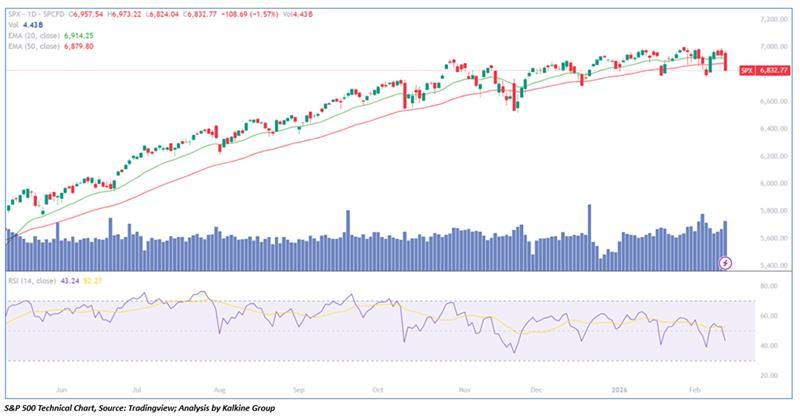
After ending Wednesday's choppy trading session modestly lower, the stock experienced a more significant decline during Thursday’s trading. The major averages once again failed to sustain an early rally and sharply declined as the day progressed. The S&P 500 dropped by 108.69 points, or 1.57%, closing at 6,832.77. From a technical standpoint, the index faced resistance at key levels and moved lower, indicating the potential for a near-term decline. The 14-day Relative Strength Index (RSI) remains below the midpoint, further reinforcing a bearish bias. Key support is identified around 6,700, which could prompt a rebound, while resistance is near 6,900.


 Jun 05, 2026




 Please wait processing your request...