
 AU
AU
 UK
UK
 CA
CA
 NZ
NZ
 IND
IND

 US
US

 Share
Share
 X (Formerly Twitter)
 Whatsapp
 Facebook
 LinkedIn
 Telegram
 Email This Article
 Copy Link
 Summarize with AI
 Chat GPT
 Perplexity
Index Update: Energy prices stayed below their recent monthly peaks after the IEA proposed a record release of strategic oil reserves and President Trump suggested the conflict could end soon. However, earlier energy-driven inflation pressures pushed yields higher, weighing on credit-sensitive stocks and reducing expectations for Federal Reserve rate cuts. Investors are now awaiting the February CPI report, which will not yet reflect the latest oil shock, while technology stocks supported the broader market, led by Oracle’s 10% surge following stronger-than-expected guidance.
Market Movers: On Tuesday, the top gainers were Agape ATP Corporation (+87.13%), followed by Polaryx Therapeutics, Inc. (+69.60%). On the contrary, SciSparc Ltd. (-28.34%), and Inflection Point Acquisition Corp. IV (-23.57%) declined the most the same day.
Commodities Update: WTI and Brent crude futures eased slightly on Wednesday, with WTI trading near USD 85 per barrel and Brent around USD 90 after briefly approaching USD 89 and USD 93, respectively, as markets evaluated the potential for a coordinated release of strategic oil reserves to ease supply pressures. Reports suggest Japan may begin releasing reserves early next week, while the International Energy Agency has proposed its largest-ever coordinated stockpile release, with the G7 expressing preliminary support ahead of discussions among ministers. Despite this, geopolitical tensions remain elevated as the conflict with Iran intensifies, with the Strait of Hormuz effectively shut and major Middle Eastern producers cutting output by more than 6 million barrels per day, while investors also await OPEC’s upcoming monthly outlook on the global crude market. Gold traded near USD 5,180 per ounce on Wednesday, maintaining recent gains as escalating Middle East tensions and uncertainty surrounding the U.S.–Israel conflict with Iran supported safe-haven demand, while mixed signals from U.S. officials added to market volatility. At the same time, investors closely monitored upcoming U.S. inflation data, with expectations that price pressures will remain above the Federal Reserve’s target and that only one rate cut may occur this year. In contrast, silver slipped below USD 88 per ounce after three consecutive sessions of gains, as traders reacted to geopolitical developments and reports of a potential large-scale release of strategic oil reserves by the IEA, although supply disruptions from the effective closure of the Strait of Hormuz continue to influence broader commodity markets.
Macro Updates: U.S. Inflation Data in Focus Amid Rising Geopolitical Risks
Investors are closely watching the upcoming U.S. consumer price index (CPI) report for February, which is expected to show moderate inflation. Economists forecast headline CPI to rise 0.3% month-over-month, slightly higher than January’s 0.2%, while annual inflation is projected to remain steady at 2.4%. Core CPI, which excludes food and energy, is expected to increase 0.2% monthly, easing from 0.3% previously, with the yearly rate holding at 2.5%. However, the report is unlikely to fully reflect the inflationary impact of the Iran conflict, as rising oil and gasoline prices since the escalation could push inflation higher and potentially influence the Federal Reserve toward a more hawkish policy stance.
U.S. Mortgage Applications Rise Despite Higher Interest Rates
U.S. mortgage applications increased by 3.2% in the first week of March, marking the fourth consecutive weekly gain and reaching the second-highest level since 2022 despite rising mortgage rates. The increase occurred as higher energy prices, driven by the Persian Gulf conflict, pushed long-term Treasury yields upward. Applications for home purchases surged 7.8%, showing stronger housing demand, while refinancing activity—more sensitive to interest rate changes—edged up modestly by 0.5%.
U.S. Dollar Weakens Amid Geopolitical Uncertainty
The U.S. dollar index slipped below 99 on Wednesday, reversing earlier gains as investors weighed uncertainty surrounding the Middle East conflict. Mixed signals from the Trump administration—ranging from suggestions that the war with Iran could end soon to indications that military operations are intensifying—added to market volatility. Meanwhile, oil prices eased after reports that the International Energy Agency proposed the largest coordinated release of oil reserves in history to stabilize markets. Investors are now focused on the upcoming U.S. inflation data, which may provide insight into price trends but is unlikely to reflect the full impact of the Iran conflict.
Bonds Commentary: The 10-year U.S. Treasury yield held near 4.17% on Wednesday after earlier volatility, as investors awaited the upcoming U.S. inflation report for further signals on price trends, although it is unlikely to reflect the impact of the Iran conflict. Markets also tracked mixed developments in the Middle East, with President Trump suggesting the conflict could end soon while officials indicated military operations were intensifying and diplomatic talks remained unlikely. Meanwhile, oil prices eased following reports that the IEA proposed its largest-ever coordinated release of oil reserves to help stabilize global energy markets.
Futures Update: U.S. stock index futures traded slightly lower on Wednesday morning as investors awaited upcoming consumer inflation data, while ongoing tensions related to the Iran conflict continued to weigh on market sentiment. Dow Jones Futures declined about 0.2%, and both S&P 500 and Nasdaq 100 futures edged down roughly 0.1%
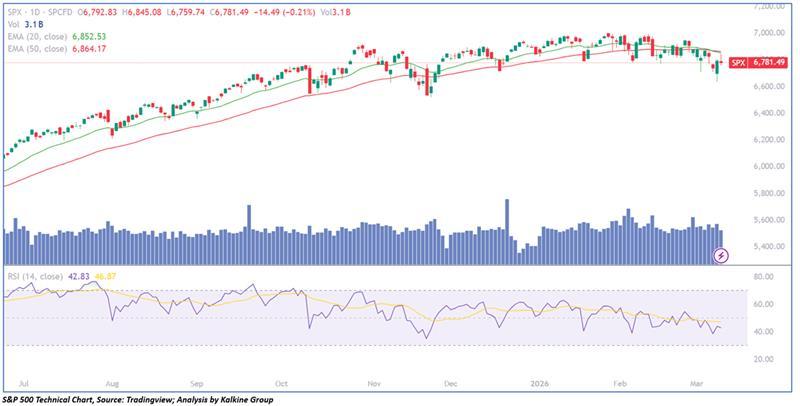
Following an early rally on Monday’s session, which mostly finished higher, stocks lacked clear direction throughout Tuesday’s trading day. The major averages fluctuated back and forth across the unchanged line before ultimately closing narrowly mixed. The S&P 500 declined by 14.49 points (0.21%), ending the day at 6,781.49. From a technical standpoint, the index is now hovering around key resistance levels. The 50-period Exponential Moving Average (EMA), which had been trending upward, has recently begun to slope downward, indicating a potential shift in momentum after a sustained rally. Additionally, the 14-day Relative Strength Index (RSI) has dropped below its midpoint, suggesting a cautious outlook in the short term. Immediate support is identified around 6,666, which could serve as a potential bounce zone, while near-term resistance is near 6,855.


 Jun 05, 2026


 Please wait processing your request...