
 AU
AU
 UK
UK
 CA
CA
 NZ
NZ
 IND
IND

 US
US

 Share
Share
 X (Formerly Twitter)
 Whatsapp
 Facebook
 LinkedIn
 Telegram
 Email This Article
 Copy Link
 Summarize with AI
 Chat GPT
 Perplexity
Index Update: U.S. equities declined, with S&P 500 and Dow contracts down 0.4% and Nasdaq 100 futures falling over 1.7%, marking their lowest levels this year. Escalating Middle East tensions, including strikes on Persian Gulf energy facilities and Iran’s warning over Strait of Hormuz transit, drove oil and gas prices sharply higher, lifting Treasury yields and pressuring credit-sensitive sectors. Major technology stocks traded lower premarket, while financials faced added strain amid private credit fund redemptions. Target bucked the trend, rising on upbeat guidance.
Market Movers: On Monday, the top gainers were TMD Energy Limited. (+231.82%), followed by Battalion Oil Corporation. (+113.77%). On the contrary, Aardvark Therapeutics, Inc. (-56.20%), and uniQure N.V. (-32.82%) declined the most the same day.
Commodities Update: Oil prices surged to multi-month highs amid escalating Middle East tensions, with WTI near USD 76 per barrel (highest since January 2025) and Brent around USD 83 per barrel (highest since July 2024), both extending gains of over 6%. Supply disruption fears intensified after a drone strike halted operations at Saudi Arabia’s Ras Tanura refinery and debris from an intercepted drone caused a fire at the UAE’s Fujairah oil hub. Although Iran has not closed the Strait of Hormuz, shipping activity has slowed significantly, and insurers are reconsidering war-risk coverage, further heightening market concerns. Gold fell nearly 2% to around USD 5,200 per ounce, while silver dropped over 7% below USD 83 per ounce, as a stronger U.S. dollar and rising bond yields reduced demand for safe-haven assets despite escalating Middle East tensions. Surging energy prices heightened inflation concerns, prompting markets to push expectations for the next Federal Reserve rate cut from July to September, though two 25-basis-point cuts remain anticipated. Meanwhile, prospects of intensified U.S. military action against Iran and threats to shipping through the Strait of Hormuz have further elevated geopolitical risks.
Macro Updates: Escalating Middle East Conflict Weighs on Global Market Sentiment
Investor sentiment deteriorated as escalating Middle East tensions, including reported drone strikes and expanded U.S. military involvement, heightened geopolitical uncertainty. Rising oil prices amid supply disruption fears have amplified inflation concerns, reinforcing expectations that the Federal Reserve will remain cautious on interest rate cuts.
U.S. Logistics Activity Rebounds to One-Year High in February
The U.S. Logistics Manager’s Index rose to 61.5 in February 2026, its highest level in a year and above the long-term average, signaling steady expansion across supply chains. Growth was broadly consistent across upstream, downstream, early, late, large, and small respondents. Inventory levels remained stable, while inventory costs eased. Warehousing utilization increased despite flat capacity, and transportation activity strengthened, with rising utilization and tightening capacity driving higher transportation prices.
U.S.–China Officials to Hold Pre-Summit Trade Talks in Paris
U.S. Treasury Secretary Scott Bessent and Chinese Vice Premier He Lifeng are set to meet in Paris next week to discuss potential business agreements ahead of a planned summit between Presidents Donald Trump and Xi Jinping. Discussions are expected to focus on Chinese purchase commitments for Boeing aircraft and U.S. soybeans, as well as the future of tariffs related to fentanyl controls after the U.S. Supreme Court struck them down. The meeting is viewed as a preparatory step before Trump’s scheduled visit to Beijing at the end of March.
Bonds Commentary: The U.S. 10-year Treasury yield climbed to 4.1%, its highest level since mid-February, as escalating tensions with Iran and surging energy prices fueled inflation concerns. The usual safe-haven demand for bonds was absent, with markets prioritizing inflation risks over defensive positioning. Expectations for the Federal Reserve’s next rate cut have shifted from July to September, though two 25-basis-point cuts remain priced in for 2026, while investors await the upcoming jobs report for further economic clarity.
Futures Update: U.S. stock index futures declined sharply Tuesday amid escalating Middle East tensions, heightening concerns over potential economic slowdown. As of 07:35 ET, Dow Jones Futures fell 735 points (1.5%), S&P 500 Futures dropped 100 points (1.5%), and Nasdaq 100 Futures slid 465 points (1.9%). However, stronger-than-expected results from retailer Target helped partially cushion broader market losses.
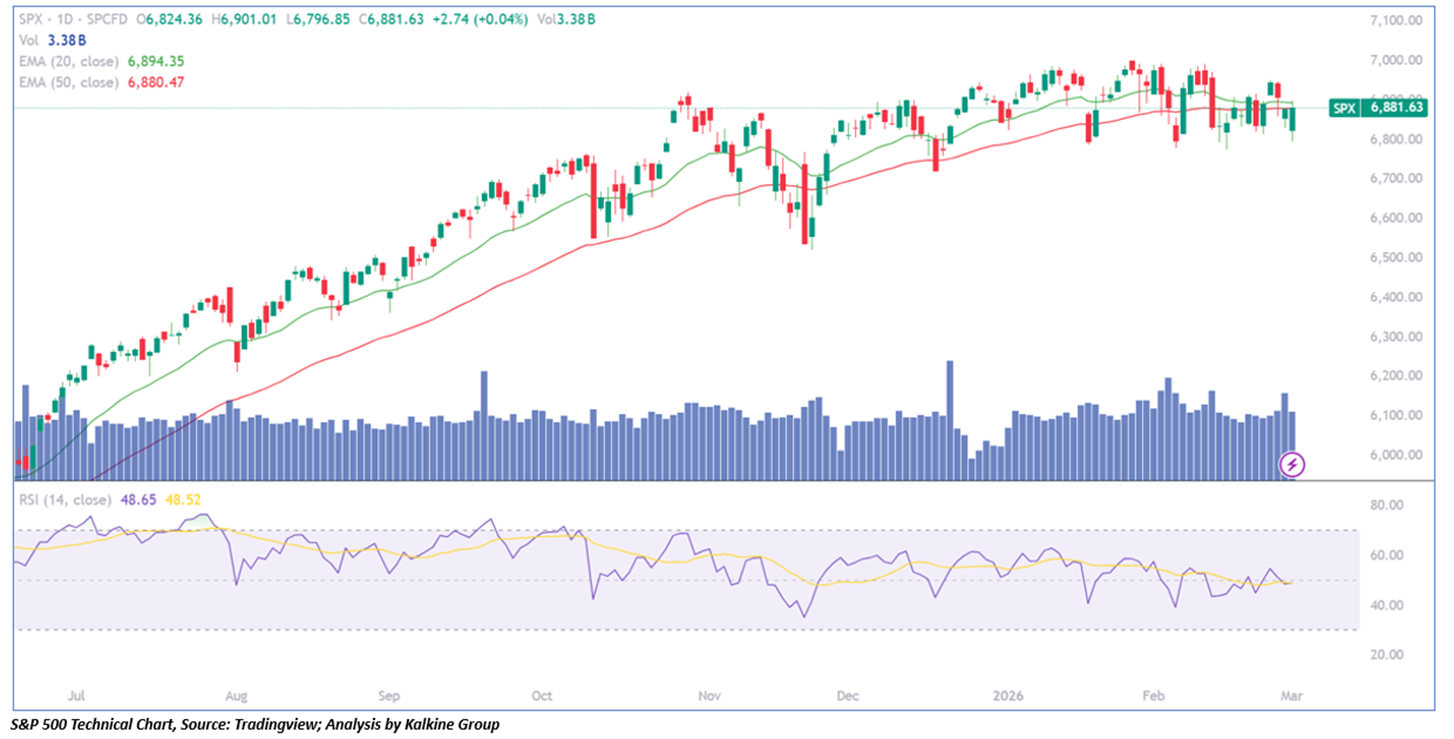
Stocks dropped sharply at the open on Monday amid concerns over escalating conflict in the Middle East but rebounded significantly as the session progressed. The major averages recovered well from their intraday lows and ultimately finished the day narrowly mixed. The S&P 500 up 2.74 points, or 0.04%, to close at 6,881.63. From a technical standpoint, the index is facing resistance at key levels, suggesting the potential for a near-term pullback. Additionally, the major moving averages remain above the current price and have started to flatten after a sustained upward trend, which may cap further upside momentum. The 14-day Relative Strength Index (RSI) is also nearing a move below the midpoint, reinforcing a cautious outlook. Immediate support is located near 6,750, which could act as a short-term bounce area, while near-term resistance is around 6,920.

 Jun 05, 2026
 Please wait processing your request...