
 AU
AU
 UK
UK
 CA
CA
 NZ
NZ
 IND
IND

 US
US

 Share
Share
 X (Formerly Twitter)
 Whatsapp
 Facebook
 LinkedIn
 Telegram
 Email This Article
 Copy Link
 Summarize with AI
 Chat GPT
 Perplexity
Index Updat: Energy index futures fell more than 1% as Saudi Arabia joined Kuwait, Bahrain, and the UAE in cutting oil output after the blockage of the Strait of Hormuz disrupted exports and pushed storage capacity to its limits. The resulting surge in crude oil and natural gas prices lifted Treasury yields and strengthened expectations that the Federal Reserve may keep interest rates higher for longer. In equities, credit-sensitive technology stocks declined in premarket trading, with Amazon, Alphabet, and Microsoft each falling around 1.5%, while Jefferies dropped about 3% after a Morgan Stanley downgrade tied to concerns over private credit exposure; meanwhile, oil producers extended their gains amid the supply disruption.
Market Movers: On Friday, the top gainers were Peraso Inc. (+151.54%), followed by Edesa Biotech, Inc. (+80.61%). On the contrary, Owlet, Inc. (-38.21%), and VCI Global Limited (-24.66%) declined the most the same day.
Commodities Update: WTI and Brent crude oil futures surged more than 10% on Monday, briefly rallying as much as 29% and pushing prices above USD 100 per barrel after disruptions in the Strait of Hormuz forced major Middle Eastern producers—including Saudi Arabia, the United Arab Emirates, Kuwait, and Iraq—to cut output as tanker traffic slowed and storage facilities filled. The sharp supply disruption raised fears of global energy shortages and renewed inflation pressures, with prices briefly approaching USD 120 before easing as G7 nations considered releasing emergency strategic reserves. The rally follows a roughly 35% jump in crude prices last week—the largest weekly increase since futures trading began in 1983—while geopolitical uncertainty intensified further after Iran selected the son of Ayatollah Ali Khamenei as its new Supreme Leader. Gold prices slipped to around USD 5,110 per ounce on Monday as a stronger U.S. dollar and fading expectations of near-term Federal Reserve rate cuts outweighed safe-haven demand amid escalating Middle East tensions. Meanwhile, oil surged above USD 100 per barrel for the first time since 2022 after disruptions in the Strait of Hormuz curtailed supply from major Middle Eastern producers, heightening concerns about inflation and complicating the Fed’s policy outlook. Silver edged slightly lower to about USD 83.9 per ounce, pressured by a stronger dollar and rising bond yields despite geopolitical risks, while copper fell below USD 5.7 per pound to multi-week lows as investors feared prolonged conflict, higher energy costs, and slowing global growth, with additional pressure from dollar strength and rising inflation in China.
Macro Updates: The U.S. dollar index rose above 99.5, reaching a three-month high as oil prices surged past USD 100 per barrel amid fears that the ongoing Middle East conflict could disrupt global energy supplies for an extended period. Rising inflation expectations have strengthened bets that the Federal Reserve may delay interest rate cuts, while the dollar also gained from safe-haven demand as the Iran conflict entered its second week without resolution. Additional geopolitical uncertainty followed Iran’s appointment of Mojtab Khamenei as Supreme Leader, reinforcing expectations of continued hardline leadership, with the dollar outperforming gold and other traditional safe-haven assets over the past week.
Bonds Commentary
The U.S. 10-year Treasury yield climbed to around 4.2%, its highest level in nearly a month, as oil prices surged above USD 100 per barrel amid fears that the ongoing Middle East conflict could cause prolonged disruptions to global energy supplies. Rising energy costs have pushed investors to revise inflation expectations, reducing the likelihood of near-term Federal Reserve rate cuts despite last week’s weak U.S. jobs data. Geopolitical tensions intensified as the Iran conflict entered its second week, with President Donald Trump demanding Tehran’s unconditional surrender and Iran appointing Mojtab Khamenei as the new Supreme Leader, reinforcing expectations of continued hardline leadership.
Futures Update: U.S. stock index futures declined sharply on Monday as escalating Middle East tensions pushed oil prices above USD 100 per barrel, raising concerns that higher energy costs could slow economic growth. Dow Jones Futures fell more than 540 points, while S&P 500 and Nasdaq 100 Futures declined about 1% each. The weakness follows a negative close in the previous week, when all major Wall Street indices dropped at least 1% amid rising geopolitical and economic uncertainty.
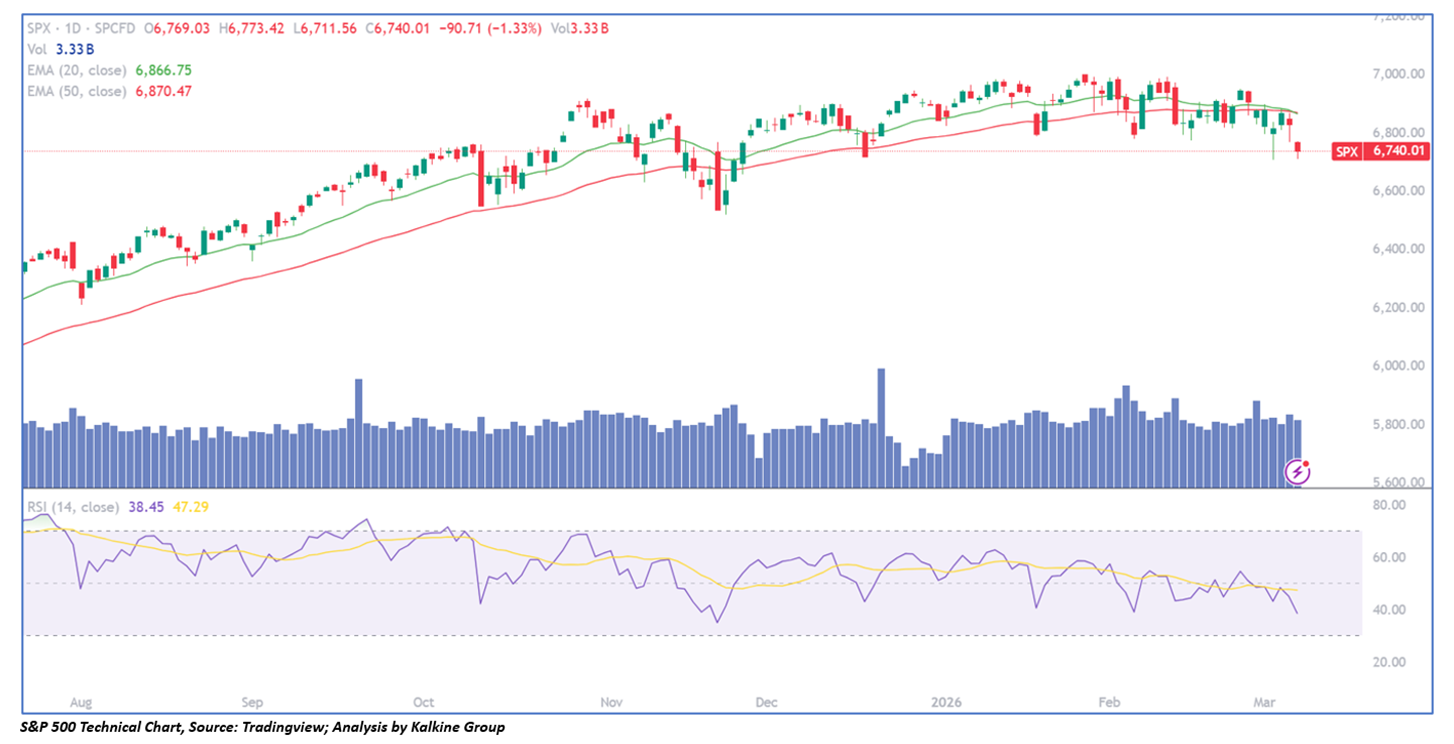
After a sharp earlier move, stocks regained some ground during Friday’s trading session but continued to show notable weakness. The S&P 500 declined by 90.71 points (1.13%) to close at 6,740.01. From a technical standpoint, the index encountered resistance near key levels. The 50-period Exponential Moving Average (EMA) has begun to slope downward after a prolonged uptrend and prices have drifted lower, indicating the possibility of a near-term decline. The falling EMA may also limit further upside momentum. Meanwhile, the 14-day Relative Strength Index (RSI) has slipped below its midpoint, pointing to a cautious short-term outlook. Immediate support is seen around 6,666, which could act as a potential bounce zone, while near-term resistance is placed near 6,855


 Jun 05, 2026

 Please wait processing your request...