
 AU
AU
 UK
UK
 CA
CA
 NZ
NZ
 IND
IND

 US
US

 Share
Share
 X (Formerly Twitter)
 Whatsapp
 Facebook
 LinkedIn
 Telegram
 Email This Article
 Copy Link
 Summarize with AI
 Chat GPT
 Perplexity
Index Update: Markets interpreted Kevin Warsh’s nomination as Fed chair as a relatively hawkish signal on rates, while investors weighed a mixed batch of corporate earnings. Apple and Visa slipped despite solid results, American Express fell after missing expectations, and energy stocks declined alongside weaker oil prices, though Verizon gained on a strong performance. Despite the day’s pullback, U.S. equities closed the month higher, with the S&P 500, Dow Jones, and Nasdaq all posting solid January gains of around 2%.
Market Movers: On Thursday, the top gainers were TechCreate Group Ltd. (+889.23%), followed by ENvue Medical, Inc. (+66.96%). On the contrary, Inuvo, Inc. (-34.43%), and GlucoTrack, Inc. (-33.43%) declined the most the same day.
Commodities Update: Oil prices eased on Friday, with WTI slipping below $65 a barrel and Brent falling under $69, but both remained on course for their strongest monthly performance since July 2023. The rally has been underpinned by a rising geopolitical risk premium, particularly around renewed U.S.–Iran tensions and fears of disruption to energy shipments through the strategically vital Strait of Hormuz. Additional support this month came from supply constraints in Venezuela and Kazakhstan, U.S. production freeze-offs, and tighter restrictions on Russian oil, which have outweighed concerns about a potential global oversupply. Gold and silver saw sharp sell-offs on Friday as profit-taking sparked a broad pullback across precious metals, following their recent record highs. Gold dropped over 5% to around $5,100 after surging to $5,608, while silver plunged more than 13% to near $100 after touching $121.64, though both remained on track for exceptionally strong monthly gains. The broader rally has been driven by economic uncertainty, persistent U.S. dollar weakness, tight physical markets, and heightened geopolitical tensions, including renewed U.S.–Iran frictions, fresh trade measures linked to Cuba, and uncertainty around U.S. monetary policy after Donald Trump nominated Kevin Warsh as the next Federal Reserve chair.
Macro Updates: Trump Taps Kevin Warsh as Next Federal Reserve Chair
President Donald Trump has nominated former Federal Reserve governor Kevin Warsh to succeed Jerome Powell as Fed chair, with the transition expected in May. Announcing the decision on Truth Social, Trump highlighted Warsh’s strong background in economics and finance, including his independent monetary policy reform work for the Bank of England. He also pointed to Warsh’s prior experience on the Federal Reserve’s board of governors from 2006 to 2011 as key credentials for leading the central bank.
Dollar Retreats Despite Fed Leadership Clarity, Posts Weakest Month Since June
The U.S. dollar index eased back toward 96.4 on Friday, near early-2022 lows, after President Trump’s nomination of Kevin Warsh as the next Fed chair, a move largely anticipated by markets. While Warsh is viewed as relatively hawkish, investors still expect two rate cuts later this year, starting in June. For January, the dollar slid 2%—its sharpest monthly drop since June—pressured by geopolitical risks, shifting U.S. trade policies, a weaker yen, and broad “sell America” sentiment, even as lawmakers moved closer to averting a government shutdown.
Bonds Commentary: U.S. 10-year Treasury yields held above 4.25% on Friday, extending weekly gains after President Trump named former Fed governor Kevin Warsh as the next Federal Reserve chair. Warsh is viewed as a relatively hawkish choice, known for opposing aggressive balance sheet expansion during past crises and maintaining a strong focus on inflation, despite recent support for lower rates. Earlier, the Fed kept policy unchanged with a balanced outlook, while markets continue to price in two interest rate cuts later this year.
Futures Update: U.S. equity futures traded lower on Friday but pared some of their declines after President Donald Trump announced the nomination of Kevin Warsh as the next Federal Reserve chair. Dow Jones futures were down 245 points, or 0.5%, S&P 500 futures declined 35 points, or 0.5%, while Nasdaq 100 futures eased 160 points, or 0.6%.
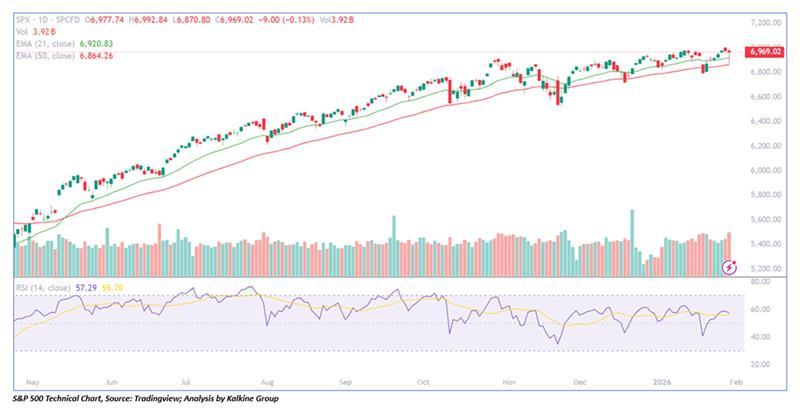
After an early-session nosedive, stocks mounted a notable recovery during Thursday’s trading session. The major averages climbed well off their intraday lows, with the Dow Jones Industrial Average even returning to positive territory. The S&P 500 ended the day down 9.00 points, or 0.13%, to close at 6,969.02. From a technical standpoint, the index may continue to trend lower, as noted in yesterday’s commentary. The 14-day Relative Strength Index (RSI) remains near the midpoint, indicating ongoing indecision at current levels. Key support is identified around 6,910—an area that could spark a rebound—while resistance is seen near 6,740.

 Jun 05, 2026
 Please wait processing your request...