
 AU
AU
 UK
UK
 CA
CA
 NZ
NZ
 IND
IND

 US
US

 Share
Share
 X (Formerly Twitter)
 Whatsapp
 Facebook
 LinkedIn
 Telegram
 Email This Article
 Copy Link
 Summarize with AI
 Chat GPT
 Perplexity
Index Update: U.S. equities declined on Thursday as escalating tensions in Iran pushed WTI crude above USD 80 per barrel, fueling concerns over inflation and a potential global economic slowdown. The Dow fell 1.8%, while the S&P 500 and Nasdaq dropped 0.81% and 0.61%, respectively, as investors sold cyclically sensitive industrial and materials stocks. Companies such as Caterpillar (-3.6%) and GE Aerospace (-3.4%) declined on fears of supply chain disruptions and margin pressure, while Goldman Sachs (-3.7%) and Morgan Stanley (-3%) also fell amid volatility in bond yields and rising market uncertainty.
Market Movers: On Thursday, the top gainers were Alto Ingredients, Inc. (+54.62%), followed by CPI Card Group Inc. (+41.25%). On the contrary, Grocery Outlet Holding Corp. (-27.87%), and FTC Solar, Inc. (-27.11%) declined the most the same day.
Commodities Update: WTI crude rose above USD 84 per barrel and Brent climbed above USD 87 per barrel on Friday, heading for their largest weekly gains since 2022, as escalating Middle East tensions disrupted global energy flows. Shipping through the Strait of Hormuz, which typically carries about 20 million barrels of oil per day, has nearly halted due to security risks, insurance constraints, and operational uncertainty, while some producers have begun shutting in output, further tightening supply. Markets remain on edge after Iranian officials signaled no intention to negotiate, although the U.S. indicated potential measures to ease supply pressures, including a possible Strategic Petroleum Reserve release and allowing India to purchase some Russian crude already at sea. Meanwhile, Saudi Arabia raised crude prices for Asian buyers and redirected shipments via Red Sea routes to bypass Hormuz. Gold rose to around USD 5,110 per ounce and silver climbed above USD 84 per ounce on Friday as geopolitical tensions in the Middle East supported safe-haven demand. However, both metals remained on track for weekly declines—gold marking its first drop in five weeks and silver losing over 10% for the week—as a stronger U.S. dollar and rising Treasury yields offset the risk premium. Surging oil prices heightened inflation concerns, leading markets to scale back expectations for Federal Reserve rate cuts to just one this year, with the next potential cut now pushed toward September or October. Meanwhile, the U.S.–Israel conflict with Iran entered its seventh day, with Iran launching missile and drone strikes across the Gulf and Israel continuing airstrikes on Tehran, while stronger U.S. economic data further supported the dollar.
Macro Updates: U.S. Considers Measures to Stabilize Oil Markets Amid Iran Conflict
The Trump administration is evaluating a range of measures to counter rising oil and gasoline prices triggered by the escalating Iran conflict. Officials are considering both immediate and longer-term actions, including providing insurance guarantees and naval escorts for tankers passing through the Strait of Hormuz to protect global oil shipments. The administration is also reviewing a potential release of crude from the Strategic Petroleum Reserve, possibly in coordination with other countries, although no final decision has been made
U.S. Job Growth Expected to Slow in February
The U.S. economy is projected to have added about 59,000 jobs in February 2026, a sharp slowdown from 130,000 jobs in January, partly due to around 31,000 workers striking in the healthcare sector linked to the United Nurses Associations of California. Despite the softer hiring pace, the unemployment rate is expected to remain steady at 4.3%. Wage growth is also forecast to remain stable, with average hourly earnings rising 0.3% month-on-month after a 0.4% increase in January, keeping annual wage growth at around 3.7%.
U.S. Dollar Strengthens Amid Middle East Tensions and Inflation Concerns
The U.S. dollar index held near 99 and was set to rise over 1% for the week, supported by safe-haven demand as the escalating Middle East conflict and surging oil prices unsettled global markets. The U.S.–Israeli offensive against Iran entered its seventh day, with Tehran launching fresh missile and drone strikes across the Gulf, while political uncertainty increased after President Donald Trump signaled interest in influencing Iran’s leadership transition. Rising oil prices have intensified inflation concerns, prompting markets to push back expectations for Federal Reserve rate cuts to September or October from earlier July forecasts. The dollar posted its strongest gains against the euro, reflecting Europe’s heavy dependence on Middle East energy supplies.
Bonds Commentary: The U.S. 10-year Treasury yield rose for a fifth straight session to around 4.17%, marking a weekly increase of nearly 20 basis points, the largest since April, as surging energy prices fueled inflation concerns and led investors to scale back expectations for Federal Reserve easing to just one 25-basis-point rate cut this year. Rising geopolitical tensions, with the Iran conflict entering its seventh day and shipping through the Strait of Hormuz nearly halted, have heightened fears of supply disruptions, with warnings that Gulf production shutdowns could push oil prices toward USD 150 per barrel. Meanwhile, markets are awaiting the U.S. February jobs report for further signals on labor market strength.
Futures Update: U.S. stock index futures moved lower on Friday, extending recent declines as escalating Middle East tensions and rising oil prices weighed on investor sentiment ahead of a closely watched U.S. jobs report. Dow Jones Futures fell about 105 points (0.2%), S&P 500 Futures declined 22 points (0.3%), and Nasdaq 100 Futures dropped 100 points (0.4%)
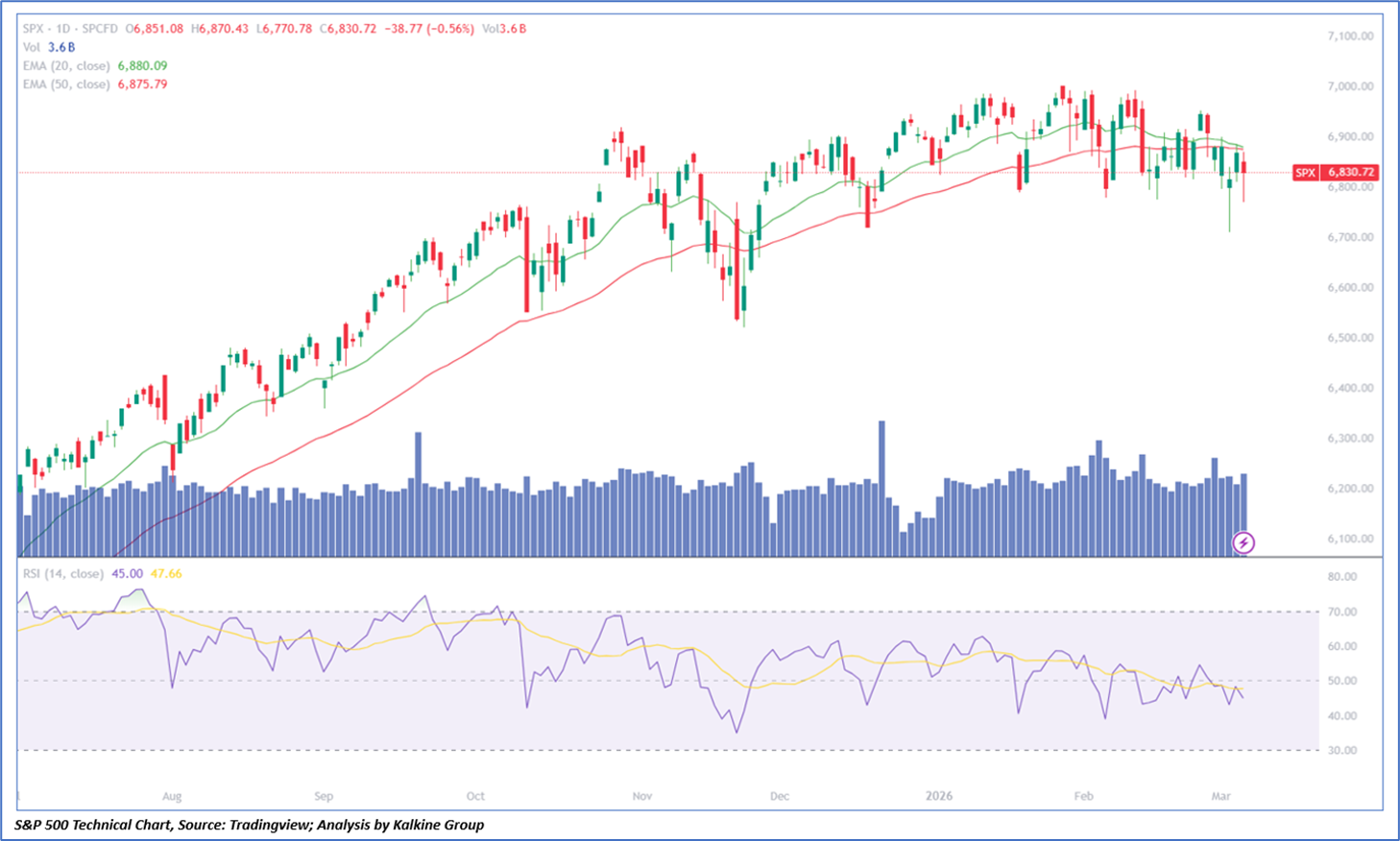
After a strong performance in the previous session, stocks pulled back during Thursday’s trading. The S&P 500 declined by 38.77 points, or 0.56%, to close at 6,830.72. From a technical perspective, the index faced resistance at key levels and ended the day near its intraday low. Additionally, the major moving averages remain above the current price and have begun to flatten after a sustained uptrend, which could limit further upward momentum. The 14-day Relative Strength Index (RSI) has fallen below the midpoint, indicating a cautious short-term outlook. Immediate support is around 6,770, potentially serving as a short-term bounce zone, while near-term resistance is near 6,940.

 Jun 05, 2026
 Please wait processing your request...