
 AU
AU
 UK
UK
 CA
CA
 NZ
NZ
 IND
IND

 US
US

 Share
Share
 X (Formerly Twitter)
 Whatsapp
 Facebook
 LinkedIn
 Telegram
 Email This Article
 Copy Link
 Summarize with AI
 Chat GPT
 Perplexity
Index Update: Markets had opened higher on Nvidia’s upbeat earnings but quickly reversed, with the Dow sliding 0.84%, the S&P 500 falling 1.56%, and the Nasdaq dropping 2.15%. Major tech and AI-linked stocks—Nvidia, AMD, Palantir, Micron, and Oracle—fell sharply amid growing fears of an AI bubble. The delayed BLS jobs report added pressure by showing stronger-than-expected September payroll growth ahead of the December FOMC meeting.
Market Movers: On Thursday, the top gainers were Mobile-health Network Solutions (+83.13%), followed by Epsium Enterprise Limited. (+66.36%). On the contrary Brera Holdings PLC. (-63.73%), and mF International Limited (-39.06%) declined the most the same day.
Commodities Update: WTI and Brent crude both fell to four-week lows on Friday, poised for weekly losses as reports of potential Ukraine–Russia peace talks raised fears of higher Russian oil exports and oversupply. Although skepticism remains among European diplomats, the possibility of sanctions being lifted pressured prices, even as new U.S. sanctions on Rosneft and Lukoil took effect, leaving millions of barrels stranded and prompting Indian refiners to seek new suppliers. Gold also declined toward $4,040 per ounce, weighed down by reduced expectations of a December Fed rate cut after a stronger-than-expected U.S. jobs report. Payrolls rose sharply, unemployment edged up to 4.4%, and wage growth remained firm, reinforcing the view that the labor market is cooling gradually rather than weakening sharply. Traders now assign only about a 40% chance of a rate cut next month.
Macro Updates
Dollar Strengthens as Markets Expect Fed to Hold Rates in December
The U.S. dollar index held above 100 on Friday and is on track for a nearly 1% weekly gain, as traders increasingly expect the Federal Reserve to keep rates unchanged in December. A mixed but stronger-than-expected September jobs report—showing faster payroll growth but a rise in unemployment to a four-year high of 4.4%—did little to alter the outlook. With this being the final labor data before the December FOMC meeting, markets see the Fed maintaining caution amid economic uncertainty and still-elevated inflation. The dollar is set to end the week stronger against all major currencies, with the biggest gains against the yen, New Zealand dollar, and Australian dollar.
Kansas City Fed Manufacturing Activity Accelerates to Over Three-Year High
The Kansas City Fed’s Manufacturing Production Index rose to 18 in November 2025—its strongest level since April 2022—up from 15 in October, signaling a faster pace of expansion. Both durable and nondurable goods output improved, led by gains in food, printing, machinery, and furniture. Most month-over-month indicators were positive, with moderate increases in production and shipments, though export orders and the average workweek declined. Price pressures eased slightly for both finished goods and raw materials. On a year-over-year basis, however, many indicators remained negative, including production and employment, with only supplier delivery times and capital expenditures showing strength.
Bonds Commentary: U.S. 10-year Treasury yields steadied near 4.1% as markets absorbed the delayed September jobs report, which showed stronger-than-expected payroll growth of 119K, a rise in unemployment to 4.4%, and softer wage gains. Initial jobless claims also fell to 220K, signaling a stabilizing labor market. Despite the data, traders still see only about a 36% chance of a December Fed rate cut. FOMC minutes revealed policymakers were divided over the need for further easing, while the BLS’ decision to skip the October jobs report adds uncertainty to the Fed’s outlook.
Futures Update: U.S. stock futures stabilized on Friday after Thursday’s sharp selloff, as fading expectations of a near-term Federal Reserve rate cut weighed on sentiment. Futures on the S&P 500 and Nasdaq ticked slightly lower, while Dow futures edged up. All major indexes remain on track for a losing week, with declines of roughly 3% across the S&P 500, Dow, and Nasdaq. A stronger-than-expected September jobs report reduced the odds of a November rate cut, reversing earlier optimism driven by Nvidia’s strong earnings and upbeat guidance. Investors now turn to a fresh batch of economic data—including PMI readings, industrial production, housing starts, and Michigan consumer sentiment—for further market direction.
Index Update
Markets had opened higher on Nvidia’s upbeat earnings but quickly reversed, with the Dow sliding 0.84%, the S&P 500 falling 1.56%, and the Nasdaq dropping 2.15%. Major tech and AI-linked stocks—Nvidia, AMD, Palantir, Micron, and Oracle—fell sharply amid growing fears of an AI bubble. The delayed BLS jobs report added pressure by showing stronger-than-expected September payroll growth ahead of the December FOMC meeting.
Market Movers
On Thursday, the top gainers were Mobile-health Network Solutions (+83.13%), followed by Epsium Enterprise Limited. (+66.36%). On the contrary Brera Holdings PLC. (-63.73%), and mF International Limited (-39.06%) declined the most the same day.
Commodities Update
WTI and Brent crude both fell to four-week lows on Friday, poised for weekly losses as reports of potential Ukraine–Russia peace talks raised fears of higher Russian oil exports and oversupply. Although skepticism remains among European diplomats, the possibility of sanctions being lifted pressured prices, even as new U.S. sanctions on Rosneft and Lukoil took effect, leaving millions of barrels stranded and prompting Indian refiners to seek new suppliers.
Gold also declined toward $4,040 per ounce, weighed down by reduced expectations of a December Fed rate cut after a stronger-than-expected U.S. jobs report. Payrolls rose sharply, unemployment edged up to 4.4%, and wage growth remained firm, reinforcing the view that the labor market is cooling gradually rather than weakening sharply. Traders now assign only about a 40% chance of a rate cut next month.
Macro Updates
Dollar Strengthens as Markets Expect Fed to Hold Rates in December
The U.S. dollar index held above 100 on Friday and is on track for a nearly 1% weekly gain, as traders increasingly expect the Federal Reserve to keep rates unchanged in December. A mixed but stronger-than-expected September jobs report—showing faster payroll growth but a rise in unemployment to a four-year high of 4.4%—did little to alter the outlook. With this being the final labor data before the December FOMC meeting, markets see the Fed maintaining caution amid economic uncertainty and still-elevated inflation. The dollar is set to end the week stronger against all major currencies, with the biggest gains against the yen, New Zealand dollar, and Australian dollar.
Kansas City Fed Manufacturing Activity Accelerates to Over Three-Year High
The Kansas City Fed’s Manufacturing Production Index rose to 18 in November 2025—its strongest level since April 2022—up from 15 in October, signaling a faster pace of expansion. Both durable and nondurable goods output improved, led by gains in food, printing, machinery, and furniture. Most month-over-month indicators were positive, with moderate increases in production and shipments, though export orders and the average workweek declined. Price pressures eased slightly for both finished goods and raw materials. On a year-over-year basis, however, many indicators remained negative, including production and employment, with only supplier delivery times and capital expenditures showing strength.
Bonds Commentary
U.S. 10-year Treasury yields steadied near 4.1% as markets absorbed the delayed September jobs report, which showed stronger-than-expected payroll growth of 119K, a rise in unemployment to 4.4%, and softer wage gains. Initial jobless claims also fell to 220K, signaling a stabilizing labor market. Despite the data, traders still see only about a 36% chance of a December Fed rate cut. FOMC minutes revealed policymakers were divided over the need for further easing, while the BLS’ decision to skip the October jobs report adds uncertainty to the Fed’s outlook.
Futures Update
U.S. stock futures stabilized on Friday after Thursday’s sharp selloff, as fading expectations of a near-term Federal Reserve rate cut weighed on sentiment. Futures on the S&P 500 and Nasdaq ticked slightly lower, while Dow futures edged up. All major indexes remain on track for a losing week, with declines of roughly 3% across the S&P 500, Dow, and Nasdaq. A stronger-than-expected September jobs report reduced the odds of a November rate cut, reversing earlier optimism driven by Nvidia’s strong earnings and upbeat guidance. Investors now turn to a fresh batch of economic data—including PMI readings, industrial production, housing starts, and Michigan consumer sentiment—for further market direction.
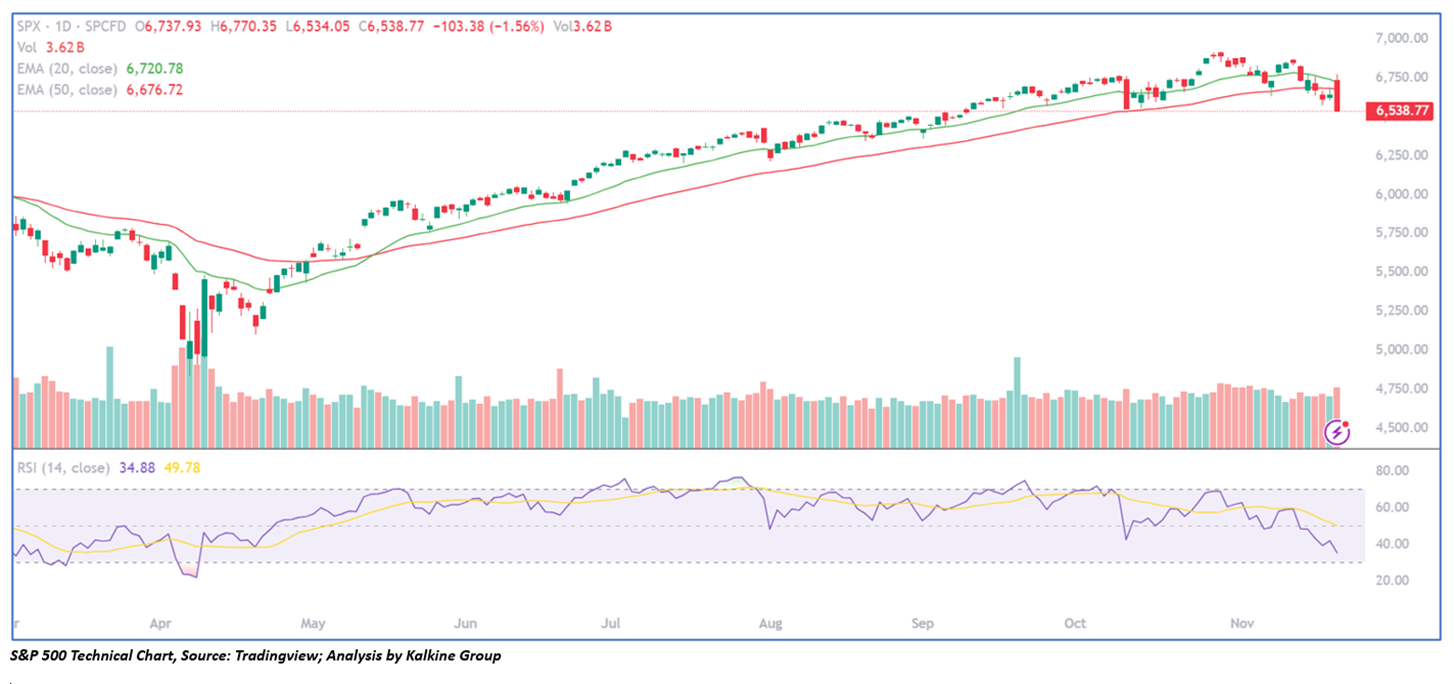
After a sharp upward movement early in the session, stocks experienced a significant decline throughout Thursday. The S&P 500 fell by 103.39 points, or 1.56%, closing at 6,534.05. From a technical standpoint, the index is breaking below a crucial support zone, with several closes below the 21-period EMA, implying potential for further downside in the near term. The 14-day Relative Strength Index (RSI) remains below the midpoint, signaling some additional downward pressure. Key support levels are around 6,455, while resistance is anticipated near 6,700.


 Jun 05, 2026


 Please wait processing your request...