
 AU
AU
 UK
UK
 CA
CA
 NZ
NZ
 IND
IND

 US
US

 Share
Share
 X (Formerly Twitter)
 Whatsapp
 Facebook
 LinkedIn
 Telegram
 Email This Article
 Copy Link
 Summarize with AI
 Chat GPT
 Perplexity
Index Update: U.S. equities advanced on Wednesday, with the S&P 500 rising 0.9%, the Nasdaq gaining 1.3%, and the Dow adding 0.6%, supported by optimism surrounding a potential resolution to the Middle East conflict after President Donald Trump indicated the possibility of a ceasefire and a phased troop withdrawal. Easing geopolitical tensions led to a decline in crude oil prices, while technology stocks outperformed, driven by gains in Alphabet, Micron, Meta, and Amazon. In contrast, Nike declined sharply following weaker guidance. Treasury yields remained stable despite resilient economic data, as investors awaited further updates from the White House on the conflict.
Market Mover: On Wednesday, the top gainers were Cyclerion Therapeutics, Inc. (+311.61%) and PMGC Holdings Inc. (133.72%). On the contrary, Oric Pharmaceuticals, Inc. (-41.00%) and U-BX Technology Ltd. (-40.12%) declined the most the same day.
Commodities Update: WTI and Brent crude oil futures surged sharply on Thursday, rising over 9% and 8% respectively to approach USD 109–110 per barrel, as geopolitical tensions intensified following President Donald Trump’s indication of a prolonged and potentially escalating conflict with Iran over the next two to three weeks. The absence of a clear de-escalation timeline, coupled with heightened risks to Gulf energy infrastructure and Iran’s assertion of control over the Strait of Hormuz, further tightened supply concerns. Despite a bearish build in U.S. crude inventories of 5.5 million barrels to 461.6 million, market sentiment remained firmly supported by geopolitical risk premiums. Gold and silver prices declined sharply on Thursday, with gold falling over 4% to around USD 4,580 per ounce and silver dropping more than 6% toward USD 70 per ounce, as a stronger U.S. dollar weighed on precious metals following President Donald Trump’s indication of a prolonged and potentially intensifying Middle East conflict. The dollar’s renewed safe-haven appeal, coupled with rising oil prices fueling inflation concerns and expectations of tighter monetary policy, pressured bullion prices further. Markets have also fully priced out U.S. rate cuts in 2026, marking a significant shift from earlier expectations of monetary easing.
Macro Updates: The dollar index rose toward 100 on Thursday, reversing a two-day decline, as heightened geopolitical uncertainty following President Donald Trump’s comments on a potentially prolonged Iran conflict boosted safe-haven demand. The dollar was further supported by rising oil prices and inflation concerns, which have led investors to scale back expectations for Federal Reserve rate cuts, reinforcing upward momentum in the currency.
Bonds Commentary: The U.S. 10-year Treasury yield rose to 4.37% on Thursday as fading hopes of a swift resolution to the Middle East conflict heightened concerns over a prolonged energy-driven inflation cycle. President Donald Trump signaled continued military action against Iran over the next two to three weeks, while Iran denied seeking a ceasefire, reinforcing geopolitical uncertainty. Strong U.S. economic data, including better-than-expected ADP payrolls and retail sales, further supported yields, with markets now pricing in no Federal Reserve rate cuts for the year despite the Fed’s projection of one reduction.
Futures Update: U.S. stock index futures declined on Thursday as President Donald Trump signaled a potential escalation in military action against Iran over the next two to three weeks, dampening hopes of near-term de-escalation in the ongoing U.S.-Israel conflict. Following his remarks, S&P 500 Futures fell 1.5% to 6,515, Nasdaq 100 Futures dropped 2% to 23,716, and Dow Jones Futures declined 1.4% to 46,158.
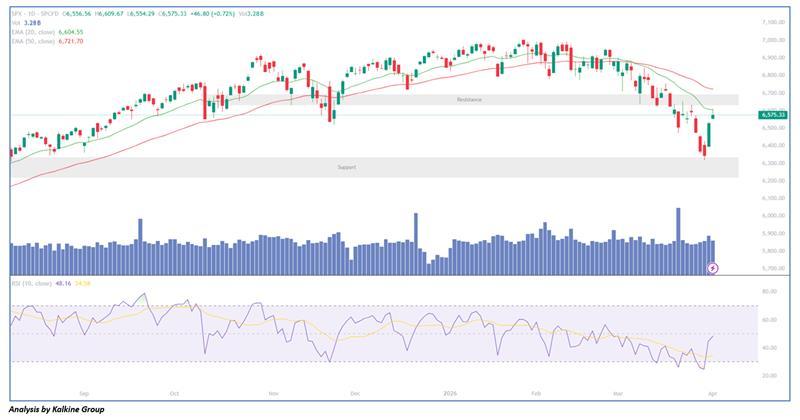
Stocks mostly advanced during Wednesday's trading session, building on the significant gains from the previous day. All major averages moved higher, with the tech-heavy Nasdaq experiencing a notable rise. The S&P 500 rose by 46.80 points, or 0.72%, closing at 6,575.33. From a technical standpoint, the index is near its immediate falling 21-day SMA, suggesting the potential for further decline. Additionally, the pattern of lower highs since late February indicates an ongoing corrective phase. The 50-day exponential moving averages (EMAs) are also trending downward, pointing to weakening momentum and serving as resistance levels. On the downside, the 14-period RSI remains below the midpoint, further supporting a negative bias. Key levels to monitor are support around 6,400 and resistance near 6,600.


 Jun 05, 2026




 Please wait processing your request...