
 AU
AU
 UK
UK
 CA
CA
 NZ
NZ
 IND
IND

 US
US

 Share
Share
 X (Formerly Twitter)
 Whatsapp
 Facebook
 LinkedIn
 Telegram
 Email This Article
 Copy Link
 Summarize with AI
 Chat GPT
 Perplexity
Index Update: U.S. premarket trading was led higher by chipmakers and AI-linked stocks after Taiwan Semiconductor reported a stronger-than-expected rise in quarterly profit and issued an upbeat revenue outlook, reinforcing confidence in long-term AI demand. Gains were seen across major semiconductor names, while bank stocks showed mixed moves as earnings season continued, with BlackRock outperforming on strong results and Goldman Sachs posting a modest rise despite a revenue miss. Broader sentiment was also supported by easing geopolitical concerns following indications from President Trump of restraint on potential military action against Iran.
Market Movers: On Wednesday, the top gainers were High Roller Technologies, Inc. (+436.65%), followed by Rich Sparkle Holdings Limited (+70.5%). On the contrary, ETryHard Holdings Limited. (-41.87%), and MetaVia Inc. (-30.06%) declined the most the same day.
Commodities Update: Oil prices retreated sharply on Thursday, with both WTI and Brent crude falling about 3% and snapping a five-day rally, as immediate geopolitical risks eased. The decline followed comments from U.S. President Donald Trump suggesting a possible delay in military action against Iran, which reduced fears of supply disruptions from Iranian output or major shipping routes. Despite ongoing tensions, including airspace restrictions around Tehran and adjustments to U.S. military deployments in the region, markets focused on easing conflict risks and rising supply pressures. Additional downside came from a sizable build in U.S. crude inventories, the largest in months, while uncertainty around potential U.S. engagement with Venezuela added to concerns over future crude flows. Precious metals declined on Thursday, with gold easing to around $4,590 per ounce as investors took profits after record highs and safe-haven demand softened amid a calmer geopolitical tone. Comments from President Trump suggesting a wait-and-see approach on Iran and reassurance over the Federal Reserve’s leadership reduced risk aversion. Softer-than-expected U.S. producer price data reinforced expectations of potential Fed rate cuts, though policymakers remain cautious on inflation. Silver saw a steeper pullback, dropping about 6% from all-time highs, as Trump delayed imposing tariffs on critical mineral imports in favor of negotiations, easing supply-chain concerns and further dampening demand for safe-haven assets.
Macro Updates: U.S. Export and Import Prices Show Modest Inflationary Pressures in November 2025
U.S. trade price data showed moderate inflationary pressures in November 2025, with export prices rising 3.3% year-on-year, supported by higher agricultural and nonagricultural prices. Over the two months through November, export prices increased 0.5%, as gains in both categories contributed, though October data were unavailable due to a lapse in federal funding. Import prices also edged higher, rising 0.4% over the same two-month period, led by nonfuel imports, while fuel prices declined. On an annual basis, import prices were up slightly by 0.1%, as increases in nonfuel goods offset a sharp year-on-year drop in fuel import prices, driven by lower petroleum costs.
U.S. Imposes Tariffs on High-End AI Chips to Boost Domestic Semiconductor Production
U.S. President Donald Trump has imposed a 25% tariff on select high-performance AI chips, including Nvidia’s H200 and AMD’s MI325X, under a national security order following a Section 232 investigation. The measure targets advanced semiconductors and devices containing them, aiming to encourage greater domestic chip manufacturing and reduce U.S. dependence on foreign supply chains, particularly from Taiwan, which the administration views as a significant economic and national security risk.
Dollar Commentary: The U.S. dollar steadied above the 99 level after recent volatility, as markets assessed incoming economic data and the outlook for Federal Reserve policy. Slightly firmer producer inflation and stronger-than-expected retail sales contrasted with subdued consumer price growth, while concerns over Fed independence eased after President Trump said he would not remove Chair Jerome Powell. Investors continue to expect the Fed to keep rates unchanged in the near term, with potential rate cuts priced in from mid-year, amid a backdrop of easing geopolitical tensions and new U.S. trade measures.
Futures Update: U.S. equity futures traded near unchanged levels on Thursday, as market participants assessed escalating geopolitical risks alongside the initial results of the quarterly earnings season. Dow Jones futures were marginally lower by 29 points, or 0.1%, while S&P 500 futures edged up 4 points, or 0.1%. Nasdaq 100 futures outperformed modestly, advancing 48 points, or 0.2%.
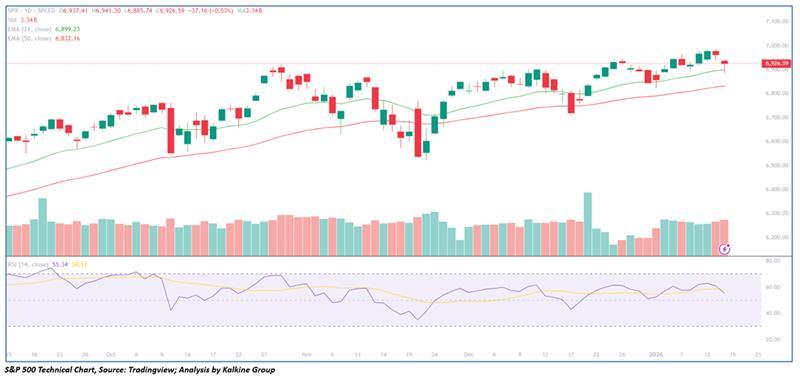
Following the modest pullback observed during Tuesday's session, the stock market experienced further declines on Wednesday. The major indices managed to recover some ground after an early drop but ultimately closed in negative territory. The S&P 500 fell by 37.16 points, or 0.53%, ending the day at 6,926.59. From a technical perspective, the index encountered resistance at key levels and moved lower, indicating the potential for a short-term decline. The 14-day Relative Strength Index (RSI) remains above the midpoint, suggesting some underlying strength but also warranting caution. The main support level is around 6,888—a critical area that could trigger a rebound—while resistance is anticipated near 6,990.


 Jun 05, 2026




 Please wait processing your request...