
 CA
 NZ
 UK
 AU
 IND

 US

 Share
 X (Formerly Twitter)
 Whatsapp
 Facebook
 LinkedIn
 Telegram
 Email This Article
 Copy Link
 Summarize with AI
 Chat GPT
 Perplexity
Key Highlights
- US stock futures rallied on Wednesday as Democrats took control of Congress and President Trump said he was willing to accept the results.
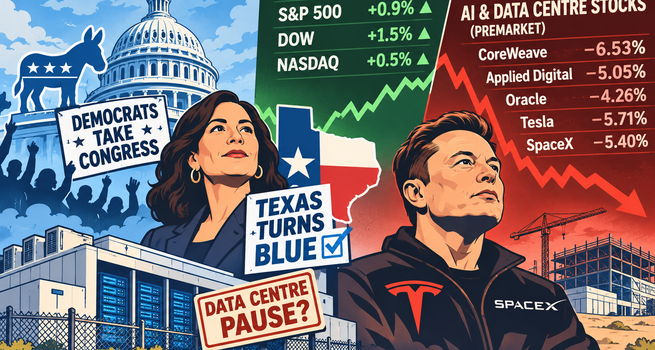
- AI data centre stocks moved the other way, with CoreWeave, Applied Digital, Oracle, Tesla and SpaceX all down 4% to 6.5% in premarket.
- Democrat Gina Hinojosa won the Texas governorship on a pledge to pause new data centres, in a state that holds 27% of planned US capacity.
- In a voter poll, 56% called data centres a crucial or major Factor in their decision, and House Democrats are calling for AI chiefs to testify.
- CoreWeave and Applied Digital sit within 5% of their 52-week lows, and CoreWeave reports Earnings on November 10.
US stock futures rose on Wednesday after Democrats won control of both chambers of Congress, and the AI data centre trade went the other way. The split shows where investors see the new risk: not in the economy, but in the cost and speed of building AI capacity.
A Market Rally With One Exception
Futures tied to the Dow Jones Industrial Average jumped 803 points, or 1.5%, S&P 500 futures rose 0.9% and Nasdaq-100 futures gained 0.5%. The gains reversed a sharp overnight drop. President Donald Trump said he was willing to accept the results and work with the new majority, and strategists pointed to the prospect of divided government, which has historically favored equities. They also noted that lower oil prices would follow any easing of the Middle East conflict.
Large caps joined in. Microsoft (NASDAQ:MSFT) and Amazon (NASDAQ:AMZN) rose 3% each, while Alphabet (NASDAQ:GOOGL) and Nvidia (NASDAQ:NVDA) gained more than 1%. Health insurers and hospital operators also climbed, led by Molina Healthcare (NYSE:MOH) at 6.3% and Centene (NYSE:CNC) at 4.7%, with UnitedHealth (NYSE:UNH) up 1.4% and HCA Healthcare (NYSE:HCA) up 1.4%.
Not everything tied to AI fell. The hyperscalers above fund their spending from Cash Flow and rose. The sell-off hit the builders that fund theirs with debt. The Nasdaq-100 had already fallen into correction territory by the end of October on fears that data centre spending was slowing, and a bank strategist had warned of a slump of more than 10% into year-end if Democrats won the Senate and the Texas governorship. Both conditions have now been met.
Texas Is the Line That Moved
The result that matters most for data centres is in Texas. Gina Hinojosa defeated three-term Republican Governor Greg Abbott, becoming the state's first Democratic governor since 1995. James Talarico beat Ken Paxton for the US Senate, the first Democratic Senate win in Texas in nearly four decades.
Hinojosa campaigned on pausing new data centre projects until the state adopts tougher rules. In a voter poll, 56% of voters called data centres a crucial or major factor in their decision.
The stakes are large. Industry forecasts have Texas overtaking Virginia as the world's biggest data centre market by 2030, and brokerage estimates put 27% of planned US data centre gigawatts in the state. Georgia holds 7%, and Ohio and Pennsylvania 5% each. Texas is the largest single pool of planned capacity, and it now has a governor who wants to slow it.
One limit stands between the pledge and a statewide pause: the Texas Legislature remains Republican, and any statutory pause needs its approval. The governor's office still controls appointments and influences utilities and regulators, so developers face a harder approval path.
Washington Turns Hostile to the Build-Out
The national picture adds to the state one. House Democrats are calling for AI company chief executives to testify, and they take control of the committees that issue subpoenas in January. The expected chair of the oversight committee told the industry to "lawyer up."
The industry also lost on political spending. Crypto, AI and online gambling interests put more than $377 million into races. Elon Musk gave more than $200 million in a failed effort to stop Talarico.
Debt-Funded Builders Take the Hit
The sell-off hit hardest where the balance sheets carry the most debt. Premarket indications show the pattern.
CoreWeave (NASDAQ:CRWV) fell 6.53% to $50.23 from Tuesday's $53.74 close. That is 1.6% above its 52-week low of $49.46 and about 64% below its high of $138.25. The neocloud funds data centres with borrowed money, and its bonds Yield about 15%. Third-quarter results arrive on November 10, with interest expense guided at $860 million to $940 million against adjusted Operating Income of $200 million to $260 million. At the midpoints, interest costs are nearly four times operating profit.
Applied Digital (NASDAQ:APLD) dropped 5.05% to $16.91, only 4.6% above its 52-week low of $16.16. Management has said about 800 MW of its 1.4 GW plan still needs financing in the next 12 months, and the company carries roughly $6.4 billion of debt. A prominent Fund Manager has warned of delays to 10 to 15 GW of expected capacity across the industry.
Nebius Group (NASDAQ:NBIS) held up better, down 2.72% to $147.52, roughly 51% below its 52-week high of $299.86. It has a $3.5 billion secured bank Facility and has raised about $2.7 billion from share sales since 2024, and it reports third-quarter earnings on November 12. IREN (NASDAQ:IREN) reports tomorrow, the first earnings read on neocloud funding this week.
Oracle: The Raise Is Done, the Overhang Is Not
Oracle (NYSE:ORCL) fell 4.26% to $120.83, wiping out most of Tuesday's 6% rebound to $126.21. A media report says Oracle cancelled a roughly $7 billion chip-leasing deal with Tencent under White House pressure, removing a customer meant to diversify its base.
Oracle has completed a $20 billion Equity and Debt raise, which management has called its final Capital need. That removes one worry and leaves others: free cash flow, a BBB- Credit rating one notch above junk and a December earnings report. The shares sit 5.5% above their 52-week low of $114.50 and about 53% below the high of $255.28.
Tesla and SpaceX Fall as Musk's Texas Spending Fails
Tesla (NASDAQ:TSLA) fell 5.71% to $375.73 and SpaceX (NASDAQ:SPCX) fell 5.40% to $133.68. Neither is a data centre landlord, but both are tied to Musk, who spent more than $200 million trying to stop the candidate who won. The new House majority will take over oversight in January.
SpaceX has its own data centre plan. Musk said orbital data centres look "pretty appealing right now." Brokerage estimates put the company's AI build-out at $473 billion of capex in 2027, a post-IPO lockup overhang remains, and the stock trades at 17.6 times 2028 earnings. Some analysts have lifted 2027 Revenue estimates to as much as $175 billion and moved free cash flow breakeven forward to 2031.
Special committees at both Tesla and SpaceX are reviewing a possible merger, and any Tesla deal needs a majority of all outstanding shares. Tesla trades about 25% below its 52-week high of $498.83, SpaceX about 41% below $225.64.
What the Market Is Saying
Gridlock is good for most companies, because a divided Congress passes fewer laws. It is bad for companies whose Business Plan depends on fast approvals, cheap power and local goodwill. Debt-funded builders borrow against the expectation that capacity will go live on schedule, so any delay costs them interest with no revenue to match.
For the next few days, the calendar sets the tone. IREN reports tomorrow, CoreWeave on November 10 and Nebius on November 12. Those results show whether lenders keep funding the build-out, and the first moves from Hinojosa and from House oversight committees show how much friction developers face.
The Takeaway
The midterms split the market in two. Most of it priced a calmer Washington and rallied. The AI data centre trade priced a harder one and fell. Debt-funded builders carry the most risk, because their funding costs are fixed while their approval timelines are not. CoreWeave's results on November 10 are the first test of whether lenders keep funding the build-out.


 Nov 10, 2026





 Please wait processing your request...