
 CA
 NZ
 UK
 AU
 IND

 US

 Share
 X (Formerly Twitter)
 Whatsapp
 Facebook
 LinkedIn
 Telegram
 Email This Article
 Copy Link
 Summarize with AI
 Chat GPT
 Perplexity
Key Highlights
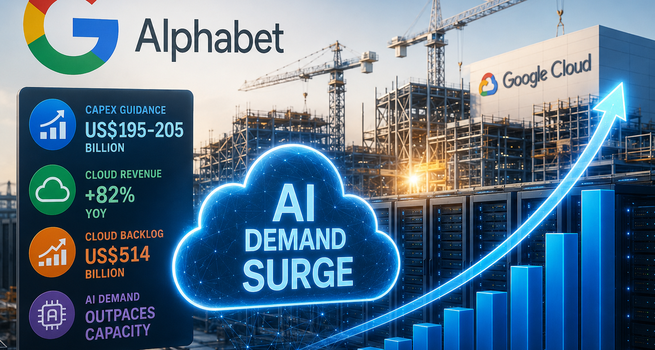
- Alphabet raised capital expenditure guidance to US$195-205 billion, citing demand that outpaces capacity.
- Google Cloud revenue rose 82% year over year to US$24.8 billion, with operating margins near 35.6%.
- Cloud backlog reached US$514 billion, up more than US$50 billion sequentially.
- Management expects spending to rise again in 2027 and has raised equity and debt to fund the buildout.
Alphabet has raised its capital expenditure guidance to a range of US$195 billion to US$205 billion, and the message from management is that the increase is a response to demand rather than ambition alone. On the company's latest earnings call, Chief Financial Officer Anat Ashkenazi framed the spending as a direct consequence of an environment in which customer appetite for artificial intelligence and cloud services continues to run ahead of the capacity the company can bring online. The scale of the commitment, and the confidence behind it, has opened a debate among investors over whether the returns will arrive as quickly as the company expects.
Demand that keeps outpacing capacity
Ashkenazi was direct about the reasoning. She noted that Alphabet has already expanded capacity significantly over the past three years, yet, in her words, "the demand still outpaces that investment." The company describes itself as operating in a "supply-constrained environment," with "very strong demand both from external cloud customers as well as across the business."
That framing matters because it shifts the justification for higher spending from a bet on future growth to a reaction to demand the company says it can already see. The stated policy is straightforward: keep investing "as long as we see an attractive return on that investment." The spending is presented as demand-led and return-gated rather than open-ended. In practice, a supply-constrained position means the company could sell more if it had the hardware, data centre space and power to deliver it, so the limit sits on Alphabet's side rather than on the customer's.
For a company of Alphabet's size, a capex range of US$195 billion to US$205 billion is a substantial commitment of capital. Management's argument is that holding back would mean turning away revenue it could otherwise capture, and ceding ground in a market where capacity itself has become the binding constraint.
The numbers behind the confidence
The figures management pointed to help explain the stance. Google Cloud revenue jumped 82% year over year to US$24.8 billion, while operating margins for the segment expanded to around 35.6%. A business growing at that rate while improving profitability offers a different backdrop for heavy investment than one where spending is running ahead of results. An 82% increase is unusual for a segment already generating billions in quarterly revenue, and pairing that growth with wider margins works against the common concern that rapid expansion comes at the expense of profitability.
The forward indicator management emphasised was backlog. Cloud backlog reached US$514 billion, an increase of more than US$50 billion from the previous quarter. Management expects a bit over half of that figure to convert into revenue within the next 24 months. A backlog of that size functions as a form of visibility, giving the company a basis for its claim that demand is contracted rather than merely projected.
Taken together, the revenue growth, margin expansion and backlog form the core of the case for spending. They suggest that the capacity being built has customers waiting for it, which is the condition Alphabet has set for continuing to invest. The question that remains is one of timing and conversion, not whether demand exists today.
Broad AI adoption
Alphabet also pointed to adoption metrics for its AI products as evidence that demand extends beyond the cloud segment. Management said nearly 90% of Fortune 100 companies are using Gemini Enterprise, while the consumer-facing Gemini app has reached 950 million monthly active users. The company also cited large increases in the volume of tokens processed across its models, a measure of how heavily its systems are being used.
These figures speak to reach across both enterprise and consumer markets. For Alphabet, broad adoption supports the argument that the infrastructure buildout serves a wide base of usage rather than a narrow set of customers. It also feeds directly into the capacity constraint, since rising usage translates into greater demand for compute.
A land-grab strategy funded by equity and debt
Management has been open about how it views the moment. Alphabet is treating the current phase as what it characterises as a once-in-a-generation infrastructure opportunity, and it is prepared to accept short-term costs to secure a position in the AI compute market before competitors do the same.
Those costs are real. Higher capital spending brings higher depreciation and operating expense pressure in the periods ahead, and the near-term effect is a drag on free cash flow. Alphabet has raised both equity and debt specifically to fund the buildout rather than slow it down, a signal that it prefers to protect the pace of investment even at the cost of a heavier balance sheet and a temporary hit to cash generation. Depreciation on new data centres and equipment is recognised over the life of those assets, so a spending surge today lifts reported costs for several years after the cash has gone out, which is why management flagged the pressure as a forward issue rather than a one-off.
The commitment does not stop with the current guidance. Capital expenditure is expected to rise significantly again in 2027, which suggests management sees the constraint persisting rather than easing. The company's position is that the long-term revenue and margin opportunity from owning capacity outweighs the temporary pressure on free cash flow.
The open question
The debate now centres on return on investment and timing. Management's case rests on the belief that owning capacity today secures durable revenue and margin gains later. The uncertainty is whether that return materialises as quickly as the company hopes.
Markets are weighing the visible evidence of demand, such as the 82% cloud growth and the US$514 billion backlog, against the scale of the spending and the pressure it places on cash flow. A backlog offers visibility but not certainty, and conversion timing can shift. If conversion runs slower than the 24-month guide, the gap between heavy upfront spending and the revenue meant to justify it would widen, which is the scenario that gives sceptics pause. For now, the company has tied its spending to attractive returns as its stated discipline, and the coming quarters will show how that discipline holds as the figures work through the accounts.


 Nov 17, 2026





 Please wait processing your request...