SoFi Technologies, Inc (NASDAQ: SOFI) operates as a digital financial services platform offering an integrated ecosystem of lending, banking, investing, and financial management solutions. The company provides personal, student, and home loans through its Lending segment, while its Technology Platform delivers cloud-based banking and payment infrastructure services to enterprise clients. Its Financial Services segment further strengthens customer engagement through products such as SoFi Money and SoFi Invest, positioning the company as a diversified fintech platform focused on expanding digital banking adoption and long-term member growth.

Recent Business Development:
- SoFi’s Diversified Fintech Platform Strengthens Long-Term Growth Outlook: SoFi Technologies is increasingly transforming from a traditional digital lender into a diversified financial services platform, with growth driven by deposits, fee-based services, and expanding ecosystem engagement rather than solely loan originations. While near-term softness in lending activity and macroeconomic pressures continue to impact investor sentiment, the company’s capital-light strategy, growing cross-selling opportunities, and scalable platform model are strengthening the quality and resilience of its earnings profile. Compared with peers such as LendingClub and Upstart, SoFi’s broader ecosystem spanning lending, banking, investing, and technology infrastructure positions the company to better navigate volatile credit cycles and support sustainable long-term growth.
Financial Performance for the quarter ended March 31, 2026 (Q1FY26)
- Robust Revenue Growth and Profitability Expansion: SoFi Technologies reported a strong financial performance in Q1 2026, supported by continued momentum across its diversified financial services platform. Total net revenue increased 43% year-over-year to a record USD 1.1 billion, while adjusted net revenue rose 41% to USD 1.09 billion. Net income surged 134% to USD 166.7 million, reflecting improved operating leverage and disciplined execution. Adjusted EBITDA climbed 62% year-over-year to a record USD 339.9 million, highlighting the company’s ability to scale profitability alongside revenue growth. Earnings per diluted share doubled to USD 0.12 during the quarter, reinforcing SoFi’s transition into a sustainably profitable fintech platform.
- Accelerating Member and Product Ecosystem Growth: The company continued to expand its customer ecosystem at an impressive pace during the quarter. SoFi added a record 1.1 million new members, taking total members to 14.7 million, representing 35% year-over-year growth. Product adoption remained equally strong, with total products increasing 39% to 22.2 million. Cross-buying trends also improved significantly, with 43% of new products adopted by existing members, demonstrating rising customer engagement and strengthening platform stickiness. The expanding ecosystem supports long-term monetization opportunities while lowering customer acquisition dependency over time.
- Record Loan Originations Supporting Lending Momentum: SoFi achieved record loan originations of USD 12.2 billion in Q1 2026, reflecting broad-based strength across its lending portfolio. Personal loan originations reached a record USD 8.3 billion, while student loan originations climbed to USD 2.6 billion, increasing approximately 2.2x year-over-year. Home loan originations also delivered strong performance, rising nearly 2.4x year-over-year to USD 1.2 billion. Additionally, the company’s Loan Platform Business continued to gain traction, with originations rising 90% year-over-year and an additional USD 3.6 billion of commitments added through new partnerships. The strong lending momentum demonstrates SoFi’s growing market penetration and improving operational capabilities.
Strategic Innovation and Platform Diversification
- Expansion into Digital Assets and Infrastructure Services: SoFi continued to diversify its business model through investments in digital asset infrastructure and enterprise-focused financial solutions. During the quarter, the company initiated minting of SoFiUSD, its U.S. dollar-backed stablecoin, while also developing settlement capabilities for interoperability between digital assets and fiat currencies through strategic partnerships such as Mastercard. These initiatives position the company to participate in the evolving digital payments ecosystem and create additional fee-based revenue opportunities. Furthermore, the launch of Big Business Banking expanded SoFi’s reach into enterprise clients, enhancing the diversification of its financial infrastructure platform.
- Continuous Product Innovation Driving User Engagement: The company maintained a strong pace of innovation across its platform, contributing to rising customer engagement and revenue generation. Brokerage fee revenue more than doubled over the past year, reflecting stronger activity within SoFi Invest. The relaunch of SoFi Plus with enhanced benefits, including a 4.5% APY on deposits and investment incentives, is expected to strengthen customer retention and acquisition. Additionally, the rollout of AI-powered tools such as the Personal Loan Doc Coach and an end-to-end digital home equity line of credit experience demonstrates SoFi’s focus on automation, efficiency, and user experience enhancement.
- Strong Credit Performance and Scalable Business Model: Despite continued macroeconomic uncertainty, SoFi maintained stable credit performance in line with internal expectations. The company’s diversified business model, growing fee-based revenue streams, and disciplined underwriting standards supported strong returns and operational resilience. SoFi also achieved its 18th consecutive quarter exceeding the “Rule of 40,” posting a score of 72%, which reflects the company’s balanced ability to drive both high growth and profitability. This consistent execution underscores management’s success in scaling the platform while maintaining financial discipline.
- Positive Outlook Supported by Diversified Growth Drivers: SoFi’s strong Q1 2026 performance highlights the company’s growing position as a diversified digital financial services platform. Record revenue, accelerating member growth, expanding product adoption, and increasing profitability indicate strong operational momentum. Strategic initiatives in digital assets, AI-powered solutions, and enterprise banking further enhance long-term growth prospects, while robust loan originations and cross-selling capabilities support recurring revenue expansion.
Key Risks:
- Macroeconomic Sensitivity: Higher interest rates, economic slowdowns, or rising unemployment could negatively impact loan demand and borrower repayment behavior.
- Regulatory and Compliance Risk: Expanding exposure to digital assets and financial services infrastructure could increase regulatory scrutiny and compliance costs.
- Credit Risk Exposure: Rapid growth in personal and student lending portfolios may elevate credit loss risks if consumer financial conditions weaken.
- Competitive Pressure: The fintech and digital banking industry remains highly competitive, with pressure from traditional banks and emerging fintech platforms potentially affecting margins and customer acquisition.
Technical Observation (on the daily chart):
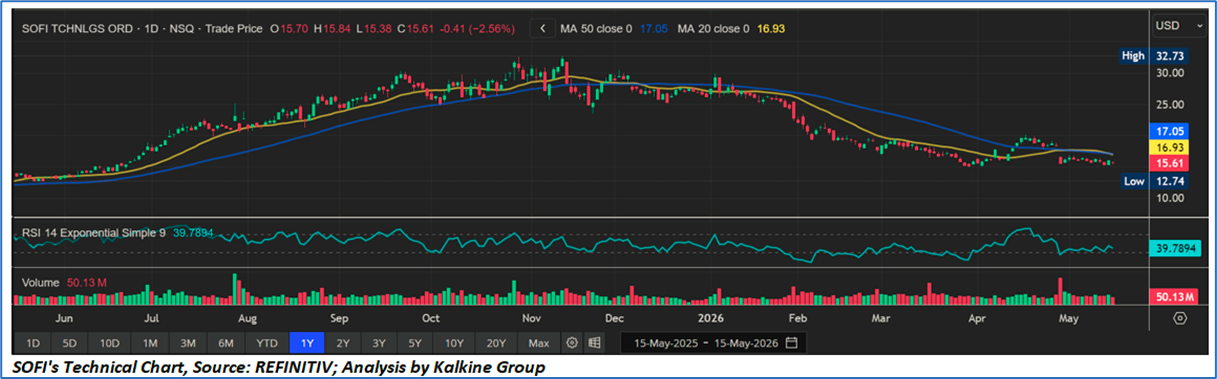
- SoFi Technologies’ stock has remained under pressure over the past several months, with the price trading below both the 20-day moving average (16.93) and the 50-day moving average (17.05), indicating a continued short-term bearish trend.
- The stock witnessed a strong rally between June and November 2025, reaching highs near the USD 32.70 level before entering a prolonged correction phase driven by profit-booking and weakening momentum.
- Recent price action suggests the stock is consolidating in the USD 15–USD 16 range after a sharp decline earlier in 2026, indicating that selling pressure may be stabilizing near current levels.
- The Relative Strength Index (RSI) is currently around 39.8, which reflects weak momentum but remains above oversold territory, suggesting that bearish sentiment persists although extreme downside pressure has eased.
- Volume activity has remained moderate during the recent consolidation phase, implying limited aggressive buying interest while investors continue to assess broader market sentiment and company fundamentals.
- A sustained breakout above the moving averages with improving volume could indicate the beginning of a recovery trend, whereas continued weakness below current levels may keep the stock range-bound or under bearish pressure in the near term.
SoFi Technologies delivered a strong Q1 2026 performance driven by record revenue growth, accelerating profitability, and expanding customer engagement across its digital financial ecosystem. The company benefited from robust loan originations, rapid member additions, and increased cross-selling activity, while continued innovation in AI-powered financial tools, digital assets, and enterprise banking strengthened its long-term growth outlook. With improving operating leverage, diversified revenue streams, and sustained product adoption momentum, SoFi appears well-positioned to capitalize on the growing shift toward digital financial services.
As per the above-mentioned price action, recent key business and financial updates, momentum in the stock over the last month, and technical indicators analysis, a ‘Buy’ rating has been given SoFi Technologies, Inc (NASDAQ: SOFI) at the closing market price of USD 15.61, as of May 15,2026.
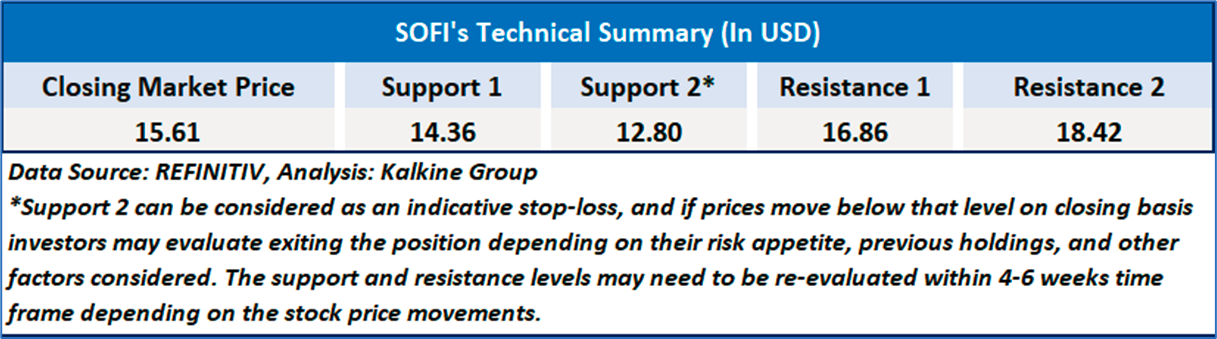
Individuals can evaluate the stock based on the support and resistance levels provided in the report in case of keen interest taking into consideration the risk-reward scenario.
Markets are trading in a highly volatile zone currently due to certain macro-economic issues and prevailing geopolitical tensions. Therefore, it is prudent to follow a cautious approach while investing.
Related Risk: This report may be looked at from a high-risk perspective and a recommendation is provided for a short duration. This report is solely based on technical parameters, and the fundamental performance of the stocks has not been considered in the decision-making process. Other factors which could impact the stock prices include market risks, regulatory risks, interest rates risks, currency risks, social and political instability risks etc.
Note 1: Past performance is not a reliable indicator of future performance.
Note 2: The reference date for all price data, currency, technical indicators, support, and resistance level is May 15,2026. The reference data in this report has been partly sourced from REFINITIV.
Note 3: Investment decisions should be made depending on an individual's appetite for upside potential, risks, holding duration, and any previous holdings. An 'Exit' from the stock can be considered if the Target Price mentioned as per the Valuation and or the technical levels provided has been achieved and is subject to the factors discussed above.
Note 4: Target Price refers to a price level that the stock is expected to reach as per the relative valuation method and or technical analysis taking into consideration both short-term and long-term scenarios.
Note 5: ‘Kalkine reports are prepared based on the stock prices captured either from the New York Stock Exchange (NYSE), NASDAQ Capital Markets (NASDAQ), and or REFINITIV. Typically, all sources (NYSE, NASDAQ, or REFINITIV) may reflect stock prices with a delay which could be a lag of 15-20 minutes. There can be no assurance that future results or events will be consistent with the information provided in the report. The information is subject to change without any prior notice.

 CA
 NZ
 UK
 AU
 IND

 US

 Please wait processing your request...