Explore 3 Stock Ideas & Industry Insights Download Free Report

mid-cap

Balancing Strength and Cyclical Pressures in Housing Finance: A Watch on Fannie Mae (OTC: FNMA)

Mar 23, 2026 | Team Kalkine
Balancing Strength and Cyclical Pressures in Housing Finance: A Watch on Fannie Mae (OTC: FNMA)
Image source: Shutterstock

Federal National Mortgage Association

Federal National Mortgage Association (OTC: FNMA) is a government-sponsored enterprise that supports the U.S. housing market by providing liquidity and access to mortgage financing. It operates through Single-Family and Multifamily segments, focusing on loans backed by residential properties with up to four units and five or more units, respectively. The company participates in the secondary mortgage market through various securitization structures and funds its operations by issuing debt in domestic and international capital markets.

Key Growth Aspects

  • Strong Market Position and Systemic Importance: Fannie Mae continues to maintain a structurally dominant position within the U.S. housing finance ecosystem, acting as one of the largest guarantors of residential mortgage debt, covering approximately 25% of single-family and 21% of multifamily markets. This entrenched market presence reinforces its systemic importance, enabling consistent access to capital markets and sustained relevance across housing cycles. Its government-backed legacy and nationwide operational footprint further strengthen its institutional credibility and resilience.
  • Stable Revenue Model Anchored by Guaranty Fees: The company benefits from a highly predictable and recurring revenue model, primarily driven by guaranty fees associated with mortgage-backed securities. Net revenues remained broadly stable at approximately USD 7.3 billion in 4Q25 and USD 29 billion annually, reflecting the defensive nature of its core business. Additionally, stable net interest margins and consistent guaranty fee contributions provide earnings visibility even amid macroeconomic volatility.
  • Robust Profitability and Capital Growth: Fannie Mae has demonstrated sustained profitability, reporting 14 consecutive years of positive earnings alongside a net income of USD 14.4 billion for FY25. The firm’s net worth increased meaningfully to USD 109 billion, highlighting internal capital generation and balance sheet strengthening. This steady capital accretion enhances financial flexibility and supports progress toward regulatory capital requirements.
  • Operational Efficiency and Risk Management Discipline: The company has undertaken meaningful cost optimization initiatives, including workforce rationalization and administrative expense reductions, leading to improved efficiency ratios. Furthermore, disciplined credit risk management is reflected in relatively low delinquency rates and effective loss-sharing mechanisms across its guaranty book. These efforts collectively position the firm to maintain operational stability while navigating evolving housing and interest rate environments.

Growth Challenges

  • Earnings Volatility and Declining Profitability Trend: Despite sustained profitability, Fannie Mae experienced a decline in net income to USD 14.4 billion in FY25 from USD 17.0 billion in FY24, indicating pressure on earnings momentum. Quarterly earnings also showed moderation, reflecting sensitivity to credit provisions and market-driven valuation adjustments. This trend suggests that earnings quality remains partially influenced by cyclical and non-recurring factors.
  • Exposure to Credit Losses and Macroeconomic Sensitivity: The company remains inherently exposed to credit risk within its large mortgage portfolio, as evidenced by increased provisions for credit losses during FY25. While delinquency levels remain contained, any deterioration in housing market conditions, unemployment, or interest rate dynamics could materially impact asset quality. This sensitivity underscores the cyclical risk embedded in its core business model.
  • Regulatory Capital Constraints and Structural Limitations: Fannie Mae continues to operate under stringent regulatory oversight, with capital requirements and buffers constraining financial flexibility. Although net worth has improved, the firm still faces a capital shortfall relative to required regulatory thresholds, highlighting ongoing structural limitations. These constraints may limit capital deployment, shareholder distributions, and strategic expansion initiatives.
  • Dependence on Housing Market and Interest Rate Environment: The company’s performance is closely tied to U.S. housing activity and mortgage rate dynamics, making it vulnerable to prolonged periods of elevated interest rates or reduced refinancing activity. Declines in mortgage origination volumes or affordability pressures could adversely affect new business volumes and fee income generation. This dependence introduces earnings cyclicality despite the otherwise stable business model.

Key Risks:

  • Credit Risk Exposure: Elevated sensitivity to borrower defaults and rising credit loss provisions amid weakening housing affordability conditions.
  • Regulatory Capital Constraints: Ongoing capital requirements and regulatory oversight may limit balance sheet flexibility and strategic capital deployment.
  • Interest Rate Sensitivity: Higher mortgage rates could suppress refinancing activity and new loan originations, impacting revenue generation.
  • Housing Market Cyclicality: Dependence on U.S. housing demand exposes performance to macroeconomic slowdowns and property market corrections.

Technical Observation (on the daily chart):
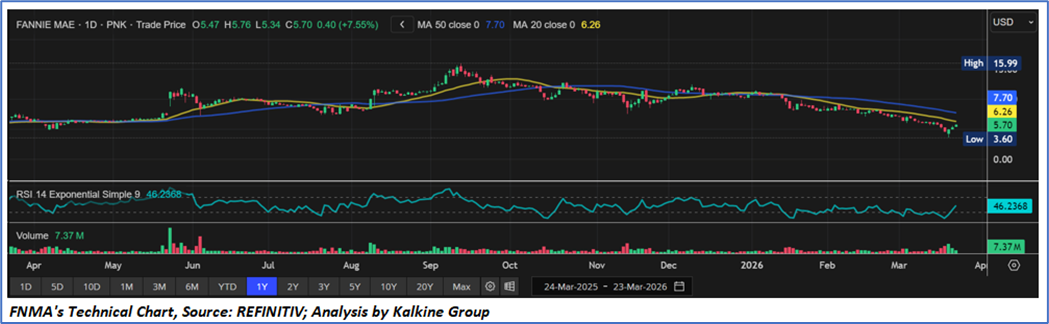
  • The stock has transitioned from a mid-year uptrend into a sustained downtrend, characterized by a sequence of lower highs and lower lows since late Q3, indicating persistent selling pressure.
  • Price remains below both the 20-day (USD 6.26) and 50-day (USD 7.70) moving averages, reflecting a continued bearish bias; the downward slope of both averages reinforces weak momentum.
  • RSI is hovering around 46, indicating neutral momentum with a slight recovery from weaker levels, suggesting early-stage stabilization but no confirmed strength.
  • Volume spikes during recent price declines indicate distribution activity earlier, while the latest bounce shows moderate participation, hinting at cautious accumulation.

Fannie Mae presents a balanced investment case, supported by its dominant position in the U.S. housing finance system, stable revenue streams anchored by guaranty fees, and consistent capital build-up reflected in its USD 109 billion net worth and long track record of profitability. However, this strength is partly offset by a moderation in earnings, rising credit loss provisions, and ongoing regulatory capital constraints, which limit financial flexibility and highlight structural risks. Additionally, its performance remains closely tied to housing market conditions and interest rate cycles, suggesting that while the business model is resilient, it is not immune to macroeconomic pressures.

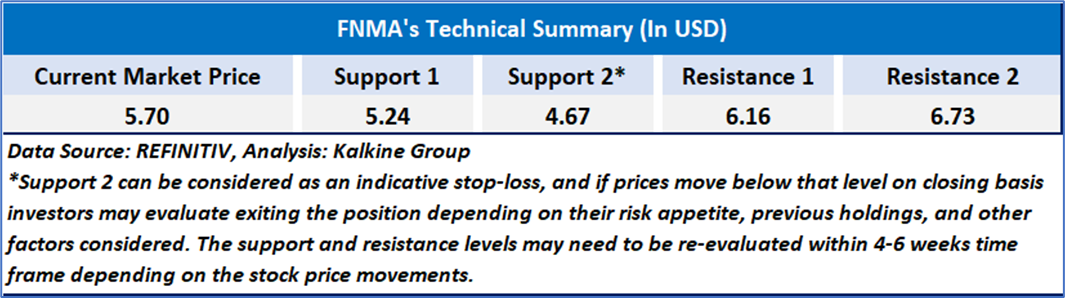
As per the above-mentioned price action, recent key business and financial updates, momentum in the stock over the last month, and technical indicators analysis, a ‘Watch’ rating has been Federal National Mortgage Association (OTC: FNMA) at the current market price of USD 5.70 as of March 23,2026 at 9:20 am PDT. 

Individuals can evaluate the stock based on the support and resistance levels provided in the report in case of keen interest taking into consideration the risk-reward scenario. 

Markets are trading in a highly volatile zone currently due to certain macro-economic issues and prevailing geopolitical tensions. Therefore, it is prudent to follow a cautious approach while investing.

Related Risk: This report may be looked at from a high-risk perspective and a recommendation is provided for a short duration. This report is solely based on technical parameters, and the fundamental performance of the stocks has not been considered in the decision-making process. Other factors which could impact the stock prices include market risks, regulatory risks, interest rates risks, currency risks, social and political instability risks etc. 

Note 1: Past performance is not a reliable indicator of future performance.

Note 2: The reference date for all price data, currency, technical indicators, support, and resistance level is March 23,2026. The reference data in this report has been partly sourced from REFINITIV.

Note 3: Investment decisions should be made depending on an individual's appetite for upside potential, risks, holding duration, and any previous holdings. An 'Exit' from the stock can be considered if the Target Price mentioned as per the Valuation and or the technical levels provided has been achieved and is subject to the factors discussed above.

Note 4: Target Price refers to a price level that the stock is expected to reach as per the relative valuation method and or technical analysis taking into consideration both short-term and long-term scenarios.

Note 5: ‘Kalkine reports are prepared based on the stock prices captured either from the New York Stock Exchange (NYSE), NASDAQ Capital Markets (NASDAQ), and or REFINITIV. Typically, all sources (NYSE, NASDAQ, or REFINITIV) may reflect stock prices with a delay which could be a lag of 15-20 minutes. There can be no assurance that future results or events will be consistent with the information provided in the report. The information is subject to change without any prior notice.


Disclaimer-

Kalkine Equities LLC, with Delaware File Number 4697384, Foreign Qualification Registration in California File Number 202109211078, and Texas File Number 805521396, is authorized to provide general advice only. The information on https://kalkine.com/ does not take into account any of your investment objectives, financial situation or needs. You should consider the appropriateness of advice taking into account your own objectives, financial situation and needs and seek independent financial advice before making any financial decisions. The link to our Terms and Conditions  and Privacy Policy has been provided for your reference. On the date of publishing the reports (mentioned on the website), employees and/or associates of Kalkine do not hold positions in any of the stocks covered on the website. These stocks can change any time and readers of the reports should not consider these stocks as advice or recommendations later.

Past performance is not a reliable indicator of future performance.

Support

Hi! How can we help you today?

Loading…