The Offer
Company Overview
BW Industrial Holdings Inc. is a U.S.-based engineering, procurement, and construction (EPC) company headquartered in Houston, Texas, providing design, construction, and integration services for critical process systems across multiple industrial sectors. The company serves clients in automotive parts manufacturing, energy storage and battery manufacturing, renewable energy infrastructure (particularly solar module manufacturing), electronics production, advanced manufacturing, and semiconductor fabrication industries. Founded in November 2016 as Bestwater USA Inc. and reorganized as BW Industrial Holdings Inc. in April 2025, the company has built its business primarily serving international companies, especially overseas enterprises seeking to establish and expand manufacturing operations in the United States.
Key Highlights
Primary Offering:
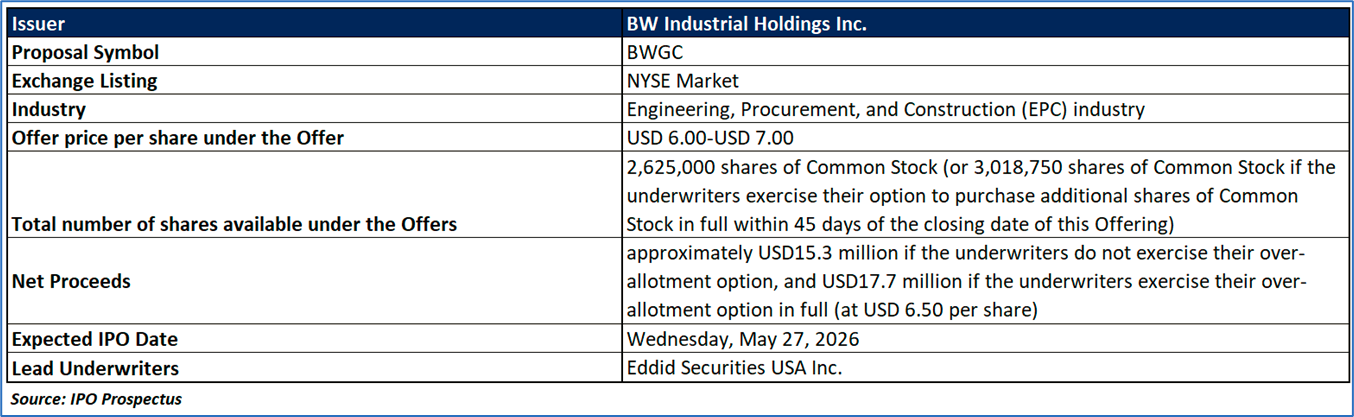
BW Industrial Holdings Inc. has launched an initial public offering of 2.625 million common shares at an indicative price range of USD 6.00–USD 7.00 per share, with a 15% over-allotment option, and expects to raise gross proceeds of approximately USD 17.1 million at the midpoint price of USD 6.50 per share, with the shares proposed to list on the NYSE American under the ticker symbol “BWGC.” Following the offering, the company will remain a controlled company under NYSE American rules, with founder Yunlong Zhang retaining majority voting control, while investors will face immediate dilution of approximately USD 5.17 per share; the company also qualifies as an emerging growth company and smaller reporting company, enabling it to utilize reduced regulatory and disclosure requirements.
Use of proceeds:
- Business Expansion Initiatives: BW Industrial Holdings Inc. intends to allocate approximately 50% of the estimated net proceeds, or nearly USD 7.7 million, toward business expansion initiatives aimed at strengthening its operational scale and market presence. Planned initiatives include talent acquisition to enhance organizational capabilities, geographic expansion beyond its existing operations in Texas, Arizona, and Florida, and diversification of project scope into public infrastructure and commercial construction sectors, including municipal water and wastewater projects. The company has already satisfied eligibility requirements to participate in government project bidding in Texas and maintains dedicated personnel for government procurement opportunities, reflecting a strategic effort to broaden its customer base beyond its current concentration in overseas manufacturing and renewable energy clients.
- Strategic Acquisition Strategy: Approximately 35% of the net proceeds, equivalent to around USD 5.4 million, is expected to be directed toward strategic acquisitions intended to enhance vertical integration and strengthen the company’s competitive positioning. Management has indicated interest in acquiring design institutes, engineering firms, or building materials manufacturing businesses that could complement existing operations and expand technical capabilities. However, the prospectus notes that no specific acquisition targets have been identified or negotiated as of the filing date, indicating that the acquisition strategy remains preliminary and subject to execution risk associated with sourcing, evaluating, negotiating, and integrating suitable opportunities within anticipated timelines.
- Working Capital and Corporate Purposes: The remaining 15% of proceeds, estimated at approximately USD 2.3 million, is expected to support working capital requirements and general corporate purposes. Given the capital-intensive nature of engineering, procurement, and construction (EPC) contracts, the company requires substantial upfront expenditures for materials, equipment, and subcontractor payments prior to receiving milestone-based customer payments. Although the company reported profitability, operating cash flow generation remained limited, with cash flow from operations totaling only USD 58,907 in 2024 and USD 56,303 in 2025, highlighting the working capital pressures inherent in project-based revenue recognition and contract execution cycles.
- Management Flexibility and Deployment Risks: Management retains broad discretion regarding the ultimate allocation and timing of the net proceeds and may revise its intended use of funds in response to evolving business conditions, strategic opportunities, or unforeseen circumstances. The prospectus identifies several factors that could materially influence capital deployment decisions, including project delays or cancellations, increases in operating costs, regulatory developments, adverse economic conditions, operational disruptions, force majeure events, and unanticipated investment opportunities. Pending utilization, the company intends to preserve capital by investing unused proceeds in short-term investment-grade securities and U.S. government instruments.
Dividend Policy:
BW Industrial Holdings Inc. does not expect to declare or pay cash dividends in the foreseeable future, as the Board of Directors intends to retain available capital and future earnings to support business expansion, working capital requirements, and strategic growth initiatives. Prior to the proposed IPO, the company declared special dividends totaling approximately USD 4.3 million, including USD 2.3 million distributed to controlling stockholder Yunlong Zhang on December 31, 2024, and USD 2.0 million distributed to stockholders on June 1, 2025, thereby reducing cash balances before the public offering. Future dividend determinations will remain subject to the discretion of the Board and will depend on factors including the company’s financial condition, operating performance, capital needs, contractual obligations, and overall business outlook. Consequently, prospective investors should primarily view potential returns as dependent on capital appreciation rather than recurring dividend income, although the company’s limited operating history, customer concentration exposure, and relatively modest profitability margins may create uncertainty regarding long-term value creation.
BW Industrial Holdings Inc. – Business Model, Operational Risks and Strategic Positioning
- EPC Business Model and Revenue Volatility: BW Industrial Holdings Inc. operates as an engineering, procurement, and construction (EPC) contractor providing turnkey industrial facilities and process systems primarily under fixed-price contracts. The company recognizes revenue using the percentage-of-completion method, which exposes earnings to significant volatility arising from cost overruns, project delays, and revisions to estimated project costs. Revenue declined sharply from approximately USD 102.0 million in fiscal 2024 to USD 22.5 million in fiscal 2025 due to the completion of major projects, the postponement of a USD 30 million battery manufacturing contract, and the termination of a significant solar-related agreement.
- Significant Customer and Vendor Concentration: The company remains highly dependent on a limited number of customers and subcontractors, creating material operational and financial concentration risk. In fiscal 2024, two customers accounted for approximately 97% of total revenues, while in fiscal 2025, two customers represented nearly 73% of revenues. A similarly concentrated pattern exists across accounts receivable, contract assets, and vendor relationships, limiting the company’s negotiating leverage and increasing vulnerability to project cancellations, payment delays, or disruptions involving key counterparties.
- Strategic Focus on Renewable Energy and Semiconductor Projects: BW Industrial’s project pipeline is concentrated in renewable energy manufacturing and semiconductor infrastructure projects, including solar manufacturing facility expansions in Texas and semiconductor-related work in Arizona. These projects position the company within sectors benefiting from increased industrial investment and supply chain localization trends. However, future revenue realization remains dependent on project execution timelines, customer approvals, milestone completion, and potential contract modifications, which collectively create uncertainty regarding revenue timing and backlog conversion.
- Fixed-Price Contract and Profitability Risks: The company’s reliance on fixed-price contracts exposes it to substantial cost estimation and execution risks, as BW Industrial must absorb costs exceeding original estimates while managing labor, material, subcontractor, and scheduling uncertainties. During fiscal 2025, profitability was materially supported by a favorable vendor reconciliation adjustment of approximately USD 3.7 million, which significantly increased reported gross margin. Management has acknowledged that future revisions to project cost estimates may lead to reductions in previously recognized revenues and profits, contributing to earnings unpredictability.
- Scalability and Cash Flow Challenges: Despite reporting positive net income, BW Industrial has generated limited operating cash flow due to substantial working capital requirements associated with project-based operations. The company also faces scalability concerns, as operating expenses increased despite a significant decline in revenue during fiscal 2025, reflecting weak operating leverage. In addition, the payment of approximately USD 4.3 million in special dividends during 2024 and 2025, despite modest cash generation, has raised concerns regarding capital allocation priorities and the sustainability of long-term growth initiatives.
BW Industrial Holdings Inc. – Industry Landscape, Competitive Dynamics and Market Positioning
- S. Industrial Construction Market Supported by Manufacturing Reshoring: The U.S. industrial construction market is benefiting from long-term structural trends driven by manufacturing reshoring, supply chain diversification, and government-supported domestic production initiatives. Legislative programs such as the CHIPS Act and the Inflation Reduction Act have accelerated investments in semiconductor, renewable energy, and advanced manufacturing facilities across the United States. BW Industrial Holdings Inc. specifically targets overseas enterprises, particularly Asian manufacturers, seeking turnkey EPC solutions for establishing or expanding U.S.-based operations while navigating domestic regulatory, permitting, and construction requirements.
- Renewable Energy and Semiconductor Infrastructure Opportunities: The company is strategically positioned within sectors experiencing significant near-term investment activity, particularly renewable energy manufacturing and semiconductor infrastructure. Federal incentives tied to domestic solar panel, battery, and electric vehicle component manufacturing are driving increased demand for specialized industrial facilities requiring process integration, environmental compliance, and advanced engineering capabilities. Semiconductor facility investments supported by CHIPS Act funding further expand market opportunities, although these projects are typically awarded to larger contractors with greater technical scale and execution capacity.
- Competitive Landscape and Scale Limitations: BW Industrial operates within a highly competitive industrial construction market characterized by both large integrated contractors and specialized regional firms. Major industry participants such as Bechtel, Turner, Kiewit, and Fluor benefit from extensive project experience, stronger balance sheets, established customer relationships, broader geographic reach, and superior supply chain capabilities. At the same time, specialized regional contractors maintain advantages through technical expertise, local networks, and sector-specific execution capabilities. Compared with these competitors, BW Industrial faces scale disadvantages that may limit its ability to compete for larger projects, achieve pricing power, or diversify geographically.
- High Entry Barriers and Operational Complexity: The industrial EPC industry presents substantial barriers to entry and expansion, including significant capital requirements, bonding capacity constraints, regulatory compliance obligations, and the need for specialized engineering expertise. Contractors must maintain sufficient working capital to fund upfront project costs while managing extended customer payment cycles, and many projects require bid, performance, and payment bonds that smaller firms may struggle to obtain. In addition, successful execution requires integrating international engineering standards with U.S. construction practices, managing complex permitting processes, and maintaining strong relationships with subcontractors, suppliers, and regulatory authorities.
- Cyclical Industry Dynamics and Execution-Based Competition: The engineering and construction sector remains highly cyclical and sensitive to economic conditions, interest rates, customer capital expenditure trends, and financing availability. Economic slowdowns, rising financing costs, material shortages, labor inflation, or project delays can materially reduce demand for industrial construction services and compress contractor margins. Competitive success within the industry depends heavily on strong supply chain relationships, disciplined financial management, rigorous project controls, safety and quality assurance systems, and the ability to consistently execute projects on schedule and within budget. BW Industrial’s relatively limited operating history, customer concentration, and smaller operational scale may constrain its ability to withstand industry cyclicality and compete against more established market participants.
Financial Highlights (Comparison of operating results for the financial years ended December 31, 2025, and 2024) (Expressed in USD)
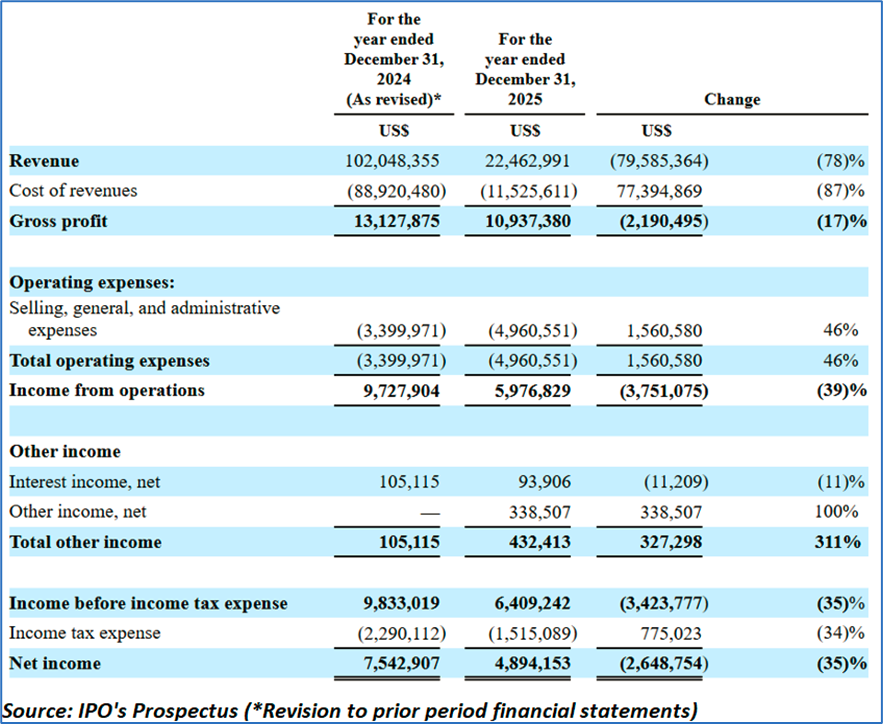
- Revenue Contraction and Business Volatility: BW Industrial Holdings Inc. reported a substantial decline in fiscal 2025 revenue to approximately USD 22.5 million, compared to USD 102.0 million in fiscal 2024, reflecting significant business volatility and project concentration risk. The decline was primarily attributable to the completion of several major EPC projects, the postponement of a USD 30 million battery manufacturing contract, and the termination of a large solar-related agreement, although the majority of the solar project revenue had already been recognized. While the company secured additional EPC contracts toward the end of 2025 that are expected to contribute to future backlog and revenue generation beginning in 2026, the timing gap between completed and newly commenced projects materially compressed reported revenue during the year.
- Non-Recurring Margin Expansion and Operating Cost Pressure: Gross profit margin increased significantly from 13% in fiscal 2024 to 49% in fiscal 2025; however, the improvement was largely driven by non-recurring items rather than sustainable operational enhancement. The margin expansion primarily reflected favorable project change orders and a downward revision of approximately USD 3.7 million in previously accrued vendor costs following invoice reconciliations. At the same time, selling, general, and administrative expenses increased 46% year-over-year to approximately USD 5.0 million despite the sharp decline in revenue, indicating weak operating leverage and elevated fixed cost pressures. Management also cautioned that fiscal 2025 profitability metrics may not be indicative of future performance.
- Profitability Trends and Financial Reporting Concerns: Net income declined from approximately USD 7.5 million in fiscal 2024 to USD 4.9 million in fiscal 2025, despite the temporary benefit from elevated gross margins. The company also disclosed previously understated sales tax and state tax liabilities related to prior fiscal periods, resulting in adjustments to expenses, retained earnings, and tax liabilities, although management determined that the impact was not material enough to require restatement of previously issued financial statements. These disclosures raise concerns regarding the robustness of internal controls and financial reporting processes during the company’s pre-IPO operating period.
- Weak Operating Cash Flow and Strengthened Post-IPO Capitalization: Despite reporting positive accounting earnings, BW Industrial generated minimal operating cash flow in both fiscal 2024 and fiscal 2025 due to significant working capital requirements associated with contract assets, receivables, and milestone-based payment structures. Contract assets increased materially to approximately USD 11.3 million by year-end 2025, reflecting revenue recognized but not yet billed to customers. The company also distributed approximately USD 4.3 million in special dividends during 2024 and 2025 despite limited cash generation, reducing available liquidity prior to the IPO. As of December 31, 2025, BW Industrial reported total assets of approximately USD 23.3 million and stockholders’ equity of USD 14.3 million with no long-term debt outstanding; the proposed IPO is expected to materially strengthen the balance sheet and liquidity position through additional capital infusion.
Key Management Highlights
Risk Associated (High)
Investment in the initial public offering of BW Industrial Holdings Inc. (BWGC) is subject to several material risk factors, including the following:
- Extreme Customer Concentration Risk: A substantial majority of BW Industrial’s revenues, receivables, and contract assets are concentrated among a limited number of customers, exposing the company to significant financial and operational risk in the event of client loss or project disruption.
- Revenue Volatility and Project Timing Risk: The company’s dependence on large-scale EPC contracts with uneven execution timelines has resulted in significant revenue volatility, including a 78% year-over-year revenue decline in fiscal 2025 following project completions, contract postponements, and terminations.
- Fixed-Price Contract and Cost Overrun Risk: BW Industrial’s fixed-price contract structure exposes profitability to labor, material, and subcontractor cost overruns, while revisions to project cost estimates under percentage-of-completion accounting may materially impact reported revenues and earnings.
- Contract Termination and Project Cancellation Risk: Customers retain broad termination-for-convenience rights that may allow cancellation or suspension of projects without cause, creating substantial uncertainty regarding revenue visibility and future project continuity.
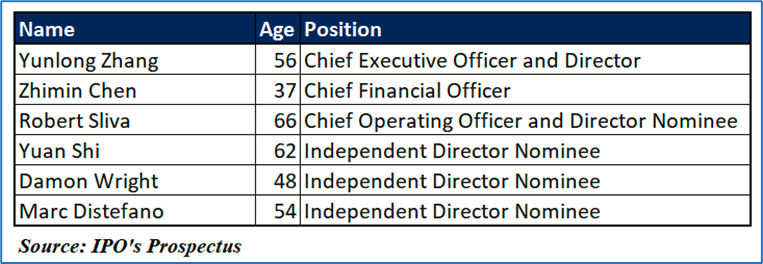
- Controlled Company and Governance Risk: Post-IPO, founder Yunlong Zhang will retain majority voting control, enabling significant influence over corporate decisions and allowing the company to rely on reduced corporate governance requirements available to controlled companies under NYSE American rules.
Conclusion
BW Industrial Holdings Inc. (BWGC) operates as a specialized engineering, procurement, and construction (EPC) contractor focused on supporting international companies establishing manufacturing operations in the United States, particularly within renewable energy, semiconductor, battery manufacturing, and advanced industrial sectors. The company has demonstrated capabilities in executing turnkey industrial projects integrating overseas engineering standards with U.S. regulatory and construction requirements, supported by a project pipeline that includes solar manufacturing expansions and semiconductor-related infrastructure projects. However, BWGC faces several material business and financial risks, including extreme customer concentration, significant revenue volatility driven by project timing and contract terminations, limited operating cash flow generation despite reported profitability, and exposure to fixed-price contract execution risks. The company also operates within a highly competitive industrial construction market dominated by larger and more established contractors, while its controlled company governance structure provides founder Yunlong Zhang with majority voting control following the IPO. Although management intends to utilize IPO proceeds to support expansion initiatives, acquisitions, and working capital, the company’s recent financial performance reflects substantial fluctuations in revenue and profitability, with fiscal 2025 results materially impacted by non-recurring margin benefits and delayed project activity.
Hence, given the company’s positioning within U.S. industrial manufacturing expansion and renewable energy infrastructure projects, demonstrated EPC execution capabilities, and planned use of IPO proceeds for business expansion and strategic growth initiatives, but balanced against extreme customer concentration, significant revenue volatility, limited operating cash flow generation, fixed-price contract execution risks, controlled company governance structure, and reliance on non-recurring factors supporting recent margins, “BW Industrial Holdings Inc. (BWGC)” IPO appears “Neutral” at the IPO price.
Past performance is not a reliable indicator of future performance.

 CA
 NZ
 UK
 AU
 IND

 US

 Please wait processing your request...