Company Overview
Cerebras Systems Inc. is an advanced artificial intelligence infrastructure company headquartered in Sunnyvale, California, focused on designing, manufacturing, and deploying the world's fastest AI computing systems. The company is centered on three integrated technology platforms: its flagship Wafer-Scale Engine (WSE) processor, the CS-3 data center system, and comprehensive software stack enabling training and inference for frontier-scale AI models. The WSE-3 processor measures 46,225 square millimeters (58 times larger than NVIDIA's B200 chip), integrates 900,000 compute cores with 44 gigabytes of on-chip SRAM memory, and delivers 21 petabytes per second of memory bandwidth (2,625 times more than NVIDIA's B200 package). This architecture enables inference speeds up to 15 times faster than leading GPU-based solutions and training time reductions exceeding 10 times compared to same-generation GPU systems, positioning Cerebras as the performance leader in AI compute infrastructure.
Initial Public Offering
The company launched its IPO on May 12th, 2026, under the ticker CBRS and sold approximately 28,000,000 shares of Class A Common Stock at USD 120.00 per share. We had covered this IPO in our 'Kalkine IPO Report' on May12, 2026, and had concluded that this IPO was "Attractive" given the proven technology differentiation, strategic validation from OpenAI and AWS, accelerating revenue momentum, but balanced against extreme customer concentration risks, operational unprofitability, and near-term financing requirements.
Conclusion
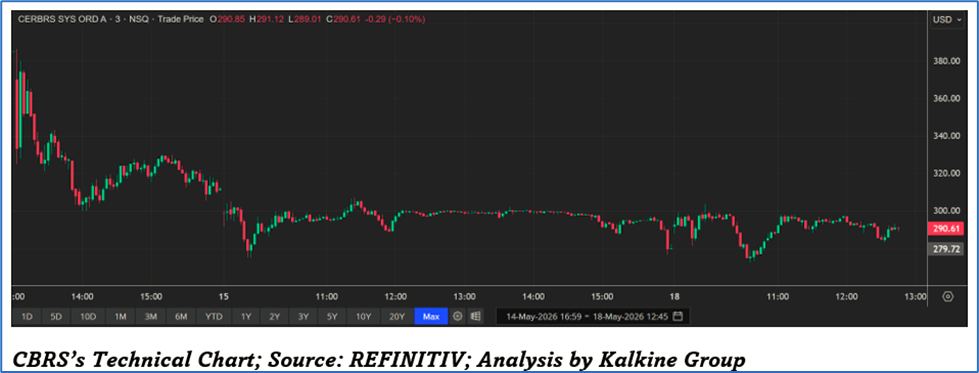
Investors who have invested in this IPO can consider ‘Exiting’ from their position at the current price of USD 290.61. as on May 18, 2026, at 07:50 am PDT, given:
- Decent gains: The stock has moved up more than ~142.17% from its IPO offering price of USD 120.00 per share.
- Extreme Customer Concentration Risk: Substantially all of Cerebras' revenue derives from only four strategic relationships (G42, MBZUAI, OpenAI, and AWS), with the company's filing explicitly warning that loss of any single customer would materially harm financial performance. The hardware business (70% of 2025 revenue at USD 358 million) concentrates on Abu Dhabi Sovereign AI initiatives, while the Master Revenue Agreement with OpenAI creates both visibility and execution risk. This extreme concentration represents a fundamental vulnerability where customer-specific issues budget cuts, strategic pivots, internal silicon development by hyperscalers, or geopolitical considerations could cause substantial revenue collapse with limited near-term diversification options.
- Operational Unprofitability Masked by Non-Recurring Gains: Despite reporting USD 238 million net income in fiscal 2025, the company remains structurally unprofitable from operations, with a core operating loss of USD 146 million. The reported accounting profit resulted from USD 391 million in non-recurring other income, primarily USD 1.0 billion fair value remeasurement of warrants offset by USD 618 million debt extinguishment losses, masking fundamental operational economics. Cloud gross margins collapsed to 30% from 61% as infrastructure investments preceded revenue realization, while R&D consumed USD 243 million (48% of revenue). Until cloud margins expand sustainably above 50% and revenue scales sufficiently to cover fixed R&D and operational costs, the business will continue consuming cash despite reported GAAP earnings.
- Capital Intensity and Near-Term Dilution Risk: Management explicitly acknowledges that cloud offerings "require significant data center capacity and capital investments for which we expect to require significant additional capital" beyond the USD 3.36 billion IPO proceeds, signaling 18-24 months liquidity runway at current burn rates before requiring dilutive follow-on financing. The OpenAI Master Revenue Agreement creates upfront capital requirements with delayed compensation over service periods, while 48% R&D intensity represents fixed costs pressuring cash generation. The company's explicit statement that future funding will come "through future issuances of debt or equity securities" creates near-term dilution risk for IPO investors, particularly as cloud infrastructure buildout accelerates ahead of contracted capacity obligations.
- NVIDIA Competitive Threat and Ecosystem Disadvantage: NVIDIA commands approximately 90% market share through CUDA software ecosystem lock-in, vastly superior scale, continuous innovation across hardware (Blackwell, Hopper architectures) and software (TensorRT, Triton inference server), and established customer relationships spanning every major AI lab and hyperscaler. Cerebras must continuously demonstrate performance advantages justifying premium pricing and operational complexity customers incur deviating from standard GPU infrastructure, while technology advantages can erode through competitor innovation (NVIDIA Grace Hopper integration, NVLink improvements reducing interconnect bottlenecks) or workload evolution where compute constraints rather than memory bandwidth become primary bottleneck. The absence of a comparable developer ecosystem creates customer switching costs favoring NVIDIA even when Cerebras delivers measurable performance gains.
- Supply Chain Concentration and Manufacturing Vulnerability: Cerebras relies on TSMC for wafer fabrication and specialized vendors for packaging and assembly, procuring manufacturing services on purchase order basis without capacity or volume commitments, meaning the company competes for foundry allocation against much larger customers (Apple, NVIDIA, AMD) during industry capacity constraints. The unique 46,225mm² wafer size creates manufacturing challenges around yield, testing, and packaging that few vendors can address, concentrating supply chain risk. Supply chain disruptions, inability to secure sufficient TSMC capacity during industry upturns, or manufacturing yield issues could delay product deliveries, harm customer relationships, and enable competitors to capture market share, while the company lacks the volume and strategic customer status to secure preferential foundry treatment.
The reference data in this report has been partly sourced from Refinitiv.
Disclaimer-
Kalkine Equities LLC, with Delaware File Number 4697384, Foreign Qualification Registration in California File Number 202109211078, and Texas File Number 805521396, is authorized to provide general advice only. The information on https://kalkine.com/ does not take into account any of your investment objectives, financial situation or needs. You should consider the appropriateness of advice taking into account your own objectives, financial situation and needs and seek independent financial advice before making any financial decisions. The link to our Terms and Conditions and Privacy Policy has been provided for your reference. On the date of publishing the reports (mentioned on the website), employees and/or associates of Kalkine do not hold positions in any of the stocks covered on the website. These stocks can change any time and readers of the reports should not consider these stocks as advice or recommendations later.
Past performance is not a reliable indicator of future performance.

 CA
 NZ
 UK
 AU
 IND

 US

 Please wait processing your request...