
 AU
AU
 UK
UK
 CA
CA
 NZ
NZ
 IND
IND

 US
US

 Share
Share
 X (Formerly Twitter)
 Whatsapp
 Facebook
 LinkedIn
 Telegram
 Email This Article
 Copy Link
 Summarize with AI
 Chat GPT
 Perplexity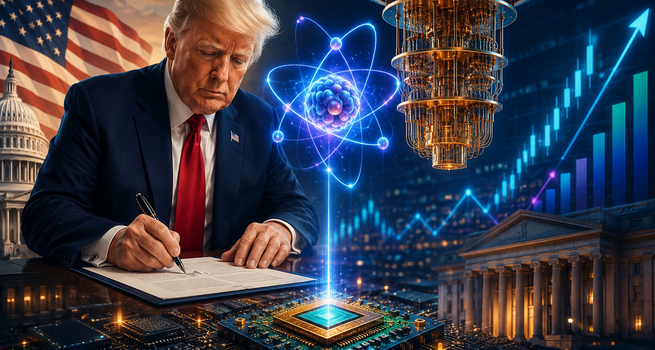
Key Highlights
- President Trump signed two major quantum-focused executive orders on June 22, 2026.
- The QC-ADDS initiative aims to deploy a utility-scale quantum computer at a Department of Energy facility by 2028.
- A federal mandate requires migration to post-quantum cryptography between 2030 and 2031.
- Quantum computing stocks rallied as investors anticipated accelerated government procurement.
- Infleqtion (NYSE: INFQ), IonQ (NYSE: IONQ), Rigetti Computing (NASDAQ: RGTI), D-Wave Quantum (NYSE: QBTS), and IBM (NYSE: IBM) emerged as leading beneficiaries.
Why Trump’s Quantum Computing Executive Orders Could Reshape the Industry
For years, quantum computing has occupied an unusual position in financial markets. Investors have been asked to value technologies that promise transformative capabilities but remain years away from widespread commercialization. The result has been a cycle of enthusiasm, disappointment, and renewed optimism as scientific milestones alternated with commercialization challenges.
The executive orders signed by President Donald Trump on June 22, 2026, may represent the most consequential policy intervention the sector has experienced since the passage of the National Quantum Initiative Act.
Unlike previous government programs focused primarily on research funding, the new orders establish clear deployment objectives, implementation timelines, procurement mechanisms, and accountability frameworks. For investors, that distinction matters.
Research grants can stimulate innovation. Government procurement commitments create markets.
The immediate reaction reflected this reality. Shares of Infleqtion (NYSE: INFQ), IonQ (NYSE: IONQ), Rigetti Computing (NASDAQ: RGTI), D-Wave Quantum (NYSE: QBTS), and IBM (NYSE: IBM) moved sharply higher as investors reassessed the commercial trajectory of the quantum computing industry.
The larger question now is whether this policy shift represents a genuine turning point for quantum commercialization or merely another episode of government-driven enthusiasm.
Understanding the QC-ADDS Program and the 2028 Quantum Computing Target
The centerpiece of the administration’s strategy is the Quantum Computer for Application Development and Discovery Science initiative, commonly referred to as QC-ADDS.
The program seeks to deploy at least one large-scale quantum computing system at a Department of Energy facility by approximately 2028.
That goal is ambitious.
Today's leading quantum systems continue to operate within what researchers call the noisy intermediate-scale quantum (NISQ) era. While qubit counts continue rising, practical fault tolerance remains one of the industry's most difficult challenges.
Yet the significance of QC-ADDS lies less in whether the exact 2028 target is achieved and more in what the target forces the industry to do.
Government agencies now have a formal mandate to accelerate procurement decisions. Vendors must compete on deployment readiness rather than theoretical roadmaps. Universities, laboratories, and technology companies receive a clear signal that quantum infrastructure is becoming a national priority.
For investors focused on long-term growth themes, the existence of a defined procurement pathway is arguably more important than the precise deployment date.
Why Infleqtion (NYSE: INFQ) May Be the Most Direct Beneficiary
Among publicly traded quantum companies, Infleqtion (NYSE: INFQ) appears uniquely aligned with the executive orders.
The company specializes in neutral-atom quantum technology, an approach that spans quantum computing, sensing, and networking.
Importantly, all three of those domains are explicitly referenced within the administration's strategic framework.
Infleqtion's position received additional attention because its chief executive attended the White House signing ceremony. On the same day, the company announced America's Quantum Space Initiative alongside partners including Voyager Technologies and the University of Colorado.
While symbolic gestures do not guarantee contract awards, they often reveal which companies have established relationships within government ecosystems.
From an investment perspective, Infleqtion (NYSE: INFQ) offers perhaps the greatest upside sensitivity to federal quantum spending.
However, it also carries meaningful risks.
Unlike larger technology firms, Infleqtion remains relatively early in its commercialization journey. Revenue visibility remains limited, profitability remains distant, and contract concentration risk remains elevated.
For institutional investors, the opportunity may be substantial, but so is the volatility.
How IonQ (NYSE: IONQ) Benefits From Quantum Networking Demand
IonQ (NYSE: IONQ) occupies a distinctive position within the quantum landscape.
The company utilizes trapped-ion technology, which has consistently demonstrated some of the highest gate fidelity metrics in the industry.
Gate fidelity may sound like an obscure engineering measure, but it has direct commercial implications.
Quantum networking requires highly reliable qubit interactions. The lower the error rate, the more practical the networking architecture becomes.
The executive orders place significant emphasis on quantum networking infrastructure, creating a potentially attractive procurement pipeline for IonQ (NYSE: IONQ).
The company already maintains relationships with government agencies and major cloud computing providers.
Its integration with cloud platforms has allowed customers to access quantum resources without building dedicated infrastructure, creating a scalable commercialization pathway that many competitors lack.
From a stock analysis perspective, the challenge is valuation.
IonQ (NYSE: IONQ) already trades at a premium revenue multiple relative to many emerging technology companies. Investors have largely recognized its leadership position.
Consequently, while the executive orders strengthen the long-term narrative, they may not dramatically alter valuation assumptions that already embed significant future growth.
Why Rigetti Computing (NASDAQ: RGTI) Remains a Key Quantum Hardware Player
Rigetti Computing (NASDAQ: RGTI) represents one of the most prominent pure-play quantum hardware companies pursuing superconducting technology.
Superconducting architectures remain among the leading candidates for achieving utility-scale quantum systems.
The advantages are significant.
Decades of semiconductor manufacturing expertise can be leveraged to scale superconducting quantum processors. Existing fabrication infrastructure provides a pathway toward industrial production that alternative approaches may struggle to match.
This is partly why major technology leaders continue investing heavily in superconducting platforms.
For Rigetti Computing (NASDAQ: RGTI), the executive orders reinforce the strategic importance of domestic quantum manufacturing capabilities.
The company could benefit from investments in supply chains, cryogenic infrastructure, advanced fabrication, and quantum system deployment.
Nevertheless, investors should recognize that Rigetti Computing (NASDAQ: RGTI) faces intense competition.
The company competes not only against other pure-play quantum firms but also against much larger organizations with substantially greater resources.
Execution risk remains a central consideration.
D-Wave Quantum (NYSE: QBTS): The Most Commercially Proven Quantum Company?
Among public quantum companies, D-Wave Quantum (NYSE: QBTS) arguably possesses one characteristic that differentiates it from much of the sector.
It already serves commercial customers.
Unlike many gate-based quantum companies focused on future breakthroughs, D-Wave Quantum (NYSE: QBTS) specializes in quantum annealing systems designed to solve optimization problems.
These applications include:
- Logistics optimization
- Supply-chain management
- Manufacturing scheduling
- Portfolio optimization
- Resource allocation
- Energy grid management
These are practical problems organizations face today.
As government agencies increasingly seek computational advantages in logistics, defense planning, and infrastructure management, D-Wave Quantum (NYSE: QBTS) may benefit from near-term procurement opportunities.
This commercial maturity reduces some of the technological uncertainty associated with other quantum investments.
That does not eliminate risk.
Quantum annealing addresses a narrower class of problems than universal gate-based quantum computing.
Still, for investors seeking exposure to current quantum adoption rather than future technological breakthroughs, D-Wave Quantum (NYSE: QBTS) occupies an attractive niche.
Why IBM (NYSE: IBM) Could Be the Safest Quantum Computing Investment
While smaller companies generated larger percentage gains, IBM (NYSE: IBM) may ultimately be among the most important beneficiaries.
The company has spent years building one of the industry's most comprehensive quantum ecosystems.
IBM Quantum supports hundreds of enterprise, academic, and government organizations through its quantum network.
Its roadmap continues advancing toward increasingly sophisticated processors while simultaneously building software tools and developer platforms.
Importantly, IBM (NYSE: IBM) possesses advantages that pure-play competitors often lack:
- Established government relationships
- Strong balance sheet
- Global research infrastructure
- Existing enterprise customer base
- Diversified revenue streams
For institutional investors, this diversification matters.
Quantum computing remains a long-duration investment theme. Many pure-play firms may require years before generating sustainable profitability.
IBM (NYSE: IBM) provides exposure to quantum growth without relying exclusively on quantum success.
The administration's explicit recognition of IBM's leadership position further strengthens the company's strategic standing.
Why Nvidia (NASDAQ: NVDA) Could Benefit Indirectly From the Quantum Revolution
Although Nvidia (NASDAQ: NVDA) is not a pure quantum computing company, it remains deeply relevant to the emerging ecosystem.
Modern quantum systems increasingly depend upon hybrid architectures combining quantum processors with classical AI and high-performance computing resources.
Quantum workloads require substantial classical computation for error correction, orchestration, simulation, and optimization.
This is where Nvidia (NASDAQ: NVDA) enters the picture.
Its accelerated computing infrastructure is becoming central to hybrid quantum-classical systems.
As government investments accelerate quantum deployment, demand for supporting infrastructure may rise as well.
This dynamic mirrors broader AI infrastructure trends, where computing ecosystems often generate more value than individual hardware components.
The Overlooked Opportunity: Post-Quantum Cryptography
While investors focused primarily on quantum hardware, the second executive order may ultimately generate faster revenue opportunities.
The administration mandated federal migration toward post-quantum cryptography between 2030 and 2031.
The rationale is straightforward.
Current encryption standards could become vulnerable once sufficiently advanced quantum computers emerge.
Security experts refer to the threat as "harvest now, decrypt later."
Adversaries can collect encrypted information today and potentially decrypt it years later when quantum capabilities improve.
As a result, government agencies must begin transitioning toward quantum-resistant encryption standards.
This creates significant opportunities across cybersecurity markets.
Companies involved in encryption software, hardware security modules, cybersecurity consulting, and infrastructure modernization could all benefit.
Unlike quantum computing deployment itself, post-quantum cryptography adoption does not depend upon technological breakthroughs.
It depends on compliance requirements.
That distinction makes the opportunity potentially more predictable.
The Competitive Landscape: Quantum Computing as a National Security Priority
One reason investors are taking these developments seriously is the geopolitical backdrop.
Quantum computing is increasingly viewed as a strategic technology.
The United States and China are competing aggressively across several advanced technology domains, including artificial intelligence, semiconductors, cybersecurity, and quantum computing.
China has invested billions of dollars into quantum research programs over the past decade.
The United States now appears determined to accelerate commercialization and deployment efforts.
When technologies become national security priorities, funding cycles often become more durable.
This reduces one of the historical concerns surrounding quantum investments: policy inconsistency.
The strategic importance of quantum technologies extends beyond any single administration.
Valuation Risks Investors Should Not Ignore
Despite the excitement, investors should remain disciplined.
Quantum computing stocks continue to trade primarily on future expectations rather than present earnings power.
Many companies remain pre-profitability.
Revenue growth trajectories remain uncertain.
Commercial adoption timelines remain difficult to forecast.
Furthermore, technical challenges remain substantial.
Fault-tolerant quantum computing has not yet been achieved at commercial scale.
The industry still faces hurdles involving:
- Error correction
- Qubit stability
- System scalability
- Infrastructure costs
- Software development
- Workforce shortages
The executive orders improve commercialization prospects.
They do not eliminate technological risk.
That distinction remains crucial for investors evaluating quantum stocks.
Investment Outlook: Which Quantum Stocks Could Benefit Most?
The executive orders create several distinct investment categories.
Highest direct policy alignment:
Infleqtion (NYSE: INFQ)
Strong networking exposure:
IonQ (NYSE: IONQ)
Hardware manufacturing opportunity:
Rigetti Computing (NASDAQ: RGTI)
Near-term commercial applications:
D-Wave Quantum (NYSE: QBTS)
Lower-risk diversified exposure:
IBM (NYSE: IBM)
Indirect infrastructure beneficiary:
Nvidia (NASDAQ: NVDA)
Each represents a different risk-reward profile.
Investors should recognize that quantum computing remains a long-term thematic investment rather than a short-term earnings story.
Conclusion
President Trump's quantum computing executive orders may ultimately be remembered as a pivotal moment in the commercialization of quantum technology. By establishing the QC-ADDS program, setting a 2028 deployment target, and mandating post-quantum cryptography adoption by 2030-2031, the administration has moved beyond research support toward operational implementation.
For companies such as Infleqtion (NYSE: INFQ), IonQ (NYSE: IONQ), Rigetti Computing (NASDAQ: RGTI), D-Wave Quantum (NYSE: QBTS), and IBM (NYSE: IBM), the policy shift creates tangible opportunities for government contracts, infrastructure investments, and long-term revenue growth.
Yet investors should remain realistic. Quantum computing remains one of the most technically challenging sectors in technology. Government support improves the probability of success but does not guarantee it.
The most attractive opportunities are likely to emerge among companies combining technological leadership, strong government relationships, scalable business models, and sufficient financial resources to navigate a multi-year commercialization cycle.
The next milestones to watch include federal procurement announcements, quantum networking deployments, post-quantum cryptography implementation programs, and progress toward the 2028 QC-ADDS target. Together, they will determine whether this policy initiative marks the beginning of a genuine quantum computing investment cycle or simply another chapter in a sector long defined by promise.


 Jun 29, 2026




 Please wait processing your request...