
 CA
 NZ
 UK
 AU
 IND

 US

 Share
 X (Formerly Twitter)
 Whatsapp
 Facebook
 LinkedIn
 Telegram
 Email This Article
 Copy Link
 Summarize with AI
 Chat GPT
 Perplexity
Key Highlights
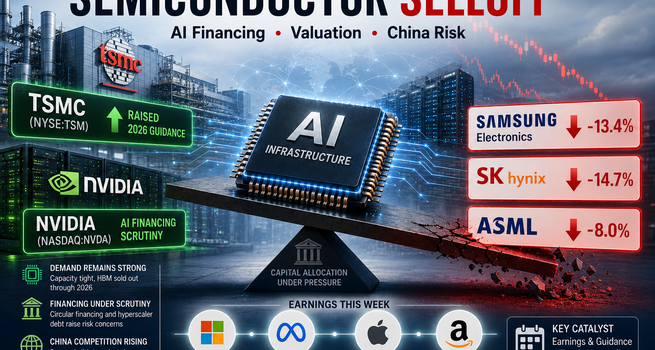
- Global semiconductor stocks recorded their steepest monthly decline since 2022 after a circuit-breaker halt on South Korea's KOSPI index.
- A reported 250 billion dollar Nvidia financing guarantee for OpenAI has intensified scrutiny of capital allocation across the AI supply chain.
- China's move into domestic lithography equipment production introduced a new competitive and regulatory risk factor for Western chip toolmakers.
- TSMC and ASML raised 2026 capital expenditure and revenue guidance even as broader investor sentiment toward the sector weakened.
- Earnings from Microsoft, Meta, Apple and Amazon this week will test whether AI infrastructure spending is converting into sustainable growth outlook.
A Correction Rooted In Financing, Not Demand
The global semiconductor rally has entered its first genuine test since the artificial intelligence investment cycle began in earnest three years ago. The MSCI World Semiconductor Index is on track for its worst monthly performance since 2022, having declined by roughly 13 percent this month while still holding a year-to-date gain of about 33 percent.
The scale of the pullback matters less than its source. Unlike earlier semiconductor downturns, this one is not being driven by a collapse in chip demand. It is being driven by questions over how the current wave of artificial intelligence infrastructure spending is financed, and whether the returns on that spending can keep pace with the capital being committed to it.
The Seoul Circuit Breaker: Anatomy Of The Selloff
The correction reached its sharpest point on 28 July, when South Korea's KOSPI index fell as much as 11 percent intraday before closing down 10.84 percent. The Korea Exchange activated a market-wide circuit breaker, halting trading for 20 minutes, the eighth such activation in 2026 alone. Samsung Electronics and SK Hynix (NASDAQ:SKHY), which together account for roughly half of the index's market weight, fell 13.4 percent and 14.7 percent respectively, with Kioxia falling more than 18 percent. The selloff extended into Japan, where the Nikkei 225 fell 3.95 percent to its lowest level since May, and into Taiwan's chip-heavy benchmark.
South Korea's equity market has now triggered more sidecar and circuit-breaker halts in 2026 than in any year since the 2008 financial crisis, a reflection of how concentrated the index has become around a small number of memory chip producers central to global AI infrastructure.
Three Pressure Points Behind The Reversal
Three separate developments converged to trigger the latest leg down, spanning financing structure, competitive positioning and system-wide leverage.
Circular Financing Comes Under The Microscope
The first is a reported financing arrangement between Nvidia (NASDAQ:NVDA) and OpenAI. Reports that Nvidia is negotiating a guarantee worth roughly 250 billion dollars to support a data centre lease in Ohio, tied to OpenAI, have drawn particular scrutiny. The arrangement would cover construction and lease financing for a 10-gigawatt campus being developed by a SoftBank energy subsidiary, separate from a reported additional financing discussion worth up to 350 billion dollars covering chip purchases. The combined project could eventually cost more than 500 billion dollars.
Because the AI developer does not carry an investment-grade credit rating, the structure would allow lenders to price debt against the chipmaker's balance sheet rather than the borrower's own credit profile. The talks remain preliminary and unconfirmed by either party, but the scale has reinforced concern that capital allocation across chipmakers, hyperscalers and AI developers is becoming increasingly circular, with each party's revenue and creditworthiness dependent on continued investment from the others.
China's Lithography Breakthrough Reshapes The Equipment Supply Chain
The second is a competitive shock from China's chip equipment industry. Reports emerged on 27 July that a Shanghai state-backed consortium had begun mass production of domestic immersion deep ultraviolet lithography systems, with plans to deliver approximately five units in 2026 and around 20 in 2027 to domestic chipmakers. Shares in ASML Holding (NASDAQ:ASML), the Dutch lithography equipment maker, fell as much as 8 percent on the news, erasing close to 44 billion dollars in market value in a single session.
The reaction should be read with some caution. The Chinese systems reportedly remain a generation behind the extreme ultraviolet technology in which the Dutch equipment maker retains an effective monopoly, and the initial production volumes are small relative to an estimated 130 immersion DUV units it plans to ship globally this year. The market response reflects a longer-term repricing of competitive risk in China's mature-node chip market rather than an immediate threat to near-term revenue.
Hyperscaler Debt And The Economics Of The AI Buildout
The third and most structural concern relates to how the broader AI infrastructure buildout is being funded. In its 2026 Annual Economic Report, the Bank for International Settlements named a potential downturn in AI-related capital expenditure, alongside circular financing arrangements, among the principal risks to global financial stability. The report noted that the five largest hyperscalers are on pace to spend more than 1 trillion dollars combined on AI-related capital expenditure across 2025 and 2026, with capital spending now estimated to absorb roughly 94 percent of their operating cash flow this year.
Technology companies issued a record 428 billion dollars in bonds during 2025 to help fund infrastructure commitments, and market estimates point to as much as 1.5 trillion dollars in additional debt issuance over the coming years. None of this indicates the spending is unproductive. It does, however, raise the threshold for how much revenue growth the underlying AI applications must eventually generate to justify the liquidity being committed to them.
Supplier Guidance Points In The Opposite Direction
Set against this anxiety is a body of evidence from the equipment and foundry side of the industry that has, so far, not weakened. Taiwan Semiconductor Manufacturing Company (NYSE:TSM) reported record second-quarter results in mid-July, with revenue up 36 percent year on year and profit up 77 percent. The company raised its 2026 capital expenditure guidance to a range of 60 to 64 billion dollars, from 52 to 56 billion dollars previously, and lifted its full-year revenue growth outlook to slightly above 40 percent. It also committed an additional 100 billion dollars to its Arizona manufacturing operations.
The Dutch equipment maker separately raised its 2026 revenue guidance for the second time this year, to a range of 43 to 45 billion euros, citing strong order intake tied to artificial intelligence demand. High-bandwidth memory, the segment most directly tied to AI infrastructure, remains largely sold out through 2026 according to industry supply data, suggesting the current bottleneck is capacity rather than demand.
Balancing The Risks
The interpretation of this correction depends on which set of data points is given more weight. Supplier capital expenditure guidance, order intake and memory pricing all continue to point toward sustained demand. Financing structures, hyperscaler leverage and valuation multiples built during an exceptional rally point toward a market that had priced in a benign outcome for the AI investment cycle without fully accounting for the debt and counterparty risk required to fund it.
Both readings remain plausible at this stage. What resolves the question in the near term is less likely to be further commentary on financing structures than hard evidence, from the companies actually spending the capital, of whether that spending is converting into revenue.
The Earnings Window That Could Settle The Debate
That evidence arrives within days. Microsoft (NASDAQ:MSFT) and Meta Platforms (NASDAQ:META) are scheduled to report second-quarter results on 29 July, followed by Apple (NASDAQ:AAPL) and Amazon (NASDAQ:AMZN) on 30 July. Collectively, the four companies are pacing toward capital expenditure well above 700 billion dollars for 2026.
For Microsoft, the focus will fall on Azure's cloud growth rate relative to a guided range of roughly 36 to 40 percent. For Meta, investors will examine advertising revenue growth alongside the return profile of its expanding data centre investment. The outcome of this earnings window is likely to carry more weight for semiconductor valuations in the near term than either the financing headlines or the competitive developments from China, since it offers the clearest available evidence of whether AI infrastructure spending is converting into revenue growth that can be measured today.
This article is for informational purposes only and does not constitute financial advice. Please consult a licensed financial adviser before making investment decisions.


 Nov 10, 2026





 Please wait processing your request...