
 CA
 NZ
 UK
 AU
 IND

 US

 Share
 X (Formerly Twitter)
 Whatsapp
 Facebook
 LinkedIn
 Telegram
 Email This Article
 Copy Link
 Summarize with AI
 Chat GPT
 Perplexity
Key Highlights
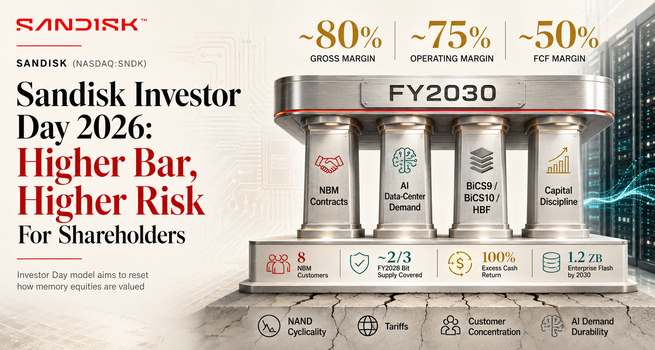
- Sandisk has laid out a FY2028 to FY2030 financial model targeting non-GAAP gross margins near 80 percent and operating margins near 75 percent.
- New Business Model agreements with eight customers now cover roughly two-thirds of bit Supply for fiscal 2028, reducing exposure to spot pricing volatility.
- The company has committed to returning 100 percent of excess cash to shareholders after funding operational investment.
- Enterprise Data Center flash Demand is projected to expand to 1.2 zettabytes by 2030, anchored in AI inference workloads.
- The strategy arrives against a backdrop of new Section 301 tariffs affecting core semiconductor supply chain regions.
A Structural Reset, Not a Cyclical Rebound
Sandisk's (NASDAQ:SNDK) 2026 Investor Day, branded "In Focus," was less a product showcase than an attempt to redefine how the market should price memory equities. Chief executive David Goeckeler framed the announcement as the culmination of an 18-month execution plan, and the financial architecture unveiled by chief financial officer Luis Visoso reflects an explicit effort to decouple Sandisk's Earnings profile from the boom-bust pricing cycles that have historically defined NAND flash.
The headline figures are notable less for their scale than for their durability. Revenue growth in the mid-to-high teens through fiscal 2030, non-GAAP gross margins near 80 percent, and adjusted free Cash Flow margins of approximately 50 percent would place Sandisk's profitability profile closer to a logic semiconductor company than a Commodity memory manufacturer. Operating expenses are modeled at roughly 5 percent of revenue, a structure that assumes limited need for reinvestment relative to the cash the business generates.
New Business Model Agreements as the Mechanism of Stability
The credibility of any multi-year Margin target in a historically cyclical industry rests on demand visibility, and this is where Sandisk's New Business Model, or NBM, agreements become the operative variable. The company has signed NBMs with eight customers, representing approximately 50 percent of bits in fiscal 2027 and approximately two-thirds of bits in fiscal 2028. These are not conventional supply contracts. They embed committed volumes, minimum financial guarantees, and structured pricing mechanisms, which collectively shift a portion of demand risk away from Sandisk and onto its counterparties.
This matters for how investors should interpret capacity discipline going forward. Sandisk has indicated it will selectively reduce wafer output during technology node transitions rather than flood the market with bits, a practice that historically triggered price collapses across the NAND sector. With average bit growth of 54 percent recorded across prior technology node changes, the company retains latitude to manage supply without sacrificing the underlying efficiency curve. Whether this contractual model scales across the remainder of Sandisk's customer base, and whether counterparties honor guarantees during a demand downturn, remains the central unresolved question for the model's credibility.
Technology Roadmap Underpins the Margin Case
Sandisk's technical announcements were positioned explicitly in service of the margin targets rather than as standalone innovation claims. The company introduced BiCS9 QLC technology, which pairs a proven BiCS8 array with a BiCS10-based CMOS wafer, and detailed a forthcoming BiCS10 QLC node projected to deliver a 60 percent increase in bit density relative to BiCS8. Both are built on CMOS directly Bonded to Array technology, which Sandisk describes as a two-dimensional scaling strategy allowing custom Derivatives to be produced without proportional increases in capital expenditure.
The company also pointed to High Bandwidth Flash, or HBF, as an emerging category addressing the memory hierarchy pressures created by AI inference workloads, where key-value cache demands are reshaping how data centers architect storage. Sandisk's total addressable market projection of 1.2 zettabytes for enterprise data center flash by 2030 is the demand assumption underlying the entire financial framework, and it depends heavily on AI infrastructure buildout continuing at its current trajectory.
Capital Return Commitment Raises the Governance Bar
Perhaps the most consequential line in Visoso's presentation was the commitment to return 100 percent of excess cash to shareholders after business Investment needs are met. This is a materially more aggressive capital return posture than is typical in a capital-intensive semiconductor Manufacturing business, and it signals that Sandisk's management views the current expansion phase as largely funded, with future Capital Expenditure needs expected to be modest relative to free cash flow generation.
For institutional investors evaluating capital allocation discipline, this commitment functions as a governance signal as much as a financial one. It suggests confidence that the NBM-driven demand visibility reduces the need for precautionary Balance Sheet buildup, a assumption that will be tested during the first meaningful downturn in AI-related storage demand.
Macroeconomic and Regulatory Context
The Investor Day announcement does not exist in isolation from broader trade policy developments. The United States has recently imposed Section 301 tariffs ranging from 10 to 12.5 percent on 60 trading partners, including Taiwan and South Korea, regions central to the global semiconductor supply chain. Sandisk's manufacturing relationships, including its Partnership with Kioxia Corporation and joint production activity at the Kitakami Facility in Japan, mean that Tariff exposure across specialty chemicals, wafers, and outsourced assembly and test capacity is a relevant risk Factor for the margin assumptions embedded in the FY2030 model.
Regulatory filings also note that Sandisk's forward guidance carries the standard caveats associated with forward-looking statements, including risks tied to trade policy, customer concentration, and technology transition execution. Investors weighing the durability of the 80 percent gross margin target should treat it as a structural aspiration underpinned by contractual demand commitments, not a guarantee independent of macroeconomic conditions.
The Bar Sandisk Has Set for Itself
Sandisk's 2026 Investor Day represents an attempt to institutionalize demand stability in a sector defined by its absence. The combination of long-term customer agreements, disciplined wafer output management, and a technology roadmap oriented toward AI-driven density gains gives the FY2028 through FY2030 financial model more structural grounding than typical memory sector guidance. Whether this framework proves durable will depend on customer adherence to NBM commitments during the next industry downturn, and on how tariff-related cost pressures interact with a margin structure that leaves comparatively little room for absorption.


 Nov 09, 2026





 Please wait processing your request...