
 CA
 NZ
 UK
 AU
 IND

 US

 Share
 X (Formerly Twitter)
 Whatsapp
 Facebook
 LinkedIn
 Telegram
 Email This Article
 Copy Link
 Summarize with AI
 Chat GPT
 Perplexity
Key Highlights
- Rigetti Computing (NASDAQ: RGTI) could benefit indirectly from Quantinuum's (NASDAQ: QNT) IPO, which has renewed investor interest in the quantum computing sector and strengthened confidence in its long-term commercial potential.
- Despite the sector enthusiasm, Rigetti stock is down 30.7% year-to-date, making it the weakest performer among major pure-play quantum computing companies, including IonQ (NYSE: IONQ), D-Wave Quantum (NYSE: QBTS), and Quantum Computing Inc. (NASDAQ: QUBT).
- The company continues to expand its commercial footprint through Rigetti Quantum Cloud Services, Amazon Braket, Microsoft Azure Quantum, and qBraid, while additional revenue is expected from Novera system shipments and the C-DAC deployment.
- Rigetti recently launched its 108-qubit Cepheus-1 quantum system and remains on track with its roadmap to reach approximately 1,000 qubits with 99.9% two-qubit gate fidelity within the next three years.
- The company maintains a debt-free balance sheet, providing financial flexibility as it continues investing heavily in research and development.
- First-quarter 2026 revenue increased to $4.4 million, driven primarily by government-funded projects and quantum system deliveries, though commercial adoption remains in its early stages.
- Rigetti reported an operating loss of $26 million in Q1 2026, highlighting that profitability remains several years away as the company prioritizes technology development.
- Valuation remains a concern, with the stock trading at a price-to-book ratio of 8.75x, well above the industry average of 4.88x, a level that earns the stock a poor grade on traditional value metrics.
- Consensus forecasts call for 257.3% revenue growth in 2026, while losses are expected to narrow significantly as commercialization gradually improves.
- Although Quantinuum's (NASDAQ: QNT) IPO has boosted sentiment across the quantum computing industry, it does not materially change Rigetti's near-term fundamentals, and investors remain focused on commercial execution and customer adoption.
- Prevailing analyst sentiment leans toward a Hold-equivalent stance, suggesting existing shareholders maintain positions while monitoring upcoming technology milestones, commercialization progress, and enterprise customer growth.
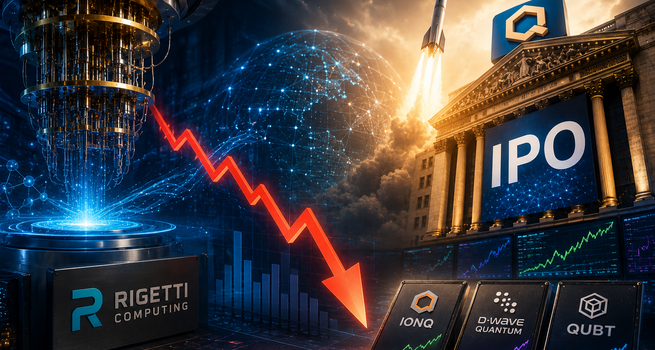
Quantinuum's (NASDAQ: QNT) long-delayed public listing has done something that months of technical progress across the quantum computing industry had struggled to achieve on its own: it put the entire sector back on growth investors' radar. For Rigetti Computing (NASDAQ: RGTI), one of a small handful of pure-play, publicly traded quantum companies, the timing raises an obvious question. Does a rival's IPO actually change anything about Rigetti's own business, or is this simply borrowed enthusiasm arriving at a moment when the stock badly needed some?
A Rough Year, Even Among Rough Peers
Context matters here, and Rigetti's (NASDAQ: RGTI) year-to-date price action provides plenty of it. Shares are down 30.7% so far this year, making Rigetti the weakest performer among the four major pure-play quantum computing stocks. IonQ (NYSE: IONQ), by contrast, has actually gained over the same stretch, while Quantum Computing Inc. (NASDAQ: QUBT) and D-Wave Quantum (NYSE: QBTS) have also posted double-digit percentage declines, though somewhat less severe than Rigetti's own.
That gap is worth sitting with. It is one thing for an entire speculative technology category to underperform the broader market during a period of macro caution; it is another for one company within that category to underperform its own direct, equally speculative peers. Rigetti (NASDAQ: RGTI) being the clear laggard among four companies facing similar macro headwinds suggests at least part of this year's decline reflects company-specific concerns, not just sector-wide sentiment.
The Bull Case: An Ecosystem Finally Taking Shape
Quantinuum's (NASDAQ: QNT) IPO matters to Rigetti (NASDAQ: RGTI) indirectly rather than directly. It does not add a dollar of revenue or a single new customer to Rigetti's books. What it does do is reinforce a narrative that quantum computing is shifting from a research curiosity funded largely by grants and government labs into something institutional growth investors are willing to underwrite through public markets. A better-funded, more visible ecosystem tends to accelerate software development, raise enterprise awareness, and encourage more organizations to experiment with quantum tools, even if actual commercial deployment remains years away.
For Rigetti (NASDAQ: RGTI) specifically, that kind of ecosystem tailwind could translate into greater demand for cloud-based quantum access and hybrid classical-quantum computing solutions, areas where the company already has a foothold. Rigetti's systems are accessible through its own Rigetti Quantum Cloud Services, as well as through Amazon Braket, Microsoft Azure Quantum, and qBraid, giving the company multiple existing distribution channels through which curious enterprises and researchers can access its hardware without needing a direct, bespoke relationship.
Beyond distribution, Rigetti (NASDAQ: RGTI) has continued to hit specific technical milestones. The company's 108-qubit Cepheus-1 system represents tangible hardware progress, and management has reiterated a roadmap target of reaching approximately 1,000 qubits with 99.9% two-qubit gate fidelity within roughly three years, alongside continued work on faster gates and chiplet-based scaling to get there. Management also expects additional revenue recognition later this year tied to previously announced Novera system shipments and a deployment with C-DAC. On top of the technology story, Rigetti carries a debt-free balance sheet, a genuinely valuable form of financial flexibility for a company whose commercial revenue remains small and whose path to profitability is still distant.
The Bear Case: Revenue Still Looks Like Grant Funding, Not a Business
Set the roadmap milestones aside, and the revenue picture is where Rigetti's (NASDAQ: RGTI) investment case gets considerably harder to defend. First-quarter 2026 revenue came in at just $4.4 million, driven primarily by Novera QPU shipments and research-related contracts rather than recurring commercial demand. That distinction matters enormously: revenue tied to individual system shipments and government-funded research contracts is inherently lumpy and unpredictable, dependent on the timing of specific deployments and award cycles, rather than the kind of steady, compounding subscription or usage-based revenue that typically underpins a durable growth stock valuation.
Most of Rigetti's (NASDAQ: RGTI) current customers are still using its systems for research, proof-of-concept testing, and algorithm development, not for mission-critical, revenue-generating workloads. That is not a criticism unique to Rigetti; it broadly describes where the entire quantum computing industry sits today. But it does mean that near-term revenue growth is likely to remain uneven, swinging based on whether a large system deployment or government award lands in a given quarter, rather than building predictably.
The cost of pursuing that long roadmap is also real and immediate: Rigetti (NASDAQ: RGTI) posted an operating loss of $26 million in the first quarter alone, reflecting continued heavy investment in research and development. A company burning that much cash against just $4.4 million in quarterly revenue is, by definition, betting heavily on a commercialization timeline that has not yet arrived.
The Valuation Question
Then there is price. Rigetti (NASDAQ: RGTI) currently trades at a price-to-book ratio of 8.75 times, meaningfully above the broader industry average of 4.88 times, a gap wide enough to earn the stock a poor grade on traditional value-oriented screening metrics. A premium of this size means the market is already pricing in a considerable amount of future success, well beyond what the company's current $4.4 million quarterly revenue base and $26 million quarterly loss would otherwise justify on their own. That gap between price and current fundamentals is precisely why a sector-wide sentiment boost, like the one Quantinuum's (NASDAQ: QNT) IPO has provided, can lift a stock like Rigetti even when nothing about its actual business has changed: the stock's price is driven far more by narrative and multiple expansion than by trailing financial results at this stage.
What the Growth Numbers Actually Show
Looking ahead, consensus estimates call for Rigetti's (NASDAQ: RGTI) 2026 revenue to grow 257.3%, an eye-catching figure that reflects both the small base the company is growing from and genuine expected acceleration in system deliveries and contract activity. On profitability, per-share losses are expected to remain negative but improve meaningfully year over year, a narrowing that suggests the path toward eventual profitability, while still distant, is not standing still.
Where the Peer Group Stands
It's worth stepping back to place Rigetti (NASDAQ: RGTI) within the broader pure-play quantum landscape one more time. IonQ (NYSE: IONQ) has emerged as the clear relative outperformer among the group this year, while Quantum Computing Inc. (NASDAQ: QUBT) and D-Wave Quantum (NYSE: QBTS) have each posted their own declines, though not as steep as Rigetti's. Quantinuum (NASDAQ: QNT), now newly public, adds a fifth name to the pure-play quantum conversation, and its arrival is likely to sharpen comparisons across all four incumbents on metrics like qubit count, fidelity, commercial contracts, and balance sheet strength in the months ahead.
Putting It Together
Rigetti's (NASDAQ: RGTI) situation captures a tension that runs through the entire quantum computing sector right now: a company can be executing reasonably well against its own technology roadmap while still carrying a stock price that has run well ahead of its commercial reality. The Cepheus-1 launch, the debt-free balance sheet, and the expanding cloud partnerships are all genuine, credible signs of progress. But revenue remains small, concentrated in lumpy government and shipment-driven contracts, losses remain large, and the stock's valuation already assumes a considerable amount of future success that has not yet shown up in the financial statements.
Quantinuum's (NASDAQ: QNT) IPO changes the emotional temperature around the entire sector without changing any of these specific facts about Rigetti's own business. It is a reminder that investor enthusiasm and business fundamentals can move on entirely different timelines, particularly in a nascent, capital-intensive technology category where the eventual winners are still far from determined. Prevailing sentiment currently leans toward existing shareholders maintaining their positions while closely watching execution against the commercialization roadmap, rather than treating the recent valuation reset as a clear signal to add new exposure. Whether that reset makes the stock more reasonably priced than before, or whether it remains ahead of itself even after this year's decline, is likely to hinge less on sector-wide sentiment events like the Quantinuum listing and more on whether Rigetti's own commercial revenue can begin decoupling from the timing of individual government contracts and system shipments over the next several quarters.


 Nov 10, 2026





 Please wait processing your request...