
 CA
 NZ
 UK
 AU
 IND

 US

 Share
 X (Formerly Twitter)
 Whatsapp
 Facebook
 LinkedIn
 Telegram
 Email This Article
 Copy Link
 Summarize with AI
 Chat GPT
 Perplexity
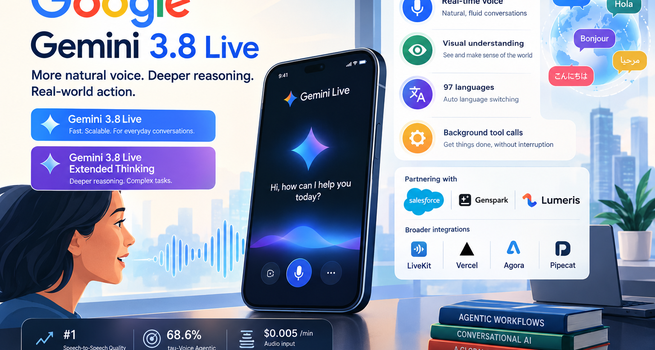
Key Highlights
- Google introduced two new real-time voice models: Gemini 3.8 Live and 3.8 Live Extended Thinking.
- 3.8 Live Extended Thinking ranks #1 on Artificial Analysis' Speech-to-Speech Quality index at 82.6.
- Both models support near real-time visual understanding, automatic switching across 97 languages, and background tool calls without interrupting conversation.
- Google is partnering with Salesforce (NYSE: CRM), Genspark, and Lumeris, alongside broader platform integrations.
Google (NASDAQ: GOOGL) introduced two new real-time voice models, Gemini 3.8 Live and 3.8 Live Extended Thinking, designed for conversational AI and agentic workflows, extending the company's Gemini Live product line toward more capable, tool-using voice assistants.
What Happened
Gemini 3.8 Live is built for scale and lower-cost deployment, positioning it as the model of choice for high-volume, everyday conversational applications where cost per interaction matters more than depth of reasoning. The 3.8 Live Extended Thinking variant adds deeper multi-step reasoning while continuing to speak and narrate progress during longer tasks, meaning the model can talk through its own thought process out loud rather than going silent while it works through a complex request.
Both models support near real-time visual understanding, automatic switching across 97 languages, and background tool and API calls without interrupting the conversation. That combination is aimed squarely at agentic use cases, where a voice assistant needs to look at an image or document, call an external service or database, and keep talking naturally with the user throughout, rather than pausing the conversation each time it needs to complete a task in the background.
Automatic language switching across 97 languages is particularly relevant for global deployments, since it allows a single conversation to shift languages mid-stream if a user does so, without requiring the developer to explicitly configure or restart the session in a new language.
3.8 Live Extended Thinking ranks #1 on Artificial Analysis' Speech-to-Speech Quality Index at 82.6 and scored 68.6% on the tau-Voice agentic task completion benchmark, positioning it as a leading model for voice-based reasoning tasks that require the system to work through multiple steps while remaining conversational. Benchmarks like these are increasingly used across the industry to differentiate voice models not just on how natural they sound, but on how reliably they can complete multi-step tasks end to end.
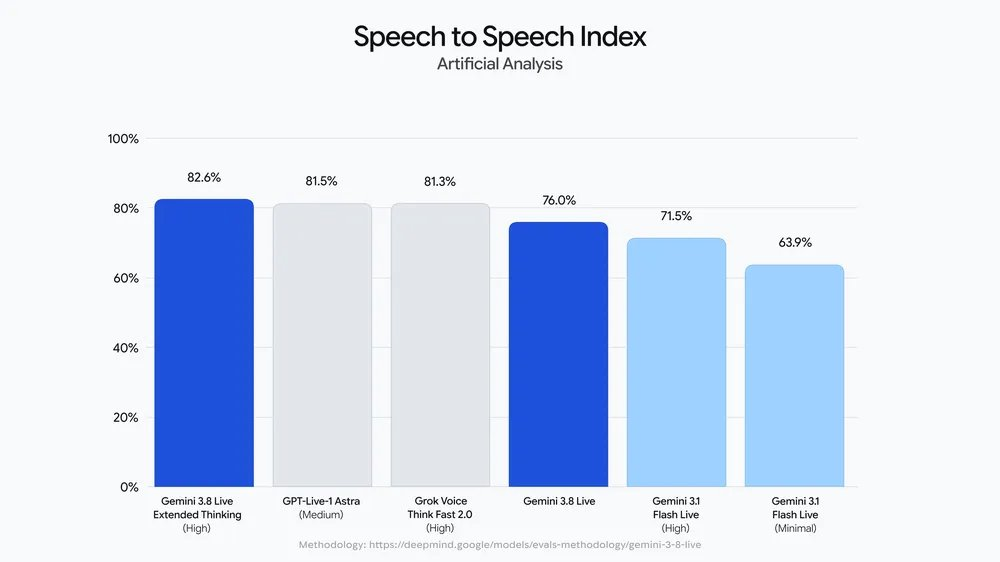
Speech to Speech Index — Artificial Analysis
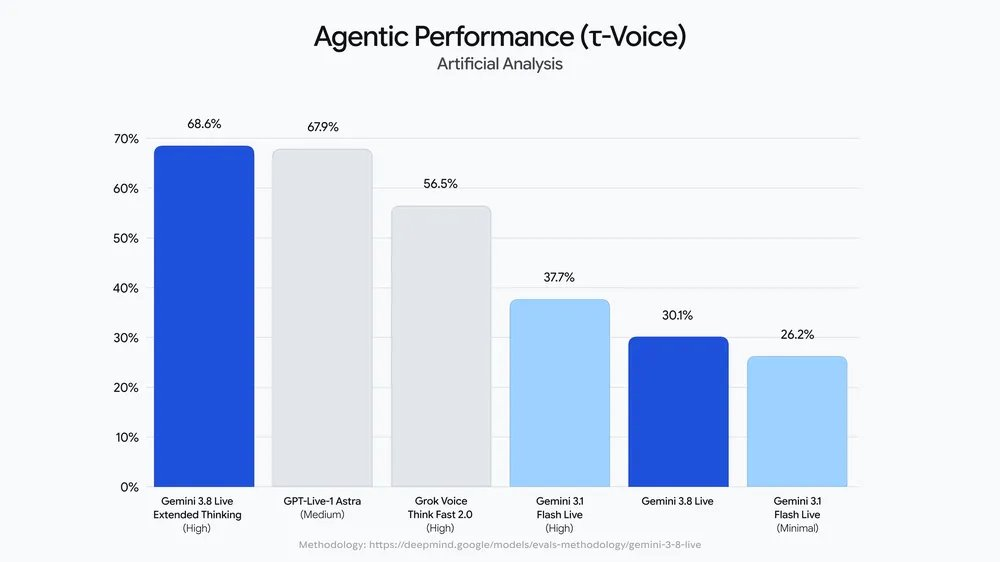
Agentic Performance (τ-Voice) — Artificial Analysis
The ability to narrate progress during longer tasks addresses a common usability problem with earlier generations of voice assistants, where a user asking a complex question would experience an uncomfortable silence while the system processed the request in the background. By having the model speak through its reasoning as it works, Google appears to be targeting a more natural conversational experience for tasks that take longer than a simple question-and-answer exchange, such as planning a multi-step itinerary or working through a troubleshooting process.
Market Reaction
Both models are available through the Gemini Live API at $0.005 per minute for audio input and $0.018 per minute for audio output, a pricing structure aimed at supporting scaled, cost-sensitive deployment across enterprise use cases. Pricing by the minute, rather than by token count as with many text-based models, reflects the continuous, streaming nature of voice interactions, where a conversation can run for an extended period regardless of how much is ultimately said.
Google is partnering with Salesforce (NYSE: CRM), Genspark, and Lumeris on the rollout, while broader integrations span platforms including LiveKit, Vercel, Agora, and Pipecat, extending the models' reach across a wide range of developer and enterprise tooling. The Salesforce Partnership in particular signals an early enterprise use case, since Salesforce's customer relationship management and service platforms are a natural fit for voice agents that can converse with customers while pulling information from backend systems in real time.
The breadth of infrastructure partners, spanning real-time communication platforms like LiveKit and Agora, developer deployment platforms like Vercel, and voice-agent frameworks like Pipecat, suggests Google is positioning Gemini 3.8 Live as infrastructure for third-party developers to build on, rather than a closed, Google-only product experience.
Outlook
Continued adoption of Gemini 3.8 Live and 3.8 Live Extended Thinking across these partner platforms and integrations represents the next relevant development for Google's voice AI strategy, particularly as agentic workflows that combine conversation, reasoning, and tool use become a more central focus across the AI industry.
The distinction Google has drawn between the two models, a lower-cost model built for scale and a more capable model built for deeper reasoning, mirrors a broader pattern across the AI industry of offering tiered models so that developers can match the cost and capability of a given deployment to the complexity of the task at hand, rather than defaulting to the most expensive model for every use case.
Continued benchmark performance, alongside real-world adoption data from partners like Salesforce, is likely to be the clearest signal of whether these new voice models translate into meaningful usage growth for Google's broader Gemini platform.
As competition in conversational and agentic AI intensifies across the industry, the pace at which Google can convert benchmark Leadership into actual developer adoption, particularly through its expanding roster of infrastructure and enterprise partners, is likely to be closely watched in the coming quarters.
Independent Benchmark Validation
Separate third-party testing from ServiceNow's Eva Bench, which measures the tradeoff between conversational experience and task accuracy, placed Gemini 3.8 Live and Gemini 3.8 Live Extended Thinking (minimal) in the upper range of the experience-to-accuracy curve among the voice models evaluated, alongside competing systems such as GPT Realtime 2.1 and configurations combining Scribe Realtime with Claude Haiku 4.5 and Eleven Flash v2.
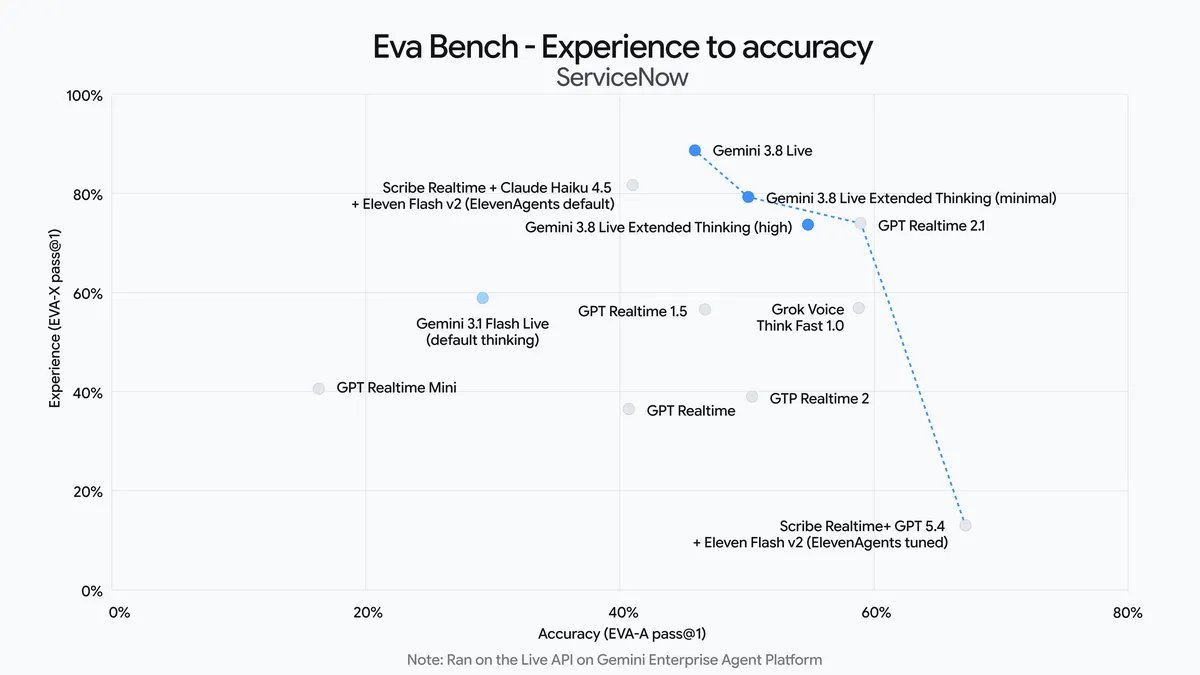
Eva Bench — Experience to Accuracy — ServiceNow. Ran on the Live API on the Gemini Enterprise Agent Platform.


 Nov 10, 2026





 Please wait processing your request...