
 CA
 NZ
 UK
 AU
 IND

 US

 Share
 X (Formerly Twitter)
 Whatsapp
 Facebook
 LinkedIn
 Telegram
 Email This Article
 Copy Link
 Summarize with AI
 Chat GPT
 Perplexity
Apple (NASDAQ: AAPL) closes at $271.06, $3.98T market cap. Apple's on-device AI, services growth & buyback make it 2026's quiet AI compounder. Full equity deep-dive.
Key Highlights
- At $3.98T and a 34x P/E, Apple is the institutional "safe harbor" AI play — down 0.87% on a chip-euphoria day that sent the broader market up 0.80%.
- Apple's two billion+ device installed base is reframed in this report as the most underappreciated AI distribution platform on the planet, ahead of any hyperscaler.
- Services gross margin expansion — not hardware — is the silent engine compounding Apple's multiple, with the buyback acting as a structural bid underneath the stock.
Apple (NASDAQ:AAPL) is the rare global business that operates simultaneously as a hardware giant, a services platform, and a privacy-focused software ecosystem. Its product line — iPhone, iPad, Mac, Watch, AirPods, and the Vision spatial-computing line — is bolted to a deeply entrenched services franchise spanning the App Store, iCloud, Apple Music, Apple TV+, advertising, payments, and a fast-growing licensing book. By 2026, the line between hardware and services is increasingly artificial: the device is the funnel, and the services compound layered on top are where investors price the long-duration earnings stream.
What makes Apple different from every other megacap is the discipline of its installed base. With more than two billion active devices in the wild and an attach rate to services that keeps rising, Apple has built the closest thing in technology to an annuity that also happens to ship a new flagship every fall. That installed base is the most underappreciated AI distribution platform on the planet — and 2026 is the year that began to show up in the financials.
Stock Performance in 2026 (YTD)
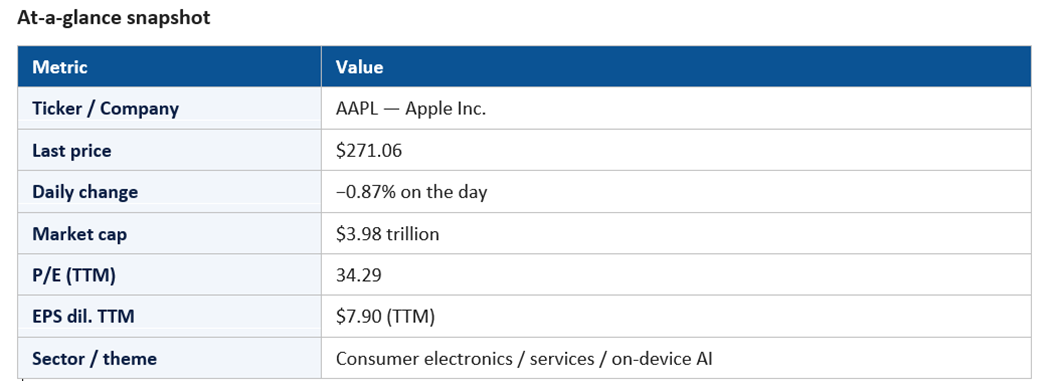
AAPL is trading at $271.06 with a market capitalization of $3.98 trillion, a hair below the symbolic $4T mark. The April 24 close was a 0.87% pullback on a session in which the broader market rallied 0.80% and the chip complex went vertical. That rotation tells a story: on days when AI-infrastructure speculation surges, investors rotate out of Apple's defensive-growth posture and into the higher-beta semis. On days when the macro turns nervous, the same flow reverses.
At a P/E of 34.29 on $7.90 of TTM diluted earnings, Apple trades at a clear premium to the historical megacap average but at a discount to the AI hyper-growth cohort. That mid-position is precisely what many institutional allocators want from Apple in 2026: enough exposure to the AI on-device theme to participate, with cash flows durable enough to anchor a portfolio that has otherwise become very NVIDIA-shaped.
The implied YTD performance has been characterized by less drama than the market cap suggests. Apple has been the steady compounder underneath a much louder narrative tape — and that may be exactly the point.
Key Price Movements and Milestones
Three milestones define the 2026 tape. First, the persistent grind toward — but not yet through — the $4 trillion threshold. The line has functioned as a magnet and a ceiling, with multiple sessions delivering brief pierces followed by mean reversion. Second, Apple's relative trade against the AI semis has tightened: when the basket led by NVIDIA, AMD, and Micron rallies hard, Apple sells off mildly, and vice versa. That negative correlation is a regime-defining feature of 2026 portfolio construction.
Third, services-revenue confirmation prints have been the quiet kingmaker. Each disclosure cycle that confirms double-digit services growth has supported the multiple. Without that print, Apple's hardware-only narrative would face a meaningfully tougher market.
Major Catalysts: Why the Stock Moved
Apple Intelligence — the on-device and private-cloud AI stack — is the dominant 2026 catalyst. The pitch is simple and powerful: AI that runs locally on a top-of-stack device, hits the cloud only when needed, preserves user privacy by default, and is integrated with the apps users already live inside. Investors care less about benchmark scores than about whether this drives faster device upgrades, higher services attach, and a new App Store revenue layer from AI-native applications.
The second catalyst is the iPhone replacement cycle. The installed base is older than at any point in the last decade, and an AI-driven upgrade reason — paired with hardware that requires the latest silicon to run on-device models — is precisely the kind of forcing function Apple's revenue model thrives on. Every percentage point of pull-forward in the upgrade cycle materially shifts the next four quarters of revenue.
Macro and Fed-rate dynamics matter at the margin. Apple is duration-sensitive in theory — a high-multiple, long-cash-flow stock — but in 2026 it has behaved more like a defensive megacap whose risk is consumer slowdown, not rate sensitivity. Geopolitics, particularly the China supply chain and India ramp, remain a steady undercurrent rather than a single dramatic catalyst.
Sector Trends Influencing the Stock
Three sector shifts are working in Apple's favor. The first is the consumer-electronics consolidation: premium smartphones have become a stable oligopoly, and Apple's ecosystem lock-in is tighter than at any time in its history. The second is the move of AI from training to on-device inference. Apple silicon — A-series and M-series — is architected for exactly this, and the company has spent a decade quietly investing in neural engines, custom memory hierarchies, and unified memory designs that pay off precisely now.
The third is the services-economy tailwind. As more users do more things through their device — pay, stream, message, browse, search, buy — the services ARPU rises and the operating margin profile of the segment expands. Services in 2026 is not just a revenue line; it is the reason analysts can defend a 34x multiple on an old hardware franchise.
Competitive Positioning
Apple's competitive position in 2026 is curiously asymmetric. Against Android, it is taking premium share globally and consolidating mind-share at the top of the market. Against the cloud-AI giants — Microsoft, Google, Amazon — it is not competing for hyperscaler infrastructure dollars but for end-user moments. Apple's bet is that a meaningful share of consumer AI interactions will happen on the device, in the moment, with the model the user already trusts. That bet does not require Apple to win the model race; it requires Apple to win the distribution race.
Against Meta and the emerging spatial-computing field, Apple is playing a longer game. Vision Pro and its successors remain a small revenue line but a strategic option on the next computing platform. The Vision line in 2026 is best understood as R&D in production, not a near-term P&L driver.
The most underrated competitive advantage is the App Store as a distribution monopoly for paid AI applications. Even if developers build models with OpenAI, Anthropic, Google, or open-source weights, the consumer entry point remains the App Store, which means Apple participates in the economics regardless of who wins the model war.
Financial Highlights
TTM diluted EPS of $7.90 against a $271.06 share price gives Apple a P/E of 34.29. The bullish way to read the multiple is that Apple now belongs in the AI cohort and is being priced accordingly while still delivering sub-AI hyper-growth. The bearish way is that 34x earnings is rich for a company whose hardware revenue line is mature.
Free cash flow generation continues to be the financial bedrock. Apple converts revenue into cash at a rate few global businesses match, and it returns that cash through one of the largest buyback programs in market history. In a year when allocators are skittish about valuation extremes, the buyback is itself a kind of put underneath the stock — a structural bid that absorbs supply during weak tape.
Gross margin trajectory is the line item that quietly supports the multiple. Services gross margin sits well above hardware gross margin, and as the services share of total revenue grows, the consolidated margin profile drifts higher. That is the slow, boring math that has powered Apple's compounding for a decade.
Key Risks and Challenges
Three risks dominate the 2026 narrative. First is the China supply chain and end-market. Manufacturing diversification into India and Vietnam is real but partial, and any escalation in cross-strait tensions or U.S.-China tariff dynamics directly hits Apple's cost base and revenue base. Second is regulatory pressure on the App Store, both in Europe under the Digital Markets Act regime and in the U.S. through ongoing antitrust scrutiny. Forced changes to App Store economics could meaningfully compress services margin growth.
Third is the AI-narrative risk. Apple has chosen privacy-preserving, on-device-first AI over the more flamboyant cloud-AI demos that drive headlines. That is the right strategic posture for the brand, but it is a slow-burn marketing story in a market that often rewards spectacle. If on-device AI fails to drive the upgrade cycle the bull case requires, the multiple is exposed.
Institutional and Investor Sentiment
Apple in 2026 is the maximum-overweight that no one apologizes for. Long-only mutual funds, sovereign-wealth allocators, retail platforms, and index funds all carry outsized positions, and the structural bid from buybacks adds a permanent layer of demand. Sell-side opinion has gradually warmed on Apple Intelligence, with the constructive view increasingly framed around the upgrade cycle rather than near-term AI feature parity.
The options-market posture into earnings has been notably calmer than for the AI hyper-growth cohort, with implied volatility skew suggesting investors are willing to pay for downside protection but are not panicking about it. That is consistent with a stock the market has decided is core to a 2026 portfolio.
Signals to Watch in the Coming Quarters
Five concrete signals will define how the Apple narrative evolves through the rest of 2026. The first is iPhone unit and revenue growth, with particular attention to mix-shift toward Pro and AI-capable models. Each quarterly print that demonstrates AI-driven upgrade behavior — measured through unit growth, ASP, and replacement-cycle commentary — supports the bull case.
The second signal is services revenue and gross margin. The market expects sustained double-digit services growth and incremental margin expansion. Any deceleration, particularly in App Store revenue or in advertising, would be a meaningful narrative event given the disproportionate role services plays in defending the consolidated multiple.
The third signal is China revenue. Greater China remains a sensitive geography, and quarterly performance there is a multi-variable read on local consumer health, competitive dynamics versus domestic OEMs, and any geopolitical overhang on demand or supply.
The fourth signal is Apple Intelligence engagement. Disclosed metrics — even directional commentary — on usage of on-device AI features, developer adoption of the AI app frameworks, and consumer behavioral changes will determine whether the narrative shifts from feature rollout to platform monetization.
The fifth signal is capital return cadence. The pace of buybacks and any dividend increases continue to be a structural support to the equity story, and any change in cadence would be parsed carefully as a signal about management's view of valuation and free cash flow.
Outlook for the Rest of 2026
The base case for the rest of 2026 is steady: services keep compounding double digits, hardware grows mid-single digits with help from a refreshed AI-capable device lineup, gross margin grinds higher, and the buyback continues to do its quiet work. In that scenario, $4 trillion is decisively cleared and the conversation shifts to what a $4.5T Apple needs to deliver to defend the multiple.
The bear case is a consumer slowdown plus regulatory damage to the App Store, which would simultaneously hit hardware volume and compress the highest-margin part of services. That combination is the one the bears keep waiting for; it has not yet arrived in scale.
Apple in 2026 is doing what Apple has always done at scale: monetizing patience. The market mistakes that for missing the moment. It rarely is.
For now, the tape says Apple is the calm in the AI storm. A 0.87% down day on a session of chip euphoria is exactly the rotation pattern that has defined this market — and exactly the reason long-term holders haven't moved an inch.


 Nov 01, 2026





 Please wait processing your request...