
 AU
AU
 UK
UK
 CA
CA
 NZ
NZ
 IND
IND

 US
US

 Share
Share
 X (Formerly Twitter)
 Whatsapp
 Facebook
 LinkedIn
 Telegram
 Email This Article
 Copy Link
 Summarize with AI
 Chat GPT
 Perplexity
IBM secures $1 billion, GlobalFoundries receives $375 million, and D-Wave, Rigetti and IonQ join a widening federal commitment to quantum supremacy — sending the entire sector sharply higher
$IBM $GFS $IONQ $QBTS $RGTI
Key Highlights
- $2bn federal quantum package announced — Trump Administration takes Equity stakes in return, per WSJ
- IBM receives $1bn — the largest single allocation, cementing Big Blue's position as the federal quantum anchor
- GlobalFoundries ($GFS) gets $375mn — chip Manufacturing capacity earmarked for quantum hardware production
- D-Wave ($QBTS), Rigetti ($RGTI) and Infleqtion — public names among recipients of $100mn allocations each
- Diraq receives $38mn — startup quantum firm secures smallest but strategically notable allocation
- IonQ ($IONQ) surges 8–13% intraday — sector momentum lifts entire quantum cohort on announcement
- AI-to-quantum narrative accelerating — investors treating quantum as the next frontier after AI infrastructure
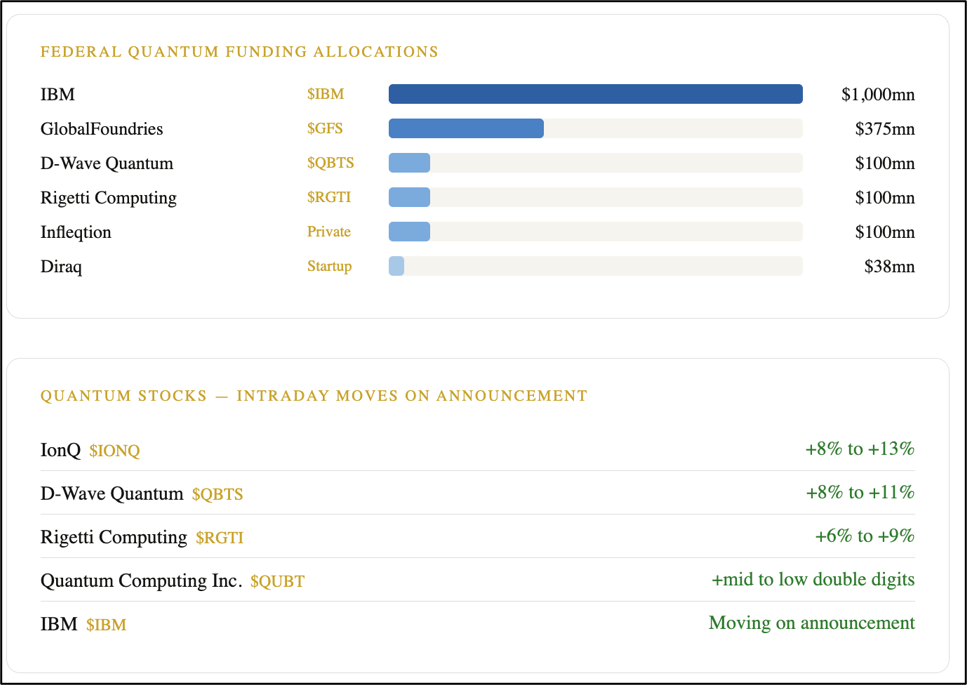
The Trump Administration has committed $2 billion to Quantum Computing companies in exchange for equity stakes, according to the Wall Street Journal, in a federal technology Investment that represents the most significant government intervention in the quantum computing sector to date and sent shares across the entire industry sharply higher on Wednesday.
The package, structured as direct investment with the government receiving ownership stakes in return, allocates $1 billion to IBM (NYSE: IBM) — the largest single quantum computing programme among established technology companies — with chip manufacturer GlobalFoundries (Nasdaq: GFS) receiving $375 million for quantum-capable semiconductor fabrication capacity. The remaining recipients receive $100 million each, with the exception of startup Diraq, which is slated for $38 million.
The Allocation Logic: Anchors, Enablers and Emerging Players
The structure of the package reveals a deliberate federal strategy: anchor the investment in proven, large-scale operators while distributing smaller tranches across the emerging quantum hardware ecosystem. IBM's $1 billion allocation reflects its position as the only company currently operating commercial quantum systems at meaningful scale, with its 1,000-plus qubit Condor processor representing the current frontier of gate-based quantum computing. For the federal government, IBM is the lowest-risk bet in a sector defined by technical uncertainty.
GlobalFoundries' $375 million allocation addresses a different constraint: manufacturing. Quantum hardware requires specialised fabrication processes that differ substantially from conventional semiconductor production, and GlobalFoundries' investment is understood to be directed at building domestic capacity for quantum chip production — a Supply chain priority that sits alongside the broader CHIPS Act framework underpinning American semiconductor policy.
The federal government is not merely funding quantum research — it is taking equity. That distinction matters. Ownership implies a commitment to commercialisation, not just capability development.
The $100 million allocations to D-Wave Quantum (NYSE: QBTS) and Rigetti Computing (NASDAQ: RGTI) — both publicly listed — and to Infleqtion represent the Administration's bet on hardware diversity. D-Wave operates annealing-based quantum systems with established commercial customers; Rigetti pursues gate-based superconducting qubit architectures directly competitive with IBM and Google. Funding both signals that the government is not yet prepared to pick a winner within the competing quantum hardware paradigms.
Why Quantum Stocks Are Surging Beyond the Direct Recipients
The market's reaction extended well beyond the named beneficiaries. IonQ (NYSE: IONQ), which was not identified as a direct recipient in initial reports, surged between 8 and 13 per cent intraday. Quantum Computing Inc. (NASDAQ: QUBT) moved by similar magnitudes. The breadth of the rally reflects a dynamic that has become familiar in frontier technology investing: when a government makes a commitment of this scale to an emerging sector, the entire category re-rates, not just the named recipients.
The AI-to-quantum narrative is also providing structural support. Investors who have spent the past two years allocating Capital to AI infrastructure plays — GPU manufacturers, data centre operators, power suppliers — are increasingly treating quantum computing as the logical next frontier. The complementarity is genuine: quantum systems offer potential advantages in optimisation, cryptography, and simulation problems that classical AI hardware cannot efficiently solve. A $2 billion federal commitment, structured with equity rather than grants, significantly advances the perceived timeline to commercialisation.
The Equity Stake Structure: What It Signals
The decision to take equity stakes rather than issue grants is analytically significant and distinguishes this package from prior federal quantum initiatives. Grant funding creates no ownership alignment between the government and the recipient — the public bears the downside if the technology fails to materialise, while private shareholders capture the upside if it succeeds. An equity structure inverts that logic, at least partially, aligning federal financial interest with commercial outcomes.
It also implies a higher bar for recipient selection. Companies receiving equity investment rather than grants have been assessed not merely for their technical capability but for their commercial viability — the government, as a Shareholder, has an interest in the investee generating returns. That implicit endorsement is a form of validation that the market is pricing in real time.
The Risks Investors Should Not Ignore
Quantum computing remains, by any honest assessment, a pre-commercial technology for most applications. The gap between current qubit error rates and the fault-tolerant quantum computing required for transformative commercial applications — cryptography, drug discovery, financial optimisation at scale — is measured in years and potentially decades, not quarters. Federal investment accelerates the timeline but does not guarantee it.
The publicly listed quantum names that have surged on Wednesday's announcement — IonQ, D-Wave, Rigetti, Quantum Computing Inc. — are, without exception, loss-making businesses with revenues that are modest relative to their market capitalisations. The sector has a history of sharp momentum-driven rallies followed by equally sharp corrections as the gap between narrative and near-term financial reality reasserts itself. Investors should treat Wednesday's move as a sentiment and policy catalyst, not a fundamental repricing.
What has changed is the policy backdrop. A $2 billion federal commitment with equity stakes is a structural development — one that reduces the sector's existential funding risk, increases the credibility of the commercialisation timeline, and makes quantum computing an investable theme for a wider range of institutional allocators. The technology still has to deliver. But the government has now placed its bet.
Frequently asked questions
Why is the Trump Administration investing in quantum computing companies?
The investment reflects a strategic priority to maintain US Leadership in quantum computing against competing programmes in China and Europe. By taking equity stakes rather than issuing grants, the Administration is structuring the investment to align government financial interests with commercial outcomes — a departure from prior federal technology funding models.
Which quantum computing stocks are receiving federal funding?
IBM (NYSE: IBM) receives $1 billion, GlobalFoundries (NASDAQ: GFS) receives $375 million, D-Wave Quantum (NYSE: QBTS), Rigetti Computing (NASDAQ: RGTI), and Infleqtion each receive $100 million, and startup Diraq receives $38 million. The total package is $2 billion.
Why is IonQ surging if it is not a named recipient?
Federal investment of this scale re-rates the entire quantum computing sector, not just the direct recipients. IonQ is perceived as a leading pure-play quantum hardware company and benefits from the narrative acceleration that accompanies major policy commitments to the sector. Investors are allocating broadly to quantum exposure, not just to named beneficiaries.
Is this a good time to invest in quantum computing stocks?
Quantum computing stocks are highly speculative and predominantly loss-making. The federal investment reduces existential funding risk and advances the commercialisation narrative, but the underlying technology remains years from large-scale deployment. These stocks are high-risk, high-Volatility instruments suited to risk-tolerant investors with long time horizons. This article does not constitute investment advice.
How does quantum computing relate to the AI investment theme?
Investors increasingly treat quantum computing as a complementary next frontier to AI infrastructure. Quantum systems offer potential advantages in optimisation, cryptography, and simulation problems where classical hardware faces fundamental limits. The AI capex cycle has established a template for large-scale technology infrastructure investment that quantum advocates are now applying to their own sector.
Related topics
quantum computing stocks 2026 Trump quantum investment $IBM $GFS federal funding $IONQ $QBTS $RGTI surge D-Wave Rigetti IonQ quantum computing ETF AI quantum computing federal tech investment 2026.


 Jun 11, 2026
_06_11_2026_12_45_08_746277.jpg)




 Please wait processing your request...