
 CA
 NZ
 UK
 AU
 IND

 US

 Share
 X (Formerly Twitter)
 Whatsapp
 Facebook
 LinkedIn
 Telegram
 Email This Article
 Copy Link
 Summarize with AI
 Chat GPT
 Perplexity
Key Highlights
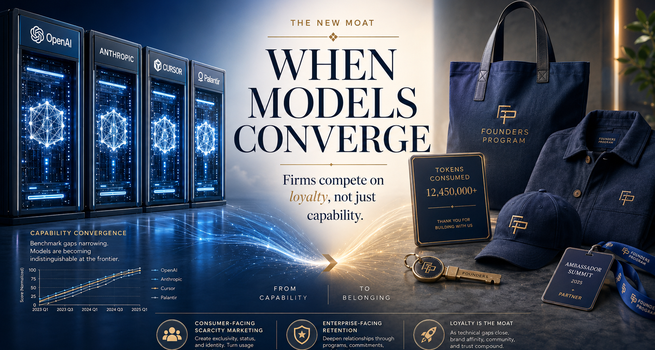
- Benchmark gaps between leading AI models are narrowing, eroding the technical moat that once justified premium positioning.
- OpenAI, Anthropic, Cursor, and Palantir have each turned scarcity into strategy, using limited merchandise and usage-based rewards to signal loyalty.
- The tactic has clear precedent in Apple, IBM, Nike, and Salesforce, all of which built lasting brand equity through scarcity and community merchandise long before AI firms adopted it.
- The strategy splits into two distinct bets: consumer-facing brand signaling and enterprise-facing retention, each with a different risk profile.
- The open question for investors: is this a genuine moat, or a discretionary cost waiting to be cut.
The Moat Is Narrowing
Foundation models no longer differentiate the way they did two years ago. Benchmark scores across leading large language models increasingly cluster together, and falling switching costs mean customers can move between providers with less friction than before. When the underlying product becomes harder to tell apart on capability alone, the traditional software moat, built on technical superiority, starts to erode.
This is a familiar pattern. Cloud infrastructure, mobile operating systems, and enterprise software all passed through similar phases, where core functionality commoditised faster than expected. Each time, incumbents leaned on ecosystem lock-in, developer relationships, and brand affinity to hold their ground. What makes the current AI cycle distinct is speed: the gap between technical leaders and fast followers is closing faster than the capital deployed on the assumption that leadership would last.
The Scarcity Playbook
A cluster of AI firms has responded by borrowing tactics from consumer branding rather than enterprise software. The mechanics are consistent across all of them: constrain supply, tie access to a defined criterion, let visibility do the rest.
OpenAI issues plaques to enterprise customers who cross defined token-consumption thresholds, alongside branded apparel sold through its merchandise arm.
Anthropic has run limited pop-up activations for its Claude product line, offering caps and tote bags that reportedly sell out within hours of appearing on social media.
Cursor has issued small batches of a functional branded key to community members who meet specific participation criteria, such as organising local events.
Palantir Technologies (NASDAQ:PLTR) has sold branded apparel, including a chore coat priced above $250, positioning the item as a lifestyle piece rather than conventional company-branded gear.
Thinking Machines Lab and General Intelligence Company of New York, smaller entrants by comparison, have pursued similar tactics, occasionally drawing scrutiny over design similarity to existing apparel brands.
Not a New Idea
This playbook did not originate in AI. Established technology and consumer companies have used scarcity and community merchandise as a loyalty tool for decades, and the current wave is, in large part, a repackaging of tactics already proven at scale.
Apple (NASDAQ:AAPL) built lasting brand affinity through its "Think Different" campaign and event-exclusive merchandise that became prized collector items among employees and developers well beyond any single product cycle.
IBM (NYSE:IBM) has run branded "Think" merchandise tied to its developer and enterprise community for decades, with some items still produced and sought after today.
Nike (NYSE:NKE), through its Air Jordan and SNKRS release model, pioneered the controlled-scarcity drop mechanics that current AI merchandise strategy closely mirrors, generating resale markets and cultural visibility far beyond the product's retail value.
Salesforce (NYSE:CRM) has used Dreamforce conference merchandise and mascot-branded gear to build informal status symbols within its partner and customer ecosystem, reinforcing loyalty independent of the core software product.
Supreme, a privately held streetwear brand, remains the clearest template for weekly limited drops creating demand and cultural cachet disproportionate to underlying utility, a mechanic AI firms have adapted almost directly.
The consistency across these precedents suggests the current AI merchandise wave is not an isolated experiment but an application of a well-tested mechanism to a new category of technology company.
Two Bets, Two Risk Profiles
This is not one strategy but two, and conflating them obscures how differently each should be judged.
Consumer-facing scarcity marketing trades on visible affiliation rather than the item itself. It borrows directly from streetwear and luxury retail, where constrained supply sustains perceived exclusivity. Its return is difficult to isolate. It behaves like a marketing cost, not a revenue driver, with value expressed indirectly through social visibility, developer mindshare, and recruitment appeal. OpenAI's apparel line, Anthropic's pop-ups, and Palantir's chore coat all sit in this category.
Enterprise-facing retention design works differently. Token-threshold plaques and ambassador tiers are structured around measurable usage, placing them closer to the retention tools already familiar in enterprise software and cloud services. Because they are tied to consumption levels that correlate with customer value, their return can, in principle, be benchmarked against retention and expansion metrics firms already track. OpenAI's token plaques and Cursor's ambassador programme fall here.
One is a bet that brand affinity generates demand. The other is a bet that recognition improves retention among customers already paying. They deserve separate scrutiny, not a single line item labelled "AI merchandise."
Will It Last
Brand-building has compounded into durable advantage before, and the precedents above are the evidence. Apple's and IBM's brand equity, built over years, became a lasting input into pricing power and customer retention, independent of any single generation of product. Nike's drop model turned scarcity into a permanent structural feature of its retail strategy rather than a one-off campaign.
The AI sector has not tested its version of this over a comparable horizon. Scarcity marketing tends to track periods of easy capital and investor enthusiasm, and it is exactly this kind of spend, hard to attribute directly to revenue, that gets cut first when discipline tightens. If funding conditions constrict or unit-economics scrutiny intensifies, consumer-facing brand spend looks more exposed than enterprise-facing retention tools.
There is a second risk closer to home: as more firms copy the same scarcity tactics, the signaling value of any one programme fades. Reports of overlapping merchandise designs across competing AI firms suggest the tactic itself is already converging, echoing the technical convergence it was built to offset.
Conclusion
Brand and loyalty strategy across AI firms looks less like a marketing trend and more like a structural response to narrowing technical differentiation, applying a mechanism that Apple, IBM, Nike, and Salesforce each proved durable in earlier technology cycles. Enterprise-facing retention tools rest on firmer ground, tied to usage metrics firms already track. Consumer-facing scarcity marketing, from Palantir's chore coat to Anthropic's pop-up caps, carries a less tested, less certain return in this specific sector. Whether either becomes a durable layer of competitive advantage, or discretionary spend exposed to the next capital tightening, remains open, and worth watching as the sector matures.


 Nov 05, 2026



 Please wait processing your request...