
 CA
 NZ
 UK
 AU
 IND

 US

 Share
 X (Formerly Twitter)
 Whatsapp
 Facebook
 LinkedIn
 Telegram
 Email This Article
 Copy Link
 Summarize with AI
 Chat GPT
 Perplexity

Key Highlights
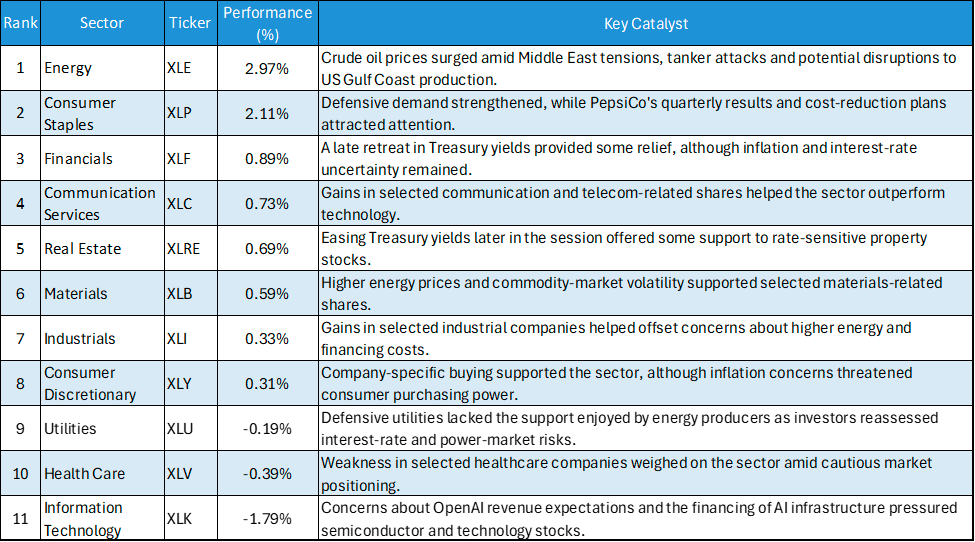
- Energy (XLE) led all eleven major US sectors, gaining 2.97% as rising Crude Oil prices and geopolitical Supply concerns supported energy stocks.
- Consumer Staples (XLP) advanced 2.11%, benefiting from defensive positioning and positive company-specific developments.
- Financials (XLF) rose 0.89%, while Communication Services (XLC) gained 0.73%.
- Real Estate (XLRE) and Materials (XLB) increased 0.69% and 0.59%, respectively.
- Industrials (XLI) and Consumer Discretionary (XLY) posted modest gains of 0.33% and 0.31%.
- Utilities (XLU) slipped 0.19%, while Health Care (XLV) declined 0.39%.
- Information Technology (XLK) was the weakest sector, falling 1.79% as concerns about artificial-intelligence Revenue expectations weighed on semiconductor and technology stocks.
US sector performance on 8 October 2026 reflected a clear rotation toward Energy and defensive consumer companies, while technology stocks faced renewed selling pressure. Rising crude oil prices, geopolitical uncertainty and concerns about Inflation shaped the trading environment. At the same time, doubts surrounding AI-related revenue expectations contributed to weakness in semiconductor shares, leaving the technology sector well behind the broader group of advancing sectors.
Performance Breakdown by Sector
Energy Leads as Oil Prices Surge
Energy was the strongest-performing sector, rising 2.97% as crude oil prices climbed amid renewed geopolitical uncertainty. Reports of attacks on shipping in the Gulf and Strait of Hormuz intensified concerns about the security of oil transportation, while hurricane-related production disruptions in the US Gulf Coast added another potential supply risk.
Higher crude prices can improve revenue expectations for oil producers and strengthen sentiment toward energy companies. However, the benefit is not uniform across the sector, as refiners, transport operators and businesses with substantial energy-input costs may respond differently. The sustainability of Energy's Leadership will therefore depend on whether supply disruptions persist and elevated oil prices translate into stronger Earnings expectations.
Consumer Staples Outperform as Defensive Demand Strengthens
Consumer Staples advanced 2.11%, making it the second-best-performing sector. The gain reflected demand for relatively defensive businesses during a session marked by inflation concerns and pressure on technology shares. PepsiCo also attracted attention following its quarterly results and plans to reduce costs in response to weakness in its North American business.
The sector's advance suggests that investors were seeking companies with established consumer demand and relatively resilient Business models. Nevertheless, higher fuel and transportation costs could eventually pressure household budgets and corporate margins. Continued performance will depend on companies' ability to manage costs while preserving sales volumes and pricing power.
Financials and Rate-Sensitive Sectors Post Modest Gains
Financials gained 0.89%, while Real Estate rose 0.69%. Both sectors were influenced by movements in Treasury yields and expectations for monetary policy. Although rising oil prices initially intensified inflation concerns and pushed yields higher, yields subsequently eased, providing some relief to rate-sensitive shares.
For Financials, the outlook remains mixed. Higher interest rates can support lending margins in some circumstances, but persistent inflation and tighter financial conditions may weaken Loan demand and increase Credit risks. Real Estate faces a similar trade-off because borrowing costs remain important to property valuations, refinancing requirements and Investment activity.
Communication Services and Materials also advanced, gaining 0.73% and 0.59%, respectively. Industrials and Consumer Discretionary recorded smaller increases, indicating that buying interest extended beyond defensive and commodity-linked companies, although cyclical participation remained relatively subdued.
Technology Underperforms as AI Concerns Intensify
Information Technology declined 1.79%, the weakest result among the eleven sectors. Semiconductor stocks faced pressure following reports questioning OpenAI's revenue outlook, raising concerns about the commercial returns from substantial artificial-intelligence investment. Investors also remained sensitive to the amount of Debt required to finance expanding AI infrastructure.
The sell-off highlights the distinction between long-term technological potential and near-term valuation risk. Even when demand for AI computing remains strong, investors may reassess companies' growth assumptions if revenue generation, profitability or financing costs become less favourable. Technology could stabilise if earnings expectations regain support, but further deterioration in AI sentiment may prolong Volatility across semiconductor and high-growth stocks.
Strategic Summary
The 8 October sector performance picture was characterised by a sharp divergence between Energy and Consumer Staples on the positive side and Information Technology on the negative side. Eight sectors advanced, while three declined. Energy's 2.97% gain reflected rising oil prices and supply concerns, whereas Technology's 1.79% loss highlighted renewed scrutiny of AI-related revenue expectations.
The key question for subsequent sessions is whether elevated oil prices continue to support energy producers without intensifying inflation and interest-rate concerns across the wider market. Investors will also watch whether AI-related selling remains concentrated in technology or spreads into other sectors. A sustained improvement in Market Breadth would require participation beyond a small group of commodity-linked and defensive stocks.

 Oct 30, 2026




 Please wait processing your request...