
 CA
 NZ
 UK
 AU
 IND

 US

 Share
 X (Formerly Twitter)
 Whatsapp
 Facebook
 LinkedIn
 Telegram
 Email This Article
 Copy Link
 Summarize with AI
 Chat GPT
 Perplexity

Key Highlights
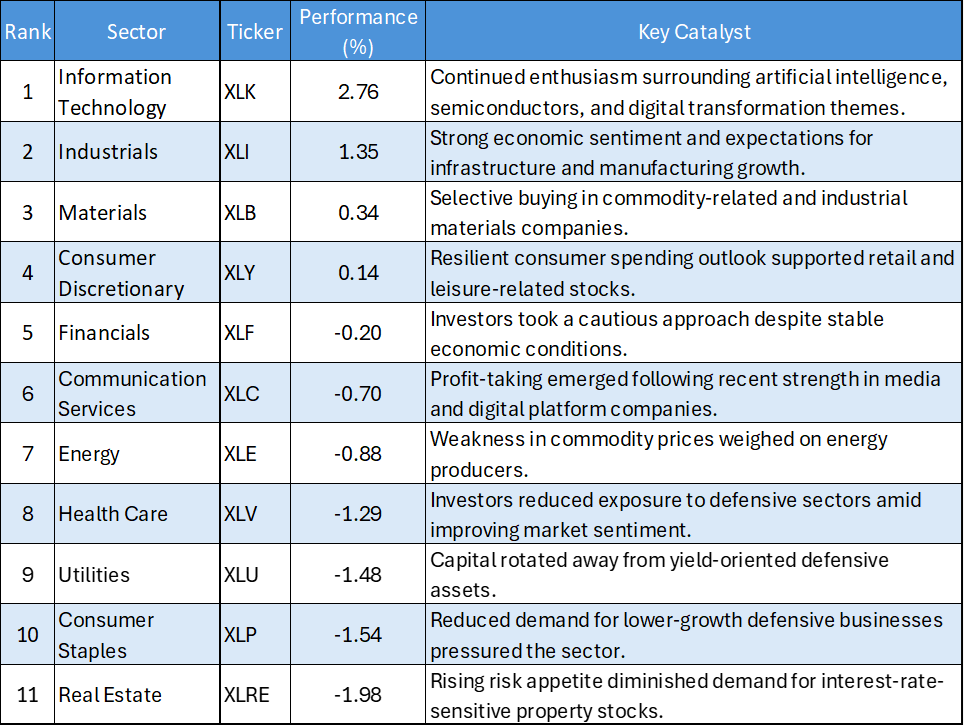
- Technology Dominates Market Leadership: Information Technology (XLK) surged 2.76%, making it the strongest-performing sector as investors continued to favor artificial intelligence, software, and semiconductor-related companies.
- Industrials Extend Gains: Industrials (XLI) advanced 1.35%, supported by improving economic sentiment and expectations for continued infrastructure and capital expenditure growth.
- Materials Remain Positive: Materials (XLB) gained 0.34%, benefiting from selective buying interest in industrial and commodity-linked stocks.
- Broad Weakness Across Defensive Areas: Utilities (XLU), Consumer Staples (XLP), Health Care (XLV), and Real Estate (XLRE) all posted notable declines as investors rotated away from traditionally defensive sectors.
- Real Estate Suffers Largest Decline: Real Estate (XLRE) fell 1.98%, making it the weakest-performing sector of the trading session amid rising risk appetite and reduced demand for interest-rate-sensitive assets.
The US equity market delivered a mixed but growth-oriented performance on June 30, 2026, with investors continuing to favor sectors tied to innovation, economic expansion, and long-term earnings growth. Technology led the market higher, while Industrials and Materials also attracted buying interest. Meanwhile, defensive sectors experienced broad selling pressure as capital rotated toward higher-growth opportunities. The session highlighted investors' ongoing confidence in economic resilience and the transformative potential of emerging technologies.
Daily US Sector Performance Summary
Key Market Themes
Technology Reclaims Market Leadership
- Information Technology (XLK) delivered the strongest performance of the session, climbing 2.76%. The sector continued to benefit from robust investor enthusiasm surrounding artificial intelligence, cloud computing, semiconductor innovation, and enterprise software adoption. Large-cap technology companies once again attracted substantial capital inflows as investors sought exposure to businesses capable of delivering superior earnings growth. The sector's outperformance reinforces its position as one of the primary drivers of the broader market's upward momentum.
Industrials Benefit from Economic Optimism
- Industrials (XLI) gained 1.35%, making it the second-best-performing sector of the day. Investors appeared increasingly confident in the outlook for economic activity, supporting companies involved in manufacturing, transportation, engineering, and infrastructure development. The sector's strength suggests market participants expect business investment and capital spending trends to remain constructive in the months ahead.
Materials and Consumer Discretionary Hold Positive Ground
- Materials (XLB) and Consumer Discretionary (XLY) both finished in positive territory, rising 0.34% and 0.14%, respectively. Materials benefited from selective buying across industrial metals, chemicals, and construction-related businesses, while Consumer Discretionary continued to find support from expectations of resilient household spending. Although gains were modest compared with Technology and Industrials, both sectors demonstrated relative strength compared with the broader market.
Communication Services and Financials Consolidate
- Communication Services (XLC) fell 0.70%, while Financials (XLF) slipped 0.20%. The weakness likely reflected profit-taking following previous gains rather than a significant deterioration in sector fundamentals. Investors remained selective as they balanced growth opportunities against valuation considerations. Financials continued to navigate uncertainty surrounding interest rates and lending conditions, contributing to subdued performance.
Defensive Sectors Fall Out of Favor
- Health Care (XLV), Utilities (XLU), and Consumer Staples (XLP) all experienced significant declines during the session. These traditionally defensive sectors often attract investors during periods of uncertainty, but the market's current risk-on environment reduced their appeal. The broad weakness across defensive industries suggests investors are increasingly willing to embrace sectors offering stronger growth prospects rather than prioritizing stability and dividend income.
Real Estate Faces Heavy Selling Pressure
- Real Estate (XLRE) recorded the largest decline among all sectors, dropping 1.98%. Property-related stocks often face challenges when investors rotate toward higher-growth opportunities, and the sector's sensitivity to interest-rate expectations can amplify selling pressure. The decline indicates market participants currently favor cyclical and technology-oriented investments over income-focused real estate assets.
Bottom Line
The June 30 trading session reinforced the market's preference for growth-oriented sectors, with Technology and Industrials emerging as clear leaders. Continued enthusiasm surrounding artificial intelligence, digital transformation, and economic expansion helped drive gains in these areas, while Materials and Consumer Discretionary also maintained positive momentum.
At the same time, widespread weakness across Real Estate, Consumer Staples, Utilities, and Health Care highlighted a significant rotation away from defensive positioning. If investor confidence in economic growth and technological innovation remains intact, Technology and Industrials may continue to lead market performance. However, the sharp underperformance of defensive sectors suggests market sentiment has become increasingly focused on growth opportunities rather than capital preservation.


 Nov 05, 2026



 Please wait processing your request...