
 CA
 NZ
 UK
 AU
 IND

 US

 Share
 X (Formerly Twitter)
 Whatsapp
 Facebook
 LinkedIn
 Telegram
 Email This Article
 Copy Link
 Summarize with AI
 Chat GPT
 Perplexity

Key Highlights
- Materials (XLB) gained 2.14%, ranking first among all eleven sectors and emerging as the strongest-performing sector.
- Health Care (XLV) advanced 1.29%, while Consumer Discretionary (XLY) gained 1.15%, providing additional support to the market.
- Financials (XLF) and Consumer Staples (XLP) also finished higher, rising 0.93% and 0.79%, respectively.
- Eight of the eleven sectors advanced, while one was unchanged and only two declined, indicating a significant improvement in market breadth.
- Utilities (XLU) fell 2.28%, recording the largest sector decline and becoming the weakest-performing sector.
- Energy (XLE) also declined modestly by 0.17%, while Real Estate (XLRE) finished unchanged.
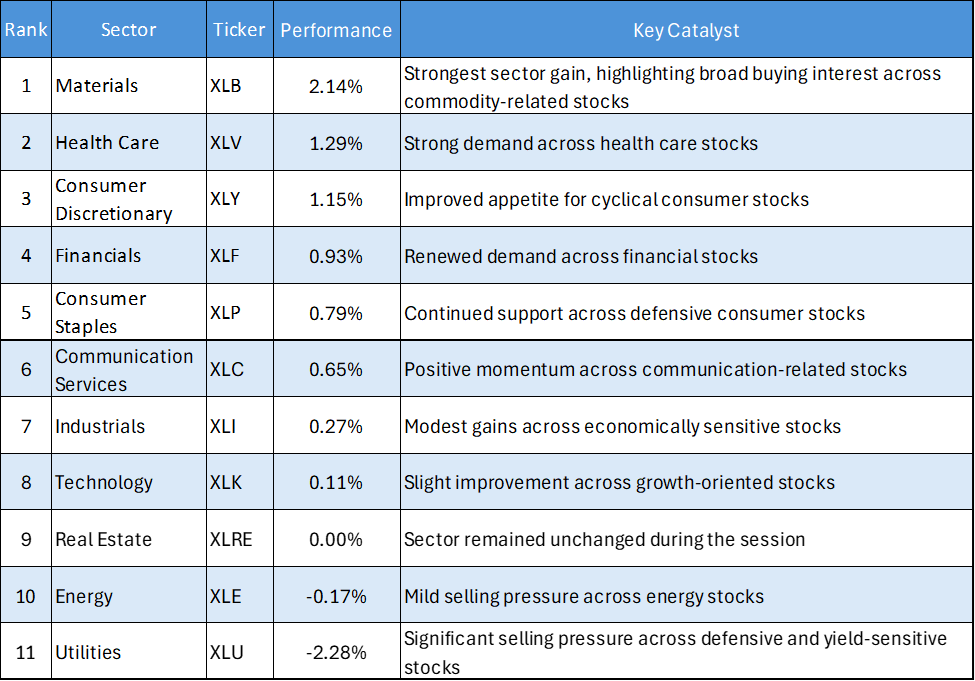
The latest US sector performance data for 21 August 2026 shows a significantly stronger market environment. Materials (XLB) led the eleven sectors with a 2.14% gain, followed by Health Care at 1.29% and Consumer Discretionary at 1.15%.
Market breadth improved substantially, with eight sectors advancing and only two declining. The broad participation across cyclical, defensive and growth-oriented sectors indicates that buying interest was considerably more widespread than in the previous session.
Performance Breakdown by Sector
Materials and Health Care Lead
Materials (XLB) was the strongest-performing sector, gaining 2.14% during the latest session. The sizeable advance placed Materials clearly at the top of the sector performance ranking and indicates strong buying interest across commodity-related stocks.
Health Care (XLV) also advanced 1.29%, ranking second among all eleven sectors. The positive performance provided additional support from a sector that combines defensive characteristics with Long-term Growth exposure.
Consumer Discretionary (XLY) gained 1.15%, highlighting stronger Demand across economically sensitive consumer stocks. The combination of Materials, Health Care and Consumer Discretionary strength indicates that buying interest extended across both cyclical and defensive areas of the market.
Financials and Consumer Sectors Provide Additional Support
Financials (XLF) advanced 0.93%, indicating renewed demand across financial stocks. The gain was accompanied by a 0.79% increase in Consumer Staples (XLP), suggesting that defensive consumer exposures also attracted buying interest.
Communication Services (XLC) gained 0.65%, while Industrials (XLI) advanced 0.27%. Technology (XLK) also finished higher, although its 0.11% gain was relatively modest.
The broad gains across these sectors demonstrate that market strength was not concentrated in a single area. Instead, buying interest extended across financial, consumer, communication, industrial and technology exposures.
Real Estate and Energy Remain Relatively Weak
Real Estate (XLRE) finished unchanged, placing it near the bottom of the performance ranking despite avoiding a decline.
Energy (XLE) fell 0.17%, making it the second-weakest sector. The relatively small decline suggests that selling pressure remained limited compared with the much larger weakness recorded by Utilities.
Utilities (XLU), however, declined sharply by 2.28%, recording the largest sector loss. The significant underperformance contrasts with the broad gains across the other major sectors and indicates substantial selling pressure across defensive and yield-sensitive stocks.
The divergence between Utilities and the broader market is particularly notable. While most sectors recorded gains, Utilities experienced a sizeable decline, suggesting that investors were willing to move away from traditionally defensive and income-oriented exposures during the session.
Strategic Summary
The latest US sector performance data points to a significant improvement in market breadth, with eight of the eleven sectors recording gains. Materials led with a 2.14% advance, followed by Health Care at 1.29% and Consumer Discretionary at 1.15%.
The broad gains across cyclical, defensive and growth-oriented sectors indicate that buying interest was widespread. However, the sharp 2.28% decline in Utilities and modest weakness in Energy show that sector rotation remained uneven.
Continued strength across Materials, Health Care, Consumer Discretionary and Financials would reinforce the improvement in market breadth. A recovery in Utilities and Energy would provide further confirmation that the current improvement is becoming more broadly distributed.


 Nov 05, 2026





 Please wait processing your request...