
 CA
 NZ
 UK
 AU
 IND

 US

 Share
 X (Formerly Twitter)
 Whatsapp
 Facebook
 LinkedIn
 Telegram
 Email This Article
 Copy Link
 Summarize with AI
 Chat GPT
 Perplexity

Key Highlights
- Energy Leads the Market: Energy (XLE) surged 1.88%, making it the strongest-performing sector as investors returned to oil and gas stocks following recent weakness.
- Consumer Staples Finish Slightly Higher: Consumer Staples (XLP) gained 0.34%, remaining the only other sector to close in positive territory as investors maintained exposure to defensive companies.
- Technology Becomes the Second Weakest Sector: Technology (XLK) fell 2.64%, extending its pullback amid broad profit-taking across large-cap technology stocks.
- Industrials Record the Largest Decline: Industrials (XLI) dropped 3.19%, making it the poorest-performing sector as economically sensitive stocks came under widespread selling pressure.
- Financials and Utilities Also Weaken: Financials (XLF) lost 1.60%, while Utilities (XLU) declined 1.34%, reflecting broad-based selling across cyclical and defensive sectors.
- Most Sectors Finish Lower: Nine of the eleven major sectors closed in negative territory, highlighting cautious investor sentiment despite the rebound in Energy.
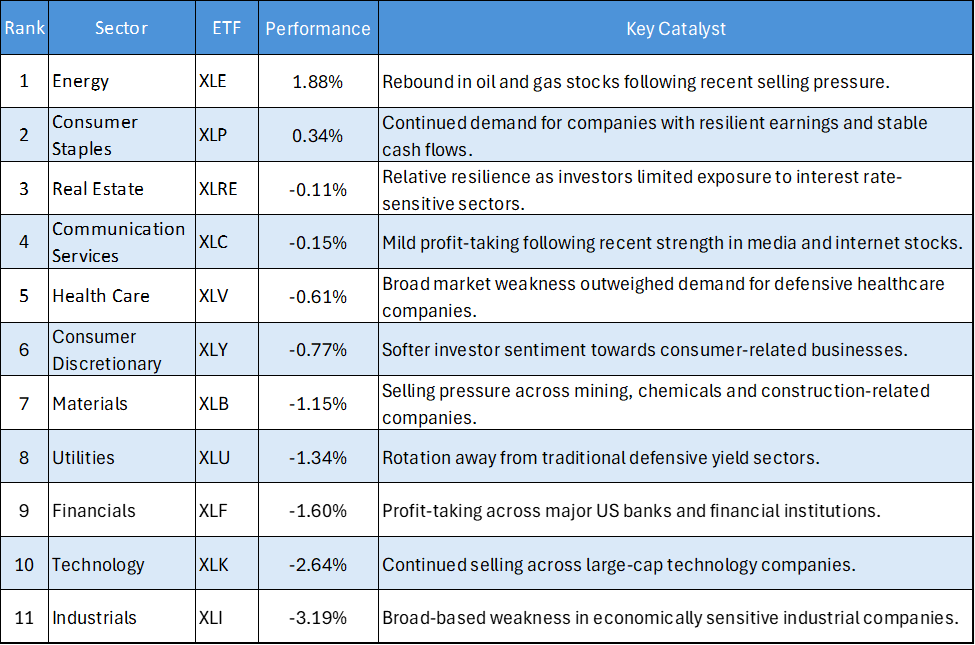
The US equity market experienced broad-based weakness on 29 July 2026, with only Energy and Consumer Staples finishing higher. Energy rebounded strongly after recent underperformance, while defensive Consumer Staples also recorded modest gains. In contrast, Industrials, Technology and Financials led the declines as investors reduced exposure to economically sensitive and growth-oriented sectors. The widespread selling across nine sectors suggests investors adopted a more cautious stance despite continued selective buying in Energy.
Daily US Sector Performance Summary
Key Market Themes
Energy Rebounds Sharply
- Energy (XLE) surged 1.88%, making it the strongest-performing sector of the session. The rebound suggests investors selectively accumulated oil and gas companies after a period of sustained weakness.
- Consumer Staples (XLP) gained 0.34%, extending its defensive appeal as investors continued favouring businesses with resilient earnings and stable cash flows.
Defensive Sectors Show Relative Resilience
- Real Estate (XLRE) slipped just 0.11%, making it one of the market's more resilient sectors despite broader weakness.
- Communication Services (XLC) eased 0.15%, indicating only modest profit-taking after its recent outperformance.
- Health Care (XLV) declined 0.61%, although its relatively small loss suggests investors maintained some exposure to defensive growth companies.
Broad Selling Across Cyclical and Growth Sectors
- Consumer Discretionary (XLY) fell 0.77%, reflecting weaker sentiment towards consumer-related businesses.
- Materials (XLB) lost 1.15%, suggesting investors reduced exposure to economically sensitive commodity-linked companies.
- Financials (XLF) declined 1.60%, as profit-taking emerged across major banks following their recent strength.
Technology and Industrials Lead the Market Lower
- Technology (XLK) dropped 2.64%, making it the second weakest-performing sector. The decline indicates investors continued locking in gains across large-cap technology stocks.
- Industrials (XLI) fell 3.19%, recording the largest decline of the session as economically sensitive companies experienced broad-based selling.
- Utilities (XLU) also weakened, falling 1.34%, suggesting investors rotated away from defensive yield-oriented sectors despite the broader market decline.
Bottom Line
The US equity market weakened on 29 July 2026, with Energy standing out as the only sector to post a meaningful gain while Consumer Staples also finished modestly higher. Meanwhile, Industrials, Technology, and Financials led the declines, highlighting broad-based selling across cyclical and growth-oriented sectors.
Looking ahead, investors will be watching whether Energy can extend its recovery and whether Technology and Industrials can stabilise following their sharp pullbacks. A rebound in these influential sectors would likely improve overall market breadth and support a more balanced advance across the US equity market.


 Nov 05, 2026



 Please wait processing your request...