
 CA
 NZ
 UK
 AU
 IND

 US

 Share
 X (Formerly Twitter)
 Whatsapp
 Facebook
 LinkedIn
 Telegram
 Email This Article
 Copy Link
 Summarize with AI
 Chat GPT
 Perplexity

Key Highlights
- Consumer Discretionary Leads the Market: Consumer Discretionary (XLY) surged 3.29%, making it the strongest-performing sector as investors aggressively accumulated consumer-focused companies amid improving risk appetite.
- Communication Services and Energy Post Solid Gains: Communication Services (XLC) climbed 1.56%, while Energy (XLE) advanced 1.00%, reflecting continued Demand for growth and commodity-linked sectors.
- Industrials Extend the Rally: Industrials (XLI) gained 0.81%, signalling renewed investor confidence in economically sensitive companies.
- Technology and Financials Finish Slightly Lower: Technology (XLK) slipped 0.22%, while Financials (XLF) eased 0.11%, indicating only modest profit-taking following recent gains.
- Defensive Sectors Underperform: Consumer Staples (XLP), Real Estate (XLRE), Health Care (XLV), and Utilities (XLU) all finished lower as investors rotated away from defensive industries.
- Materials Record the Largest Decline: Materials (XLB) dropped 2.34%, making it the weakest-performing sector as selling pressure intensified across Mining , chemicals, and construction-related companies.
- Market Breadth Remains Balanced: Four of the eleven major US sectors finished higher, with gains concentrated in cyclical and consumer-oriented industries.
The US Equity market delivered a mixed performance on 31 July 2026, with investors rotating decisively towards cyclical and consumer-oriented sectors. Consumer Discretionary led the advance by a wide Margin , supported by strong buying in retail and consumer-related companies, while Communication Services, Energy, and Industrials also posted solid gains. In contrast, defensive sectors generally underperformed, and Materials experienced broad-based selling pressure. The session reflects improving investor confidence in economically sensitive sectors despite selective weakness elsewhere.
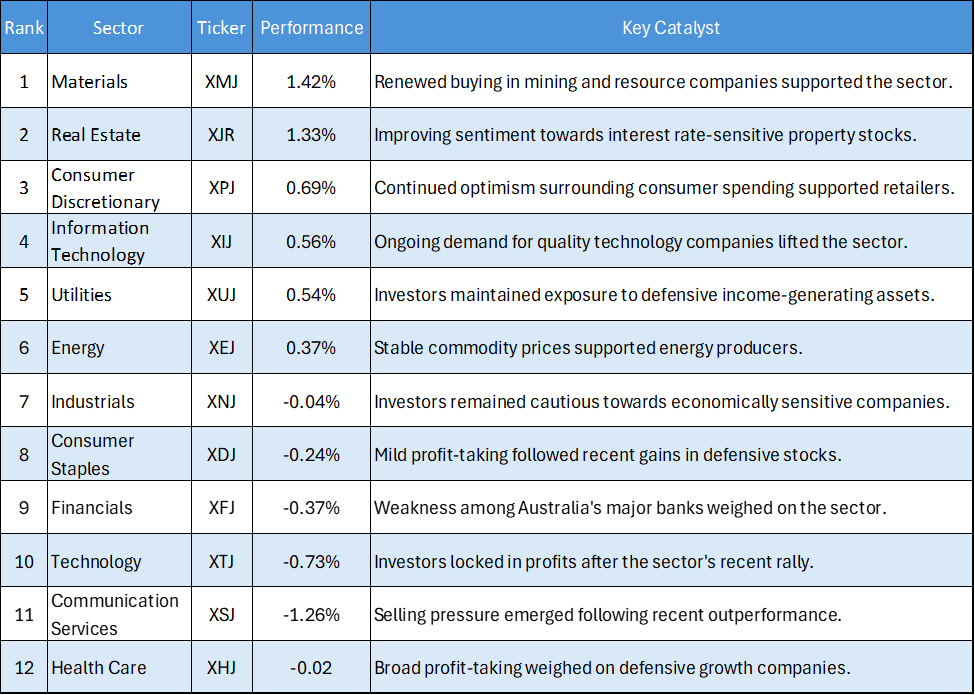
Daily US Sector Performance Summary
Key Market Themes
Consumer Discretionary Leads the Rally
- Consumer Discretionary (XLY) surged 3.29%, comfortably outperforming every other sector. The strong advance suggests investors aggressively increased exposure to consumer-related businesses as market sentiment improved.
- Communication Services (XLC) climbed 1.56%, reinforcing continued investor demand for internet, media, and digital communication companies.
Cyclical Sectors Attract Buying Interest
- Energy (XLE) gained 1.00%, supported by resilient Commodity prices and renewed buying across oil and gas producers.
- Industrials (XLI) advanced 0.81%, indicating investors remained constructive on economically sensitive companies amid expectations of improving economic activity.
Defensive Sectors Lose Momentum
- Consumer Staples (XLP), Real Estate (XLRE), Health Care (XLV), and Utilities (XLU) all finished modestly lower as Capital rotated away from traditional defensive sectors and towards higher-beta growth opportunities.
- Financials (XLF) and Technology (XLK) also edged lower, although their relatively small declines suggest investors largely maintained exposure to these influential sectors.
Materials Underperform Broadly
- Materials (XLB) declined 2.34%, making it the weakest-performing sector of the session. The sharp decline indicates broad-based selling across mining, chemicals, and construction-related companies, significantly underperforming the broader market.
The US equity market delivered a selective rally on 31 July 2026, with Consumer Discretionary, Communication Services, Energy, and Industrials leading the advance as investors favoured cyclical and growth-oriented sectors. Meanwhile, Materials experienced significant weakness, while most defensive sectors recorded modest declines as capital rotated towards higher-risk assets.
Looking ahead, investors will closely monitor whether the strong momentum in Consumer Discretionary and Communication Services can be sustained while watching for signs of stabilisation in Materials. Continued Leadership from cyclical sectors would reinforce improving risk sentiment and support a broader advance across the US equity market.

 Nov 04, 2026



 Please wait processing your request...