
 CA
 NZ
 UK
 AU
 IND

 US

 Share
 X (Formerly Twitter)
 Whatsapp
 Facebook
 LinkedIn
 Telegram
 Email This Article
 Copy Link
 Summarize with AI
 Chat GPT
 Perplexity
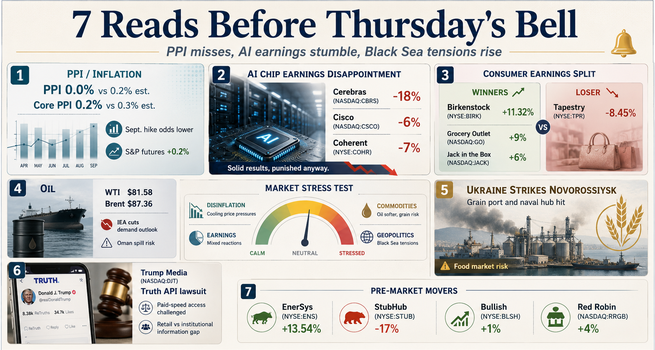
July producer prices came in flat against a forecast 0.2% rise, extending Wednesday's in-line CPI into a second day of softer Inflation data and pulling September rate-hike odds down further. Cerebras, Cisco, and Coherent all fell premarket despite mostly-solid underlying results, oil slid on a fresh IEA Demand downgrade, and Ukraine struck Russia's largest Black Sea grain and naval hub at Novorossiysk.
1. INFLATION: July PPI Flat Against 0.2% Forecast, Core Up Just 0.2% Versus 0.3% Expected; September Hike Odds Fall Further After In-Line CPI
The Producer Price index for final demand was unchanged in July, seasonally adjusted, below the 0.2% increase economists had forecast; core PPI rose 0.2%, also short of the 0.3% consensus. A 0.7% drop in final demand goods, driven by a 3.1% decline in energy prices, offset a 0.2% rise in services and a 2.2% jump in construction prices. The softer print follows Wednesday's in-line July CPI, which rose 0.1% monthly and 3.4% annually, and together the two reports have pushed September rate-hike odds down into the 33-41% range from roughly 50-60% a week earlier, according to the CME FedWatch Tool. An Interactive Brokers senior economist said the odds still favor a rate increase in either October or December once policymakers have more time to weigh both sides of the Fed's mandate. S&P 500 futures edged up 0.2% on the data, and Dow futures added 136 points.
- Two consecutive soft inflation reports in the same week give the Fed more room to treat July's weak payrolls as the dominant signal shaping September, even as officials who dissented in favor of a hike at the last meeting have yet to publicly walk that back.
- Risk note: Friday's retail sales data and the July 28-29 FOMC minutes due August 19 are the next tests of whether this week's disinflation trend holds or proves a temporary lull tied to falling energy prices.
2. AI CHIP EARNINGS: Cerebras Falls 18% Despite Beating on Revenue and Raising Guidance; Cisco and Coherent Also Slide on Otherwise Solid Results
Cerebras Systems (NASDAQ:CBRS) tumbled as much as 18% premarket even after second-quarter core revenue of $209.9 million grew 103% year over year and beat guidance; the decline centered on a wider-than-expected GAAP net loss and headline revenue of $180.1 million that missed the roughly $194 million Street consensus. Cisco Systems (NASDAQ:CSCO) fell as much as 6% despite record fourth-quarter revenue of $17.3 billion, up 18% year over year, with AI infrastructure orders from hyperscalers reaching $9.3 billion for the fiscal year, more than four times the prior year. Coherent (NYSE:COHR) fell as much as 7% after fourth-quarter adjusted gross Margin of 40.2% came in only narrowly ahead of the 40% estimate, even as first-quarter guidance topped expectations. Despite Cerebras's drop, several analysts including Morgan Stanley and Needham reiterated bullish ratings and raised price targets, citing durable AI inference demand.
- All three companies posting premarket declines despite headline strength suggests investors are pricing AI-adjacent Earnings against a higher bar than the underlying numbers alone, with any miss on a secondary metric triggering a sell-the-news reaction.
- Risk note: if this pattern extends to next week's follow-through AI infrastructure reports, it would mark a shift from rewarding AI capex growth broadly to selectively punishing execution details, a higher bar for the sector's remaining earnings this quarter.
3. CONSUMER EARNINGS: Tapestry Falls 8% on Soft Guidance Despite a Beat; Birkenstock Jumps 11% on a Raised Outlook; Grocery Outlet and Jack in the Box Also Surge
Tapestry (NYSE:TPR) shares fell as much as 8.45% premarket after fiscal fourth-quarter adjusted EPS of $1.32 topped the $1.28 estimate and revenue of $1.88 billion was roughly in line, but fiscal 2027 guidance of $7.80-7.90 in EPS came in at or slightly below the most optimistic Street forecasts; the company also raised its quarterly Dividend 16% to 46.25 cents per share. Birkenstock Holding (NYSE:BIRK) surged as much as 11.32% after fiscal third-quarter revenue of 719.5 million euros grew 13% in constant currency, beating estimates, with adjusted EBITDA up 11% at a 33.7% margin; the company raised full-year revenue growth guidance to 15% from a prior 13-15% range. Grocery Outlet (NASDAQ:GO) jumped 9% after second-quarter EPS of 20 cents beat a 13-cent estimate, and Jack in the Box (NASDAQ:JACK) rose more than 6% on fiscal third-quarter EPS of 96 cents against an 88-cent estimate. Yeti (NYSE:YETI) slipped nearly 4% despite beating on both lines, and JD.com (NASDAQ:JD) fell roughly 4% even after topping consensus on revenue and adjusted earnings.
- Tapestry's decline on guidance that merely matched rather than exceeded already-elevated expectations, following a strong multi-month share run-up, shows profit-taking risk is now attached to in-line forward guidance and not just outright misses.
- Risk note: Yeti and JD.com falling despite clean beats on both revenue and earnings suggests investors are discounting even solid consumer results when guidance lacks a clear raise, a bar that will apply directly to retailers still due to report this season.
4. OIL: WTI and Brent Fall 2% as IEA Cuts Global Demand Outlook on Deepening Hormuz Disruption; Oman Tanker Spill Threatens Wildlife Reserve
WTI crude futures fell 2% to $81.58 a barrel and Brent slid nearly 2% to $87.36 Thursday as traders weighed a weaker demand outlook against the ongoing Middle East Supply disruption. The IEA said global oil demand is set to fall further than previously expected this year, with renewed hostilities and maritime disruptions undermining efforts to boost supply; the agency said global supply remained 6.3 million barrels a day lower year over year in July. Attacks on vessels in the Gulf of Oman and Red Sea continued this week even as diplomatic efforts toward reopening the Strait of Hormuz reportedly continue. Separately, oil has begun reaching the Omani coastline from a tanker carrying an estimated 800,000 barrels of sanctioned Russian crude that ran aground on June 30, threatening a nature reserve home to Arabian Sea humpback whales. An Exness market strategist said the lack of clarity over a full Hormuz reopening could leave oil prices exposed to further upside in a market that remains tight.
- A falling demand forecast pushing prices down even as supply remains constrained and shipping attacks continue shows demand destruction is now outweighing geopolitical risk premium in day-to-day price direction, a Reversal from earlier in the conflict.
- Risk note: if the Oman spill's environmental damage escalates or forces new restrictions on tanker traffic through the region, it would add a fresh supply-side disruption independent of the war itself.
5. UKRAINE/BLACK SEA: Kyiv Strikes Russia's Novorossiysk Naval and Grain Hub, Damaging Warships and Export Terminals; Russia Warns of Global Food Market Disruption
Ukraine launched a large-scale drone and missile assault on Novorossiysk, describing it as a strike on the last major stronghold of Russia's Black Sea fleet, more than 300 kilometers from the front line; Ukrainian officials said several Russian naval vessels, including two frigates, a landing ship, and a corvette, were struck, while grain export terminals and two Russian grain trading companies also reported damage. Russia's regional governor said three people were killed and 24 injured. Russia's Agriculture Ministry said it is working to redirect cargo flows to Baltic and Caspian Sea ports and land routes, while a Russian Foreign Ministry spokesperson accused Ukraine of seeking to provoke chaos in global food markets. An agricultural consultancy said Russia, the world's largest wheat exporter, is on pace to export just 3-3.4 million metric tons of wheat this month, well below the five-year August average of 5 million tons.
- Russia's projected wheat export shortfall arriving on top of an already-weak July signals the Black Sea disruption is compounding rather than a one-off event, with direct exposure for Asian and African countries that historically received the bulk of the region's grain.
- Risk note: if both sides continue targeting each other's export infrastructure through the September harvest season, global wheat prices face sustained upward pressure independent of weather or Yield conditions.
6. TRUMP MEDIA: Truth API Faces Lawsuit From Press Freedom Groups Alleging Unconstitutional Paid Access; Retail Investors Flag Broader Earnings and Fed-Communication Concerns
The Intercept Media and the Freedom of the Press Association filed suit over Truth API, a paid-access service recently launched by Trump Media & Technology Group (NASDAQ:DJT) that allows faster access to posts on Truth Social, calling it extraordinary, corrupt, and unconstitutional. Trump Media's interim chief executive said this week the company has signed more than 10 customer agreements for the API, priced between $60,000 and $100,000 a month. The service is one of several developments worrying advocates for retail investors, who are concerned that Truth API, alongside potential changes to corporate earnings disclosure and Federal Reserve communications, could leave smaller traders at an information disadvantage relative to paying institutional subscribers.
- A sitting president's media company selling tiered, paid-speed access to his own platform's posts is a structurally novel arrangement that the lawsuit's constitutional framing suggests could set a contested precedent.
- Risk note: if Truth API's customer base expands into trading firms seeking a speed advantage on market-moving posts, the resulting information asymmetry could draw scrutiny from securities regulators independent of the press freedom lawsuit's outcome.
7. PRE-MARKET MOVERS: EnerSys Jumps 13.5% on a Beat-and-Raise Quarter; StubHub Falls 17% on a Margin Miss; Bullish Rises on Raised Guidance
EnerSys (NYSE:ENS) shares rose as much as 13.54% after fiscal first-quarter adjusted EPS of $3.66 beat a $2.83 estimate and revenue of $935.6 million topped consensus, with second-quarter EPS guidance also above expectations and the company raising its quarterly dividend 10% for a fourth consecutive annual hike. StubHub (NYSE:STUB) fell nearly 17% after second-quarter adjusted gross margin of 82.2% missed an 84.3% estimate on elevated World Cup-related fulfillment costs, even as gross merchandise value rose 34% year over year to $3.1 billion and the company reaffirmed full-year adjusted EBITDA guidance. Bullish (NYSE:BLSH) shares added about 1% after second-quarter revenue of $92.6 million topped an $87.4 million estimate, with the company raising full-year guidance for subscription and services revenue. Red Robin Gourmet Burgers (NASDAQ:RRGB) rose nearly 4% after posting a 12-cent adjusted profit against expectations for a breakeven quarter.
- StubHub's decline on a margin miss despite a strong headline revenue beat and reaffirmed full-year guidance shows the market treating World Cup-related cost inflation as a genuine near-term concern rather than the one-time item management has characterized it as.
- Risk note: if EnerSys and other industrial beneficiaries of Data Center and grid infrastructure spending continue outperforming while consumer-facing names like StubHub face margin pressure, the divergence would reinforce a rotation toward capital-goods exposure over discretionary, events-driven Business models.


 Nov 24, 2026




 Please wait processing your request...