
 CA
 NZ
 UK
 AU
 IND

 US

 Share
 X (Formerly Twitter)
 Whatsapp
 Facebook
 LinkedIn
 Telegram
 Email This Article
 Copy Link
 Summarize with AI
 Chat GPT
 Perplexity
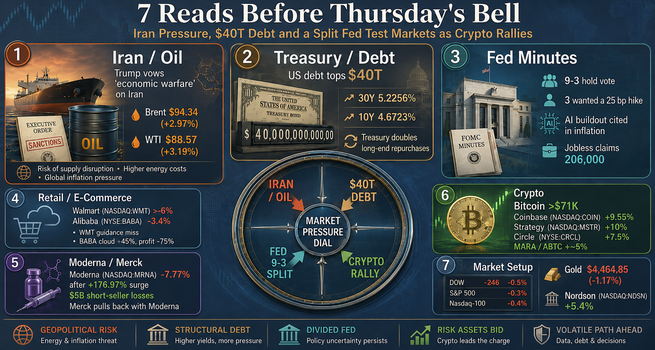
President Trump announced what he called the most crushing economic operation ever taken against a country, targeting Iran and anyone offering it a lifeline, sending oil to three-week highs. Total US government Debt crossed $40 trillion for the first time, prompting the Treasury to more than double its long-end bond repurchases, while July's FOMC minutes revealed a Fed sharply divided over whether AI-driven Demand is feeding inflation, even as fresh claims data showed the labor market holding roughly steady. Walmart and Alibaba both beat on Revenue but fell on weaker underlying details, Moderna and Merck pulled back after Wednesday's historic surge, and crypto stocks rallied on Bitcoin's push past $71,000.
1. IRAN: Trump Vows "Most Crushing Economic Operation Ever" Against Iran and Anyone Offering It a Lifeline; Oil Jumps to a Three-Week High
President Trump said in a Truth Social post that the US would launch the most crushing economic operation ever taken against any country, describing it as economic warfare and isolation on an unprecedented scale after Iran failed to accept an opportunity to make a deal. Trump also threatened tremendous economic consequences against any nation providing Iran a lifeline, including through cash transfers, currency swaps, or shipping registries. The threat came a day after the UAE suspended all trade with Iran following two ballistic missiles it said were fired toward its territorial waters, which Iran's foreign ministry denied launching. Oil prices jumped on the news: Brent Crude rose as much as 2.97% to $94.34 a barrel and WTI climbed as much as 3.19% to $88.57, both reaching three-week highs.
- Threatening secondary consequences against third countries that engage with Iran economically, rather than sanctions on Iran alone, significantly widens the scope of potential market disruption beyond direct US-Iran channels.
- Risk note: if Trump's threatened measures target specific countries or financial mechanisms in the coming days, oil could extend its rally toward the triple-digit levels some analysts have already flagged as possible.
2. TREASURY: US Debt Tops $40 Trillion for the First Time as Treasury Doubles Long-Bond Repurchases; 30-Year Yield Swings From a 19-Year High to 5.18% and Back
Total US government debt outstanding surpassed $40 trillion for the first time, more than double its level a decade ago. The Treasury Department, led by Secretary Scott Bessent, said Wednesday it would more than double the size of its debt repurchases at the long end of the curve in an effort to contain borrowing costs after the 30-year yield spiked to its highest level in nearly two decades earlier in the week. The announcement sent yields tumbling Wednesday, with the 30-year plunging more than 10 basis points to around 5.18% and the 10-year falling more than 6 basis points; both ticked back up modestly Thursday morning, with the 30-year at 5.2256% and the 10-year at 4.6723%. A former Wells Fargo macro strategist said he remains skeptical the respite will last, citing the large and unimproving Budget Deficit alongside rising defense spending as structural pressures that predate and now compound the Iran conflict's impact on yields.
- The Treasury's buyback move addresses market functioning and Liquidity concerns rather than the underlying deficit dynamics driving debt higher, meaning it can ease short-term yield pressure without resolving the structural borrowing needs that pushed yields to multi-decade highs.
- Risk note: with debt now past $40 trillion and defense spending rising alongside an already elevated deficit, the current relief in yields may prove temporary if the July FOMC minutes' Inflation concerns, detailed in story three, translate into a more hawkish Fed path.
3. FOMC MINUTES: July Meeting Ends 9-3 as Three Members Push for a Hike; Fed Staff and Participants Flag AI Buildout as a Direct Contributor to Inflation
The Federal Reserve's July 28-29 meeting minutes showed the Committee voted 9-3 to hold the federal funds rate at 3.5% to 3.75%, with Beth Hammack, Neel Kashkari, and Lorie Logan dissenting in favor of a 25 basis point hike. Fed staff attributed elevated inflation in part to the surge in demand related to the AI buildout, noting that core goods price inflation was largely attributable to Tariff effects and AI-related price pressures, with Data Center materials such as chips and steel registering large price increases alongside consumer items including smartphones and electricity. Several participants viewed AI Investment as already broadening price pressures by pushing up aggregate demand, while others said its inflationary effects so far remained limited to select categories; participants agreed inflation risks were skewed to the upside, with many citing the Middle East conflict's re-escalation as a Factor clouding the outlook. Separately, staff characterized financial-system vulnerabilities as notable, flagging that hedge fund Leverage remained near all-time highs and that the Equity premium had fallen to a level last seen during the dot-com bubble. Fresh data released Thursday showed weekly initial jobless claims fell to 206,000 for the week ending August 15, down 6,000 from an upwardly revised 212,000, though the four-week Moving Average rose to 204,000, offering an early, mixed signal on the labor market backdrop the Fed will weigh into September.
- A three-member dissent favoring an immediate hike, combined with staff explicitly naming AI investment as a current inflation driver rather than a future risk, signals the Fed's internal debate has shifted from whether AI spending affects prices to how much and how soon.
- Risk note: the staff's dot-com-era comparison for equity valuations, paired with hedge fund leverage at record highs, describes a financial stability backdrop where an AI-related repricing shock could compound rather than merely coincide with any inflation-driven tightening.
4. RETAIL/E-COMMERCE: Walmart Falls 6% on Guidance Miss Despite a Revenue Beat; Alibaba Drops 3.4% as AI Spending Cuts Profit 75% Even as Cloud Revenue Accelerates
Walmart (NASDAQ:WMT) reported second-quarter revenue of $187.9 billion, up 5.9%, beating estimates, but US comparable sales grew just 2.6% against a 3.5% consensus, and adjusted Earnings guidance for both the third quarter and full year came in below expectations even as the company raised its full-year outlook overall; shares fell more than 6% premarket. Chief Financial Officer John David Rainey said the outlook reflects continued prioritization of tariff refunds into price investments in the second half, and encouraged investors to assess second and third quarter performance together. Alibaba (NYSE:BABA) reported first-quarter revenue of RMB 269 billion, up 9% year over year, but GAAP Net Income fell 75% to RMB 10.4 billion as capital expenditures grew 75% to RMB 67.7 billion amid a three-year, RMB 380 billion AI investment plan; cloud revenue growth accelerated to 45%, a 22-quarter high. Shares fell 3.4%.
- Walmart's guidance miss stemming from deliberately reinvesting tariff refunds into pricing, rather than from weakening demand, is a materially different signal than a typical guidance cut, though the market's reaction suggests investors are treating the near-term earnings impact the same regardless of cause.
- Risk note: Alibaba's accelerating cloud growth alongside a 75% profit decline mirrors the same AI capex-versus-near-term-earnings tension flagged in the FOMC minutes' financial stability discussion, and any slowdown in that acceleration would remove the primary justification investors are using to look past the weaker profit figure.
5. MODERNA/MERCK: Shares Pull Back After Wednesday's Historic 177% Surge, the Largest Single-Day Gain for Any S&P 500 Stock This Century
Moderna (NASDAQ:MRNA) shares fell as much as 7.77% premarket Thursday, giving back a portion of Wednesday's 176.97% surge, which marked the largest single-day gain for any S&P 500 stock so far this century following the companies' positive Phase 3 melanoma trial results. Merck (NYSE:MRK) shares also pulled back after Wednesday's gains. The rally triggered roughly $5 billion in short-seller losses, according to an estimate cited in market commentary, and prompted a wave of analyst price target increases, including Piper Sandler to $167, Jefferies to $150, and Morgan Stanley to $89. Peers including BioNTech, Pfizer, and Tempus AI also rallied on the news Wednesday, while broader markets were supported by the Treasury bond buyback announcement discussed in story two, which eased yields and lifted healthcare to the top-performing S&P sector.
- A pullback of this scale immediately following a historic surge is consistent with profit-taking after an extraordinary short squeeze rather than a reassessment of the underlying trial data, which remains unchanged from Wednesday's announcement.
- Risk note: with roughly $5 billion in short-seller losses already realized, any remaining short positioning that has not yet been closed out could either amplify further declines if sentiment sours, or trigger a renewed squeeze if positive follow-on news emerges before the position is fully unwound.
6. CRYPTO: Coinbase, Strategy, and Circle All Rally as Bitcoin Tops $71,000 on Trump's Push for Crypto Legislation
Crypto-linked stocks rallied premarket Thursday as Bitcoin and ether extended gains following a White House crypto summit where President Trump and industry executives, including Coinbase CEO Brian Armstrong, pushed for swift passage of the CLARITY Act to establish clear digital-asset market rules. Coinbase (NASDAQ:COIN) rose as much as 9.55%, extending Wednesday's 12.7% rally, while Strategy (NASDAQ:MSTR) jumped 10%, Circle Internet (NYSE:CRCL) gained 7.5%, and Mara Holdings (NASDAQ:MARA) and American Bitcoin (NASDAQ:ABTC) each added roughly 5%. Coinbase's rally comes even as the company's own fundamentals remain under scrutiny following three consecutive quarterly earnings misses and declining transaction revenue.
- Legislative momentum toward a clear regulatory framework is driving crypto-linked equities higher independent of the underlying Business performance of individual companies, as illustrated by Coinbase rallying sharply despite its own recent pattern of earnings misses.
- Risk note: a rally built primarily on anticipated legislation rather than improving fundamentals is vulnerable to a sharp Reversal if the CLARITY Act's path through Congress stalls or its final provisions prove less favorable than the market is currently pricing in.
7. MARKET SETUP: Futures Fall as Oil Spike and Walmart Weigh; Gold Retreats From a Two-Month High, Nordson Raises Guidance
Dow futures fell 246 points, or 0.5%, S&P 500 futures lost 0.3%, and Nasdaq 100 futures slid 0.4% Thursday, pressured by the oil price jump and Walmart's premarket decline. The moves follow a winning session Wednesday in which the S&P 500 snapped a three-session losing streak as Treasury yields pulled back from their multi-year highs. Gold retreated as much as 1.17% to $4,464.85 an ounce, giving back part of Wednesday's more than 4% gain to a two-month peak, as the Treasury buyback news pressured the dollar and yields lower while easing safe-haven demand; traders are currently pricing a 67% chance the Fed holds rates in September, according to the CME FedWatch Tool. Morgan Stanley said it expects gold to exceed $5,000 an ounce in 2027, possibly sooner, citing an expected Fed hold and constrained COMEX short positioning. Nordson (NASDAQ:NDSN) shares rose 5.4% after the company raised full-year adjusted earnings guidance to $11.80-$12.00 per share from a prior $11.30-$11.80, above the $11.60 consensus.
- Gold's pullback despite ongoing geopolitical escalation and a weaker dollar suggests the metal's price action is currently more sensitive to real-yield and Fed-policy signals than to the Iran-driven risk premium showing up in oil.
- Risk note: with futures already lower ahead of the open and a fresh round of Iran-related headlines still developing, today's session carries meaningfully elevated two-way risk depending on whether Trump's economic warfare threat is followed by concrete measures or remains rhetorical.


 Nov 24, 2026




 Please wait processing your request...