
 CA
 NZ
 UK
 AU
 IND

 US

 Share
 X (Formerly Twitter)
 Whatsapp
 Facebook
 LinkedIn
 Telegram
 Email This Article
 Copy Link
 Summarize with AI
 Chat GPT
 Perplexity
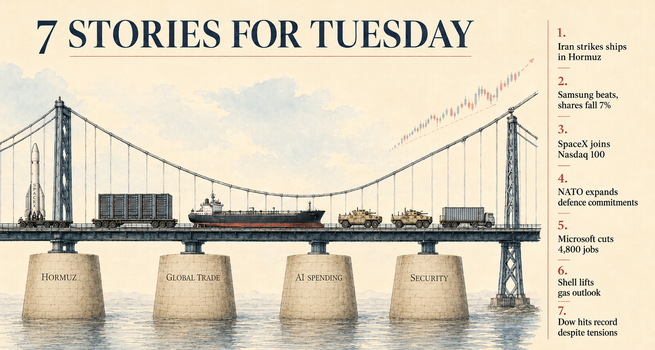
Iranian forces struck 2 commercial vessels in the Strait of Hormuz, suspending ceasefire talks and sending oil higher; Nasdaq 100 futures are down 1.1% as Samsung's 19-fold profit beat still sent the stock down 7% on AI spending durability concerns, and DeepSeek is reportedly developing its own AI chip. SpaceX joins the Nasdaq 100 today with $4.3B in passive inflows expected; Morgan Stanley and Goldman Sachs initiated with top ratings.
1. IRAN/HORMUZ: Iranian Forces Strike 2 Commercial Ships; Both Vessels Damaged; Ceasefire Talks Suspended; Oil Rising
American officials confirmed that Iranian forces struck 2 ships sailing through the Strait of Hormuz, with both vessels suffering significant damage. Ceasefire talks including discussions on the permanent reopening of the strait have been formally suspended as Iran holds a mass funeral for Khamenei. The attack arrives during the funeral ceasefire pause that Qatar-mediated diplomacy had framed as a procedural delay; the physical interdiction converts that framing into a direct challenge to the MOU framework. WTI trades at $68.99 (+0.64%) and Brent at $72.55 (+0.78%).
- The attack during the Khamenei funeral pause is analytically distinct from the prior June 27 cargo ship incident; that one triggered a stand-down within 48 hours, but this arrives with talks formally suspended and succession unresolved, removing the rapid de-escalation mechanism.
- Brent rising while simultaneously near multi-month lows on OPEC+ supply additions illustrates the competing forces: the structural glut thesis and the geopolitical incident premium are now pressing in opposite directions.
- Risk note: a third Hormuz interdiction before succession is settled closes the 60-day MOU window with no final deal framework and reprices oil structurally above $80 regardless of OPEC+ quota levels.
2. SAMSUNG/CHIPS: Q2 Profit 19-Fold to $58.4B Beats Estimate; Stock Falls 7%; Micron -5%, Nvidia -2% on DeepSeek AI Chip Report; KOSPI -4.9%
Samsung Electronics reported Q2 operating profit of 89.4 trillion won ($58.44B), a 19-fold jump from 4.7 trillion won a year prior, beating the Estimate of 87.3 trillion won; revenue rose an estimated 129% to 171 trillion won. Despite the beat, Samsung closed down 6.9%; SK Hynix ended down 6%; the KOSPI dropped 4.9%. DRAM prices rose 44% Q/Q and NAND 53% per Citi Research. DeepSeek is separately reported to be developing its own AI chip, a move that could reduce dependency on Nvidia and Samsung; Nvidia (NASDAQ:NVDA) fell more than 2% pre-market. Micron (NASDAQ: MU) dropped 5%; KLA, Marvell (NASDAQ:MRVL), Broadcom (NASDAQ;AVGO), and AMD (NASDAQ:AMD) also declined. Morgan Stanley said semiconductor weakness will likely continue as investors brace for "more capex discipline" from hyperscalers.
- Samsung beating estimates by 19-fold while falling 7% is the definitive sell-the-news signal for the AI memory trade; the market has fully priced the earnings strength and is now pricing the forward question of whether hyperscaler AI capex can sustain the demand that produced these numbers.
- DeepSeek developing its own chip is structurally distinct from the demand slowdown concern: it represents a potential reduction in the total addressable market for U.S. and Korean chip suppliers at the same moment investors are already questioning hyperscaler demand durability.
- Risk note: Samsung's detailed divisional results on July 30 will be the next hard data point; confirmation that foundry and LSI losses are widening compounds the HBM demand sustainability question at the heart of the sector de-rating.
3. SPACEX NASDAQ 100: Joins Index Today; $4.3B Passive Inflows Expected; Morgan Stanley and Goldman Initiate With Top Ratings; "AI's Final Frontier"
SpaceX (NASDAQ: SPCX) joins the Nasdaq 100 today, just 15 days after its June 12 IPO debut, among the fastest inclusions ever. Over $587 billion is benchmarked in Nasdaq 100 funds including QQQ; JPMorgan estimated $4.3 billion in passive inflows. Morgan Stanley and Goldman Sachs both initiated with top ratings; Goldman described each of SpaceX's markets as having the potential to become a multi-trillion-dollar opportunity over a 5-year-plus horizon. RBC, Bernstein, and Stifel also initiated with top ratings. CFRA is the only sell-rated brokerage; SpaceX is the sixth-largest U.S. company; shares are up more than 6% since the IPO.
- The $4.3 billion in non-discretionary passive inflows today creates structural buying pressure independent of sentiment; in a session where Nasdaq 100 futures are down 1.1% on chip concerns, the index entry provides a mechanical demand floor for the stock.
- Goldman and Morgan Stanley framing SpaceX as a multi-trillion-dollar AI infrastructure play on inclusion day converts the rocket company narrative into the AI hyperscaler narrative the current market prices at premium multiples.
- Risk note: The $780B valuation against the $2.1T market cap represents a 170% premium that depends entirely on unproven Starship reusability, xAI development, and Starlink expansion; the CFRA sell thesis on execution risk is the clearest articulation of what the bull case requires to be true.
4. NATO SUMMIT: $40B Anti-Drone Commitment; Lockheed-Rheinmetall ATACMS Deal in Germany; Saab +5%; Turkey F-35 Reinstatement Expected
NATO leaders unveiled arms deals worth tens of billions in Ankara; Secretary General Rutte announced more than $40 billion in anti-drone investment over 5 years. Lockheed Martin (NYSE: LMT) and Germany's Rheinmetall signed a draft deal to jointly produce ATACMS missiles in Germany, the first non-U.S. manufacture of the short-range ballistic missile. European countries are buying surveillance drones from Northrop Grumman (NYSE: NOC); NATO is buying planes from Sweden's Saab, whose shares rose more than 5% in Europe after Morgan Stanley upgraded the stock. NATO's European members and Canada spent $90 billion more on defence in 2025 than 2024, reaching more than $570 billion total. Trump is expected to tell Erdogan that Turkey can rejoin the F-35 programme. NATO members are expected to pledge €70 billion ($80 billion) in Ukraine assistance for 2026.
- The Lockheed-Rheinmetall ATACMS joint production agreement is the most historically significant NATO industrial announcement in years: manufacturing a U.S. ballistic missile on German soil marks a structural shift in European defence sovereignty.
- Turkey's F-35 reinstatement, if confirmed, resolves a 7-year bilateral rupture; at current F-35 unit costs, even a modest Turkish order represents multi-billion dollar revenue for Lockheed's production pipeline.
- Risk note: Trump's simultaneous criticism of NATO allies while attending the summit creates a dynamic where deal announcements and alliance friction coexist; European leaders are braced for public rebukes regardless of the billions committed.
5. MICROSOFT: Cuts 4,800 Jobs, 2% of Workforce; Xbox Loses 1,600 With 1,600 More by July 2027; HR Chief Denies AI Replacement
Microsoft (NASDAQ: MSFT) cut 4,800 jobs, roughly 2% of its workforce; the Xbox division lost 1,600 people with a further 1,600 cuts planned by July 2027. HR chief Amy Coleman said technological change made the cuts necessary but denied those being dismissed were being replaced by AI. The cuts arrive as Microsoft is simultaneously raising Xbox prices due to surging memory component costs, continuing the AI memory cost pass-through pattern that has appeared at Apple (NASDAQ:AAPL), Microsoft, and Nike (NYSE:NKE) in consecutive weeks.
- Xbox losing 3,200 of its workforce in a 12-month window while simultaneously raising prices is a two-sided squeeze: revenue pressure from declining console demand and cost pressure from AI-driven memory inflation, with headcount reduction as the margin response.
- The denial of AI replacement is analytically notable: the Microsoft cuts arrive directly after the company's $145B AI infrastructure spend commitment and its cloud-computing business launch, making the causal narrative harder to separate than the communications framing suggests.
- Risk note: if Microsoft's next quarterly earnings show AI infrastructure costs rising faster than enterprise software revenue, the headcount reduction will be read as a leading indicator of margin compression rather than a one-time restructuring.
6. SHELL Q2 UPGRADE: Raises Gas Production Guidance; LNG to 7.4-7.8M Tons; Gas Trading "Significantly Higher"; Citi Raises EPS 13%; Brent Averaged $97 in Q2
Shell (NYSE:SHEL) raised its Q2 integrated gas production forecast to 610,000-650,000 boed from prior guidance of 580,000-640,000 boed; LNG liquefaction guidance raised to 7.4-7.8 million metric tons from 6.8-7.4 million tons. Gas trading results will be "significantly higher" than the prior quarter. Citi raised its Q2 EPS forecast for Shell by 13%. Brent crude averaged approximately $97 per barrel in Q2, up from $78 in Q1; TTF gas averaged approximately €46 per MWh. Shell shares rose 3.2% in Europe and 3% in premarket in US. Shell's Pearl GTL plant in Qatar has been halted since a March attack; repairs could take a year.
- Brent averaging $97 in Q2 against a current $72 illustrates how much war premium the oil market has surrendered; Shell's Q2 earnings will reflect a price environment that no longer exists, making forward guidance the critical variable rather than the quarterly beat.
- Shell's gas trading outperformance is the direct financial beneficiary of Middle East energy-market volatility; the trading desk captured the spread between war-premium and normalisation pricing in real time.
- Risk note: the Pearl GTL outage affecting approximately 10% of Shell's Qatar-linked production for up to a year is a supply headwind that persists regardless of oil price direction; with Ras Laffan under continued conflict proximity risk, the Qatar exposure is not yet fully resolved.
7. PRE-MARKET SETUP: Dow Above 53,000 First Time Monday; Fiserv +5% on Debit Payments Sale Talks; Vertex Buys Crinetics $10B; First Solar +3%; Trade Deficit Data Due
Monday closed at records: DJIA +0.29% at 53,055.91, first close above 53,000; S&P 500 +0.72% at 7,537.43; NASDAQ +1.12% at 26,121.16. Fiserv (NYSE: FI) rallied more than 5% after reported talks with JPMorgan and Bank of America to sell its debit card payments infrastructure business. Vertex Pharmaceuticals (NASDAQ: VRTX) is acquiring Crinetics Pharmaceuticals for $10 billion to add treatments for rare hormonal diseases; Vertex -1%, Crinetics roughly doubled. First Solar (NASDAQ: FSLR) rose nearly 3% after Deutsche Bank upgraded to buy citing a potential trade policy shift. U.S. trade deficit data is due this morning.
- Monday's DJIA record above 53,000 arrived on the same day Iranian forces struck Hormuz vessels; the divergence between equity record highs and geopolitical escalation is the defining market tension entering Q3 earnings season.
- Fiserv's 5% gain on payments infrastructure sale talks follows the week's M&A pattern: businesses being separated from conglomerates are consistently rewarded, from Comcast's NBCUniversal spinoff to EasyJet's Castlelake acceptance.
- Risk note: the trade deficit data this morning lands in a session already weighted by Hormuz escalation and Samsung chip concerns; a wider-than-expected reading adds a third negative macro signal to a session where 2 are already active.
Markets Intelligence Briefing is an informational and analytical publication. Nothing contained herein constitutes investment advice, a recommendation to buy or sell any security, or a price target. All analysis is presented for informational purposes only. Investors should conduct their own due diligence before making any investment decision.


 Nov 24, 2026



 Please wait processing your request...