
 AU
AU
 UK
UK
 CA
CA
 NZ
NZ
 IND
IND

 US
US

 Share
Share
 X (Formerly Twitter)
 Whatsapp
 Facebook
 LinkedIn
 Telegram
 Email This Article
 Copy Link
 Summarize with AI
 Chat GPT
 Perplexity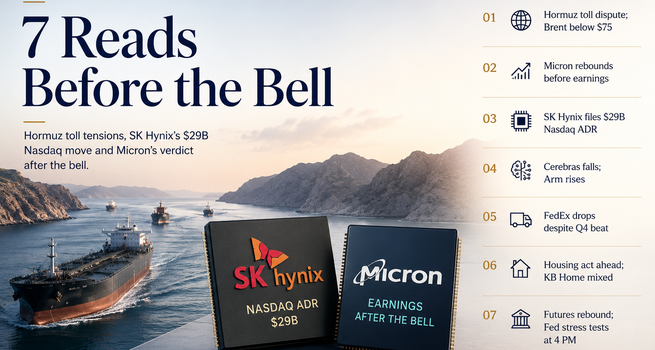
1. IRAN/GEOPOLITICS: Rubio Draws Hormuz Toll Red Line; Senate Passes War-Powers Resolution 50-48; Bessent Says Treasury to Oversee Frozen Funds; Brent Hits Pre-War Low Below $75
The Iran deal's first week is generating friction on three fronts. Secretary of State Marco Rubio warned that "no country is allowed to charge tolls" for Hormuz passage, a direct counter to Iran's stated intention to levy fees on transiting vessels. The Senate voted 50-48 to pass a war-powers resolution limiting Trump from further military action against Iran without congressional approval; as a concurrent resolution it carries no force of law and Trump called the vote "meaningless."
Treasury Secretary Scott Bessent said Iranian frozen funds will be overseen by Treasury in the Middle East, with a "very large percentage" directed toward U.S. foodstuffs and medicines; no total amount was disclosed, no Iranian role in directing purchases clarified, no enforcement tools named. The IAEA confirmed uranium enrichment inspections will proceed "soon" but dates, procedures, and sites remain unresolved. Brent trades at $74.98 pre-market, WTI at $71.25, both down nearly 2.7% and at levels not seen since February 28.
- The Rubio toll warning and the Bessent fund-oversight announcement together reveal the deal's 2 most politically sensitive pressure points: who controls Hormuz economically and where the money goes.
- Treasury's Middle East oversight structure creates a potential channel for Iranian asset flows to re-enter U.S. agricultural and pharmaceutical supply chains.
- Risk note: if Iran formally designates Hormuz toll collection as a sovereign right before the next negotiating session, the Rubio red line forces a U.S. response that the 60-day window was designed to avoid.
2. SEMICONDUCTORS/MICRON: Micron +2.5% Pre-Market Ahead of Earnings After Bell; Memory Peers Rebound After Tuesday Rout; KOSPI Leaps 4% Then Fades
Memory stocks are staging a broad pre-market recovery. Micron Technology (NASDAQ: MU) is up more than 2.5%, rebounding from its 13% fall on Tuesday, with earnings due after the close today. Sandisk rose more than 2%, Western Digital gained more than 1%, Seagate Technology rose about 1%. In Seoul, the KOSPI leapt 4% before receding, one session after falling 10%; Samsung and SK Hynix together represent more than 40% of the index, amplifying both the selloff and the bounce. The central question heading into Micron's print is whether Tuesday's 13% reversal from an all-time high was a valuation reset or a temporary dislocation.
- The breadth of the rebound across Micron, Sandisk, Western Digital, and Seagate confirms Tuesday's move was sector-wide rather than Micron-specific, raising the stakes for tonight's print as a read on the entire AI memory cycle.
- KOSPI's 4% opening surge followed by a fade illustrates how concentrated index exposure to 2 names creates mechanical amplification that does not reflect fundamental reassessment.
- Risk note: if Micron's guidance signals softening in HBM demand or pricing for the second half, the rebound unwinds across the full memory complex before the close.
3. SK HYNIX: Files $29B Nasdaq ADR; July 10 Target; 60% HBM Market Share; Shares Up 280% in 2026
SK Hynix filed to raise approximately $29 billion on the Nasdaq through American depositary receipts, issuing 17.79 million new shares at 45.45 trillion won, with a tentative trading start of July 10. BofA Securities, Citigroup Global Markets, Goldman Sachs, and JPMorgan Securities are managing the offering. SK Hynix holds approximately 60% of the global HBM market; shares have risen more than 280% in 2026, pushing market capitalisation above $1 trillion. The company is building the Yongin Cluster campus in South Korea coming online in 2027 and a $4 billion packaging plant in Indiana. Listing in New York positions SK Hynix inside the U.S. capital markets ecosystem at the moment AI infrastructure investment is being priced.
- A $29 billion ADR from a non-U.S. company is among the largest such offerings ever attempted; the size signals confidence that U.S. institutional demand for HBM exposure extends well beyond current ETF and ADR proxies.
- The Indiana packaging plant combined with the Nasdaq listing positions SK Hynix as deliberately embedding itself in the U.S. AI infrastructure ecosystem ahead of any potential trade or supply chain disruption.
- Risk note: if Micron's earnings tonight signal HBM demand softening, the $29 billion valuation assumption embedded in the ADR price faces immediate pressure before July 10.
4. CEREBRAS/ARM: Cerebras -11% on First Post-IPO Earnings; Gross Margin to Compress From 46.5% to 36-38%; Arm +3% on Agentic AI CPU Upgrade
Cerebras Systems fell 11% pre-market after its first earnings since going public in May: a first-quarter loss of 22 cents per share on revenue of $193.4 million, with core gross margin expected to compress to 36%-38% in Q2 from 46.5% in Q1. A 10-percentage-point margin decline in a single quarter signals cost scaling is not tracking revenue scaling.
Arm Holdings (NASDAQ: ARM) rose 3% after UBS and TD Cowen both raised price targets, citing improved outlook for Arm's CPU business as agentic AI shifts compute demand toward the architecture. The 2 moves capture the bifurcation inside the AI chip sector: established IP platform businesses re-rating upward while new entrants face margin normalisation from post-IPO peaks.
- Cerebras's compression from 46.5% to a guided 36%-38% in a single quarter suggests the Q1 figure reflected a favourable revenue mix or one-time pricing not repeatable at scale.
- Arm's CPU re-rating on agentic AI benefits from a different part of the AI workload stack and is less exposed to HBM demand concentration risk.
- Risk note: if Cerebras's Q2 margin guidance proves optimistic and compresses further, the de-rating extends into a category-level reassessment of AI chip company valuations at listing.
5. FEDEX: -6.5% Pre-Market Despite Q4 Beat; Last Report Before Freight Spinoff; Forward Guidance the Real Story
FedEx (NYSE: FDX) shed about 6.5% pre-market despite better-than-expected fiscal fourth-quarter results, the last report before the freight spinoff. The beat-but-drop pattern focuses attention on forward guidance and the post-spinoff cost structure. FedEx volume and yield data are a direct proxy for global trade flows, e-commerce demand, and industrial economy pace. A stock decline on a revenue beat in a session where futures are recovering signals the market is discounting something in the forward numbers: margin compression post-spinoff, volume deceleration, or both.
- The freight spinoff removes FedEx's highest-margin legacy segment from the consolidated P&L, making the remaining express and ground businesses the new valuation base.
- A 6.5% pre-market drop on a beat is a stronger signal than a miss: it means guidance or spinoff mechanics disappointed, not the reported quarter.
- Risk note: if FedEx's forward guidance implies volume deceleration in the back half of 2026, the read-across for e-commerce platforms and industrial shippers extends the negative signal well beyond the stock.
6. HOUSING: Trump to Sign 21st Century ROAD Act Today; KB Home Beats Revenue, Misses EPS; New Home Sales at 10 AM
Trump is expected to sign the 21st Century ROAD to Housing Act into law Wednesday after it passed both chambers in a rare show of bipartisan consensus. The legislation targets housebuilding speed and affordability through federal deregulation and limits on institutional investor purchases of single-family homes. KB Home (NYSE: KBH) posted fiscal second-quarter revenue of $1.11 billion against the $1.10 billion estimate, while earnings of 43 cents per share missed the 45 cents expected. New Home Sales for May print at 10 AM, consensus 632,000 against a prior 622,000; the data lands the same morning the president signs housing legislation.
- The ROAD Act's institutional investor purchase limits are the politically novel provision; if enforced, they structurally reduce one category of demand that has compressed entry-level supply in major metros.
- KB Home's revenue beat against an EPS miss reflects cost inflation absorbing volume gains, the same dynamic that has characterised homebuilder results throughout the elevated rate environment.
- Risk note: a New Home Sales miss at 10 AM on the day the president signs housing legislation creates an immediate tension between the policy narrative and the underlying demand data.
7. PRE-MARKET SETUP: S&P -1.44%, Nasdaq -2.21%, NASDAQ 100 -999 Points Tuesday; Futures Rebounding; Wendy's Short Squeeze; Fed Stress Tests at 4 PM
Tuesday's session delivered the sharpest NASDAQ 100 single-day point decline in weeks: -999.81 points, -3.29%, with the NASDAQ closing -2.21% and the S&P 500 -1.44% at 7,365.46.
Wednesday pre-market: futures are recovering; gold extended its fall to $4,060.10 (-2.15%) on a firmer dollar and rising rate-hike bets; the 10-year Treasury yield sits at 4.469%. Wendy's surged on WallStreetBets attention with short interest at approximately 23% of float, setting up a potential short squeeze. The Federal Reserve releases annual bank stress test results at 4 PM, the session's closing macro event and a read on large-bank capital adequacy under current rate and credit stress scenarios.
- Gold at $4,060.10 is a 2-week low; simultaneous pressure from dollar strength and rising rate-hike probability is compressing the metal from both the currency and real yield side.
- The Fed stress test results at 4 PM close the session with a macro catalyst separate from the tech and Iran narratives dominating the open; a clean pass removes one source of latent financial stability concern.
- Risk note: if stress test results flag capital shortfalls at any major institution in a session already pressured by Nasdaq weakness and Micron earnings uncertainty, the risk-off tone extends into Thursday's open.


 Jun 24, 2026




 Please wait processing your request...