
 AU
AU
 UK
UK
 CA
CA
 NZ
NZ
 IND
IND

 US
US

 Share
Share
 X (Formerly Twitter)
 Whatsapp
 Facebook
 LinkedIn
 Telegram
 Email This Article
 Copy Link
 Summarize with AI
 Chat GPT
 Perplexity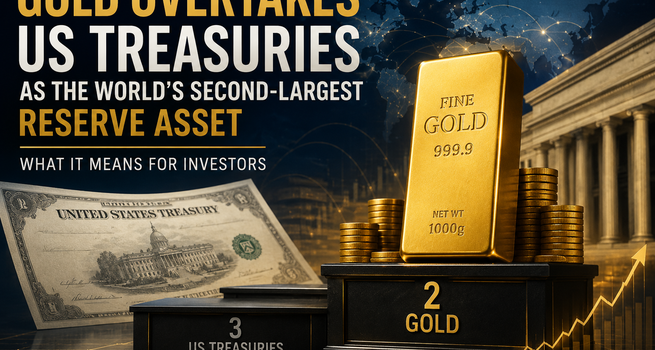
Key Highlights
- Gold now accounts for 27% of global Central Bank reserve Assets, up from 20% a year earlier, surpassing US Treasuries which fell to 22% from 25%, according to a European Central Bank report released Tuesday.
- Central banks globally hold more than 36,000 tonnes of gold, approaching levels last seen during the Bretton Woods era, when the dollar was directly convertible into gold.
- The shift has been driven by sustained buying from China, Poland, Turkey, and India, accelerating after Washington froze Russia's dollar reserves following the 2022 Ukraine invasion.
- Stablecoin issuer Tether emerged as the largest single gold buyer in 2025, acquiring more than 100 tonnes, marking a striking new category of institutional gold Demand.
- Dollar-denominated assets remain the largest share of global reserves at 42%, but the directional trend away from US Treasuries and toward gold is now confirmed by the world's most authoritative monetary institutions.
There are moments in financial history that are only fully understood in retrospect. The steady, deliberate accumulation of gold by the world's central banks over the past several years may well be one of them. On Tuesday, the European Central Bank made it official. Gold has surpassed US Treasuries to become the world's second-largest reserve asset. For investors who have been tracking this shift, the ECB report is confirmation. For those who have not, it is a signal worth examining with considerable care.
The numbers are striking in their clarity. Gold accounted for 27% of global central bank reserve assets at the end of 2025, up from 20% just one year earlier. US Treasuries, long the unquestioned second pillar of global reserves after dollar-denominated assets broadly, fell to 22% from 25% over the same period. This is not a marginal adjustment at the edges of reserve portfolios. It is a structural reallocation of meaningful scale conducted by the most conservative and deliberate class of institutional investors in the world.
Why This Is Happening
ECB President Christine Lagarde identified the primary driver with characteristic directness. Geopolitical tensions continue to drive strong central bank demand for gold. That sentence, contained in the ECB report, captures a shift in thinking among reserve managers that began in February 2022 and has not reversed since.
When Washington froze approximately $300 billion of Russia's dollar-denominated reserves following the invasion of Ukraine, every central bank outside the United States and its closest allies received the same message simultaneously. Assets held in a foreign Jurisdiction, regardless of how liquid or creditworthy they appear under normal conditions, can be rendered inaccessible by a political decision made in Washington. Gold held in domestic vaults cannot.
That realisation did not produce a sudden panic out of dollar assets, which would have been both impractical and self-defeating for countries whose trade is still largely denominated in dollars. What it produced was a quiet, sustained, and accelerating Diversification at the Margin. Every quarter since early 2022, a growing number of central banks have been directing incremental reserve accumulation toward gold rather than Treasuries. The ECB report is the first authoritative accounting of where that process has arrived.
The countries driving the shift are instructive. China, the world's second-largest economy and America's primary strategic competitor, has been systematically increasing its gold reserves while reducing its Treasury holdings for several years. Poland, one of NATO's most defence-conscious members, has been aggressively accumulating gold as a hedge against the geopolitical instability on its eastern border. Turkey and India, both large emerging market economies with histories of currency vulnerability, have been building gold positions as insurance against dollar strength and external financial pressure.
These are not fringe actors making speculative bets. They are sovereign institutions managing the financial foundations of major economies, and their collective judgment is that gold offers a form of reserve security that dollar-denominated assets no longer provide unconditionally.
The Bretton Woods Parallel and Why It Matters
The ECB report's reference to Bretton Woods is not incidental. With central banks now holding more than 36,000 tonnes of gold, reserve stockpiles are approaching levels last seen when the international monetary system was explicitly anchored to gold through the dollar's convertibility. The Bretton Woods system ended in 1971 when Nixon suspended that convertibility, initiating five decades during which the dollar functioned as the world's reserve currency on the basis of trust, economic dominance, and the absence of a credible alternative rather than any formal gold backing.
The current accumulation does not mean the world is returning to a gold standard. No serious monetary economist is arguing for that. What it does mean is that gold is recovering a role in the international monetary system that it had been progressively losing since 1971. Central banks are not buying gold because they expect to use it to settle trade invoices. They are buying it because it is the one reserve asset that carries no counterparty risk, no Jurisdiction Risk, and no political risk. In a world where geopolitical tensions are rising and trust in the unconditional availability of dollar reserves has been demonstrably shaken, those properties have regained their value.
Tether's Emergence as a Major Gold Buyer
Among the most striking details in the ECB report is the identification of Tether, the stablecoin issuer, as the largest single gold buyer in 2025, acquiring more than 100 tonnes over the course of the year. This development sits at the intersection of two of the most significant financial trends of the current era: the rise of digital assets and the rehabilitation of gold as a serious reserve asset.
Tether, which issues USDT, the world's largest stablecoin by Market Capitalisation, has been diversifying the reserves backing its digital dollar beyond conventional Treasury bills and cash equivalents. Gold, with its zero counterparty risk and historical Store of Value credentials, represents a logical hedge for an institution whose Business model depends on maintaining absolute confidence in its backing assets. That a crypto-native institution is now one of the world's largest gold buyers is an irony that monetary historians will note, and it signals that the demand base for gold is broadening in ways that were not anticipated even five years ago.
US Listed Companies That Benefit
The structural shift toward gold in global reserve portfolios creates direct and measurable tailwinds for several categories of US-listed companies.
Newmont Corporation (NYSE: NEM), the world's largest gold miner by production, is the most direct beneficiary of sustained elevated gold prices driven by central bank demand. Higher gold prices flow directly into Newmont's Revenue and free Cash Flow, and the company's global diversified production base gives it Leverage to a gold price that central bank buying has structurally supported.
Barrick Gold (NYSE: GOLD) similarly benefits from the price environment, with significant operations across Nevada, Africa, and Latin America generating substantial free cash flow at current gold price levels. The company has been using elevated prices to strengthen its Balance Sheet and increase Shareholder returns.
Agnico Eagle Mines (NYSE: AEM) has emerged as one of the sector's most consistently well-managed operators, with production concentrated in politically stable jurisdictions including Canada and Finland. In an environment where geopolitical risk is driving gold's reserve appeal, a gold miner with low geopolitical operational risk is a particularly coherent Investment.
Royal Gold (Nasdaq: RGLD) and Wheaton Precious Metals (NYSE: WPM) offer Royalty and streaming exposure to gold production, providing leverage to rising gold prices without the operational risks of direct Mining. These business models generate high-margin revenue streams that expand with gold prices while requiring minimal Capital reinvestment.
For investors seeking diversified gold exposure without individual stock selection risk, the SPDR Gold Shares ETF (NYSE: GLD) and the iShares Gold Trust (NYSE: IAU) provide direct gold price exposure in liquid, exchange-traded form. The VanEck Gold Miners ETF (NYSE: GDX) offers broader exposure across the mining sector.
The Dollar's Continued Dominance and Its Limits
It would be a misreading of the ECB report to interpret it as a dollar collapse narrative. Dollar-denominated assets still represent 42% of global reserves, more than all other currencies and gold combined. The dollar's dominance in trade invoicing, financial contracts, and Commodity pricing gives it a structural position in the global monetary system that cannot be dislodged quickly or easily.
What the report documents is a directional trend at the margin, a gradual and deliberate reduction in the rate at which newly accumulated reserves are being placed into dollar assets, combined with active reallocation toward gold. That trend does not need to accelerate dramatically to have significant consequences for Treasury demand and gold prices over a multi-year horizon.
The euro's growing international role, highlighted in the same ECB report, adds a secondary dimension. International debt issuance denominated in euros rose 30% last year to nearly one trillion euros, while foreign investors added a net 850 billion euros to euro-area assets. The euro is not replacing the dollar as a reserve currency, but it is capturing a growing share of the incremental diversification flows that are moving away from pure dollar concentration.
What Gold Prices Tell Us and Where They May Go
Gold prices near record highs reflect the demand dynamics the ECB report describes. Central bank buying of 850 tonnes in 2025, while below the record levels of the three preceding years, remains historically elevated. The World Gold Council noted in January that the value of gold held by foreign central banks was approaching $4 trillion, exceeding their roughly $3.9 trillion holdings of US Treasuries. The last time this ratio held was in 1996, before three decades of Treasury accumulation pushed gold firmly into second place.
Goldman Sachs has maintained a constructive medium-term gold price outlook, citing central bank demand as a structural floor beneath the market. Bank of America has projected gold prices could reach $3,500 per troy ounce under scenarios where central bank buying remains elevated and geopolitical tensions persist. JPMorgan's commodities team has similarly highlighted the structural nature of the reserve reallocation trend as a multi-year price support Factor rather than a cyclical phenomenon that will reverse when risk appetite improves.
Turkey's decision to sell or Loan 130 tonnes of gold in early 2026 after accumulating 220 tonnes since 2022 serves as a reminder that central bank demand is not a one-directional constant. Individual countries will buy and sell based on their specific economic circumstances, currency pressures, and Liquidity needs. The aggregate trend, however, has been consistent and is now confirmed by the most credible monetary institution in Europe.
The Bottom Line
The ECB report is not a market-moving event in the conventional sense. Gold prices did not gap dramatically on its release, and Treasury yields did not spike. What it represents is something more significant and more durable: official confirmation from one of the world's most authoritative monetary institutions that the global reserve system is undergoing a structural shift whose direction is clear even if its ultimate destination remains uncertain.
Gold has not replaced the dollar. It has replaced Treasuries as the world's second-largest reserve asset, a distinction that matters enormously for understanding where central bank demand flows over the coming years. For investors in gold miners, gold royalty companies, and gold ETFs, that structural demand floor is one of the most compelling fundamental backdrops the sector has seen in decades. For investors in US Treasuries and dollar-denominated assets more broadly, it is a trend that deserves monitoring with the same seriousness that the world's central banks are clearly applying to it.


 Jun 05, 2026




 Please wait processing your request...