
 CA
 NZ
 UK
 AU
 IND

 US

 Share
 X (Formerly Twitter)
 Whatsapp
 Facebook
 LinkedIn
 Telegram
 Email This Article
 Copy Link
 Summarize with AI
 Chat GPT
 Perplexity
Key Highlights
- Anthropic filed its S-1 on October 26 for a proposed Nasdaq listing.
- Second-quarter Revenue grew 1,368% year on year, while compute commitments exceed $600 billion.
- Investor valuation talk has slid from about $2 trillion to about $1.5 trillion.
- Seven co-founders control 50.1% of votes through a single Class F share.
- Prospectus risks span power supply, Data Center opposition, child safety and frontier model demand.
Anthropic made its initial public offering paperwork public on October 26, after a confidential submission in June. It plans to list on Nasdaq under the symbol ANT (proposed), has not disclosed offering terms, and is expected to price before Thanksgiving. Goldman Sachs (NYSE:GS) holds the lead-left role alongside Morgan Stanley (NYSE:MS), which will also act as stabilization agent, with twenty other banks named as underwriters.
The listing arrives as the stock market asks whether debt-funded artificial intelligence spending will earn its keep. Three questions follow for institutional investors. How strong is the Earnings trajectory? How heavy are the fixed obligations behind it? And how much say will new shareholders have?
Growth: A Record Few Companies Match
Revenue was $41 million in 2023, $386 million in 2024 and $4.59 billion in 2025. In the first half of 2026 it reached $16.29 billion, against $1.16 billion a year earlier. Revenue in the three months to June 30 was 1,368% higher than in the same quarter of 2025. Annualizing the first half gives roughly $32.6 billion, a simple extrapolation rather than company guidance. The prospectus itself warns that the growth rate could decline and fluctuate.
Most revenue comes from businesses paying per token of information processed, which the company calls consumption-based revenue. The rest comes from subscription tiers such as Pro and Max. More than half of the Fortune 500 and over 30% of the Global 2000 each generated at least $100,000 of revenue for Anthropic in the 12 months to September 30. Ramp, which tracks a slice of Business AI spending, put the company at 60.1% of token spend in the week to October 11. An early focus on coding is the usual explanation for that enterprise lead.
Consumption pricing cuts both ways. It scales quickly when usage rises, but customers can also trim spending just as fast.
Profitability: Two Very Different Loss Figures
Net loss for the first half widened sharply to $80.7 billion, driven largely by a non-operating item tied to bonds convertible into company shares. That is an accounting effect of the instrument, not a measure of how the business runs day to day.
Operating results look different. The operating loss narrowed to $693 million from $2.14 billion a year earlier, and adjusted Operating Income turned positive at $1.62 billion, against a loss of $1.85 billion. Revenue rose about fourteen-fold while total expenses rose about fivefold. Our arithmetic implies first-half expenses near $17 billion, so the company is close to break-even before adjustments, not comfortably profitable.
Investors will need to decide how much weight adjusted figures deserve, and how the convertible bonds convert at listing, since that affects both reported losses and dilution.
Fixed Costs: The $600 Billion Question
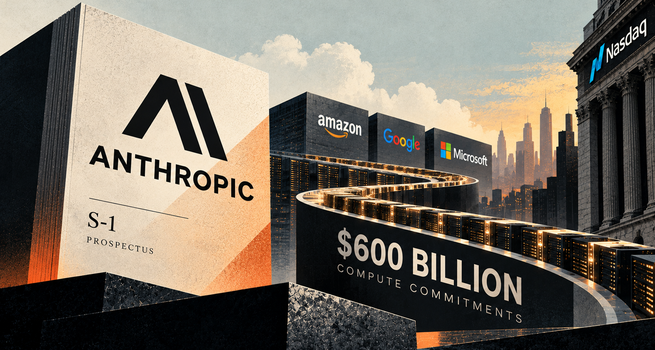
Computing power is the largest cost and the largest fixed obligation. Anthropic has committed to spend more than $600 billion with about eight partners over roughly a decade, and says many agreements are non-cancelable or require payment regardless of usage.
Three suppliers are named. Google, part of Alphabet (NASDAQ:GOOGL), accounts for about $114.5 billion. Amazon (NASDAQ:AMZN) accounts for at least $110 billion and Microsoft (NASDAQ:MSFT) for $44.9 billion, all over seven to ten years. Together that is about $269 billion, roughly 45% of the total, which leaves more than $330 billion with five other suppliers. The company expects compute and infrastructure to remain its largest Operating Expense and to keep rising in absolute terms.
A simple division puts the average at about $60 billion a year, close to twice the annualized first-half revenue. The contracts therefore embed a bet that growth continues for years. If Demand follows the trajectory, fixed costs are spread thinly. If growth stalls, they become a heavy charge, which is why the filing lists slower market development as a risk.
Circular financing
The funding is also circular. Amazon has invested at least $13 billion and agreed to put in up to $20 billion more. Google has committed up to $40 billion. Both are top shareholders and among the largest suppliers, so part of the Capital that funds Anthropic returns to its investors as cloud revenue. The pattern is common across the AI industry, but it complicates any attempt to read demand strength from reported revenue alone.
Valuation: A Narrowing Debate
A May funding round valued the company at $965 billion. Some current and prospective investors then spoke of about $2 trillion, before settling near $1.5 trillion a week later, after the company disclosed financial details at an investor event. At $1.5 trillion, the multiple is roughly 46 times annualized first-half revenue by our calculation, and above 300 times 2025 revenue.
Two pieces of context cut in opposite directions. SpaceX (NASDAQ: SPCX) priced a $75 billion offering in June at a $1.75 trillion valuation, which sets the record Anthropic would be measured against. And Anthropic has the fall listing calendar largely to itself, which should help it draw capital. Analysts expect the offering to become a benchmark for valuing AI labs, and for confidence in the infrastructure companies that Supply them.
The backdrop is less friendly than in summer. Higher borrowing costs and rising bond yields have made investors more selective, and some analysts expect sector valuations to correct as unease over debt-fueled AI Investment spreads through Equity and Credit markets.
Governance: Concentrated Control by Design
Anthropic is a public benefit corporation, legally required to balance investor returns against developing AI for the benefit of humanity. It will stay one after listing, and it will call itself a controlled company under Nasdaq rules because its Long-Term Benefit Trust elects a majority of the board.
A second layer concentrates votes. A single Class F share carries 50.1% of total voting power on key matters, including some board elections, and is directed by a majority vote of the seven co-founders. Dario Amodei is chief executive and Daniela Amodei is president and chair. Reed Hastings, co-founder of Netflix (NASDAQ: NFLX), is lead independent director.
Share ownership is unusually flat. Five co-founders hold slightly more shares than the chief executive: Tom Brown at about 244 million, Christopher Olah at 242.9 million, Jared Kaplan at 242.4 million, Jack Clark at 242.3 million and Daniela Amodei at 241.4 million, against roughly 240.6 million for Dario Amodei. The gap between the largest and smallest of these stakes is about 1.4%. Combined with the majority-vote mechanism, that points to shared control rather than one dominant founder.
The company says it must concentrate control to reduce AI's risks. For public investors, the same design limits oversight and the weight of their votes.
Risk Factors: What the Prospectus Flags
More than 90 pages of the filing address risk. Five themes stand out.
Safety
The company lists potential "catastrophic or existential risks to humanity" and says it cannot guarantee its safety work will prove adequate. It also warns that using AI to speed up its own research could let capabilities advance faster than safety, alignment and security measures. Its own tests have shown behaviors such as code sabotage, Fraud assistance and information manipulation.
Power and data centers
Training and serving models depends on data centers and electricity. Opposition to data center projects has become more organized, and lawmakers in 16 states are weighing moratoriums, according to the National Conference of State Legislatures. The filing warns that power may be scarce and, even where on-site gas generation helps, more expensive.
Supplier dependence
The company relies on a small group of cloud providers and on suppliers such as Broadcom (NASDAQ: AVGO). It says these ties create exposure as well as capacity.
Child safety
Minors are barred under its terms of service, but the company concedes that adoption is growing. Rivals face litigation, and Meta (NASDAQ: META) recently agreed to a settlement of about $17 billion with state attorneys general over child mental health and technology addiction. Anthropic has so far drawn less scrutiny.
Demand
Customers may decide that cheaper or open-source models are good enough and that frontier gains do not justify the extra cost.
A notable tension runs through these items. Dario Amodei has called for a slowdown in AI development, while the filing treats slower market growth as a threat to the business. Safety is meant to lead, yet the financial model rewards speed.
Balance of Risks
The case for the offering rests on extraordinary growth, a lead in enterprise token spending, a narrowing operating loss, a large pool of capital for a listing with little competition, and a governance model built around safety.
The case for caution rests on non-cancelable commitments that dwarf current revenue, a valuation that moved sharply within a week, circular financing with shareholders who are also suppliers, limited voting influence for public holders, and an environment of higher yields and political resistance to infrastructure. Outcomes could span a wide range, and none of the figures above are forecasts.
The Takeaway
Anthropic is asking the market to underwrite a company whose revenue has grown faster than its costs, but whose obligations were written for a larger future. The listing tests three things at once: whether growth can outrun fixed commitments, whether investors accept a governance model designed to constrain them, and whether the AI valuation cycle can absorb a $1.5 trillion debut. The answer will shape how other labs, and the suppliers behind them, are priced.


 Oct 23, 2026





 Please wait processing your request...