
 CA
 NZ
 UK
 AU
 IND

 US

 Share
 X (Formerly Twitter)
 Whatsapp
 Facebook
 LinkedIn
 Telegram
 Email This Article
 Copy Link
 Summarize with AI
 Chat GPT
 Perplexity

Key Highlights
● T3 Defense agreed in late October to acquire KeepZone AI.
● It announced a $1.3 million power-generation order for European air-defense production.
● Positech began deliveries on a $3.9 million defense order in October.
● The company has no order or contract tied to the European programs it cited.
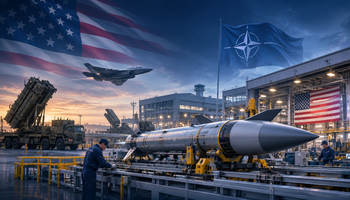
European governments are committing large sums to layered air and missile defense, and much of that spending flows not only to interceptors and radars but to the ground equipment around them: power units, launchers, vehicles and command shelters. T3 Defense Inc. (NASDAQ:DFNS), the Nasdaq-listed acquirer of Israeli defense manufacturers that was formerly known as Nukkleus Inc., has said its subsidiaries operate in exactly those categories. How much of that Demand the small company can actually convert into orders may be one of the more important questions for its next phase of growth.
Latest Company Context
T3 Defense describes itself as a company that acquires and operates mission-critical defense businesses, focusing on manufacturers with established customer relationships and backlogs. Its portfolio includes Tiltan, Rimon, Positech and ITS, and in late October it agreed to acquire KeepZone AI. In a September 8 release, the company pointed to several European developments: planned Manufacturing of ground-system components for Rafael's Iron Dome at Volkswagen's former Osnabrück site after vehicle production there ends in 2027; an Israel-Greece multi-layered air and missile defense agreement valued at about $3.5 billion, with roughly a quarter of value reportedly earmarked for local industry; and a German Navy live-fire trial of an Israeli-developed ballistic missile system.
Two days later it announced a $1.3 million power-generation order for European air-defense production, and in October Positech began deliveries on a $3.9 million defense order.
Key Business and index Drivers
The opportunity rests on a supply-chain logic. Israeli prime contractors exporting systems to Europe typically need subcontractors for power generation, mechanical assemblies and ground hardware, and those programs may also carry local-content requirements. T3 Defense's subsidiaries already Supply some of these components, which could position them as subcontractors if programs scale. However, the company's own release states that it has no order, contract or contractual relationship in connection with the European programs it cited, and notes that third-party reports may be inaccurate, delayed or abandoned. The orders announced so far, $1.3 million and $3.9 million, are modest relative to multibillion-dollar programs, so the gap between addressable spending and actual awards remains wide.
Capacity also matters: the company's model targets businesses that are capacity-constrained, meaning additional European Volume might require capital investment.
What Investors Should Watch
Items to watch include any purchase orders explicitly tied to European air-defense programs, particularly those linked to the Greek agreement or Osnabrück production, as evidence that the opportunity is moving from market commentary to contracts. Delivery updates on the Positech and power-generation orders could show execution capacity. Completion of the pending KeepZone AI acquisition, and how it is financed, may affect the company's Balance Sheet and share count. Tiltan's planned launch of new simulation products at the I/ITSEC 2026 Training conference could also indicate whether the company is diversifying demand beyond Israel and Europe. Quarterly filings may reveal Backlog figures by region, which would help gauge European exposure.
Further participation in European defense exhibitions, following Tiltan's appearance at MSPO 2026 in Poland, could also indicate how actively the group is pursuing NATO customers.
The Ground Equipment Opportunity
Europe's air-defense spending provides a sizable backdrop for a company whose subsidiaries make the kind of ground equipment those systems require. So far, though, T3 Defense's European involvement is limited to small orders, and management has been explicit that it holds no contracts with the larger programs it highlighted. The coming quarters may show whether its subsidiaries can secure subcontracting roles at meaningful scale, or whether the opportunity remains largely prospective. Order size and repeat business may be the most useful indicators to track.


 Nov 27, 2026




 Please wait processing your request...