
 AU
AU
 UK
UK
 CA
CA
 NZ
NZ
 IND
IND

 US
US

 Share
Share
 X (Formerly Twitter)
 Whatsapp
 Facebook
 LinkedIn
 Telegram
 Email This Article
 Copy Link
 Summarize with AI
 Chat GPT
 Perplexity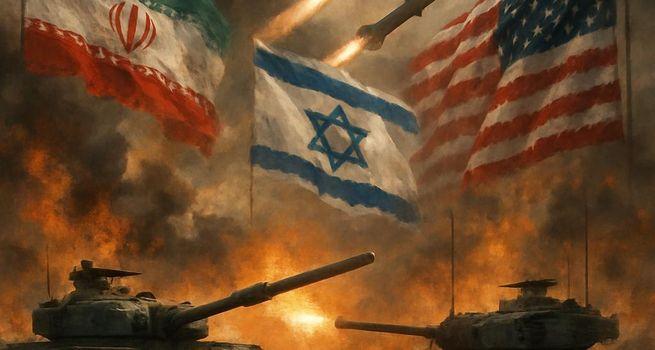
Key Highlights
- Every Iranian drone shot down is a guaranteed future sale for a US defence contractor
- Defence was the only sector rising on the day bombs fell on Tehran
- The Strait of Hormuz is closed, gold is near $5,400, and weapons CEOs have already met with the President
- Iran fires $50,000 drones. The US fires $12.77 million interceptors to stop them. The math only works one way
- The greatest risk to defence investors is not conflict. It is peace
Introduction
When the United States and Israel launched Operation Epic Fury against Iran on 28 February 2026, two things happened simultaneously. Missiles began falling on Tehran. And on Wall Street, a small group of companies got significantly richer.
On the first trading day after the strikes, Lockheed Martin, Northrop Grumman, and RTX rose between 3% and 6% each. Their combined shareholder gain in that single session was estimated at $25 to $30 billion. The S&P 500 was falling. Defence was the only sector rising. Modern warfare is, above all, a procurement event.
The US Primes: The Biggest Winners
Five American companies sit at the centre of this conflict's supply chain, and each is benefiting in a distinct way.
RTX Corporation, formerly Raytheon, is the single largest corporate beneficiary. Its Patriot missile system and Tomahawk cruise missiles are among the most heavily consumed weapons in the campaign. RTX stock rose 4.7% on Day 1 and has gained 110% since March 2023, the largest three-year rise of any major US defence prime. The company has invested over $1 billion in securing raw materials ahead of orders and has increased Patriot radar production by 25%. DoD contracts accounted for 30 to 40% of RTX's 2024 revenue of $43.6 billion in defence.
Lockheed Martin, the world's largest defence contractor by revenue, supplies the F-35 fighter jets, THAAD missile defence systems, PAC-3 interceptors, and the Precision Strike Missile, which was used in combat for the first time in this conflict. Its stock hit an all-time high on 2 March, closing at $676.70. Since the start of 2026, as tensions with Iran escalated, its share price had already risen nearly 40% before the first bomb fell. In January 2026, Lockheed signed a framework agreement with the Pentagon to quadruple THAAD interceptor production from 96 to 400 units per year. Each THAAD interceptor costs $12.77 million. Every one fired must be replaced. DoD contracts represent 74% of Lockheed's revenue.
Northrop Grumman is the biggest single-day winner in percentage terms, closing up 6% on Day 1. Its B-2 Spirit stealth bombers have been central to deep-strike missions against hardened Iranian targets. It also provides the AARGM-ER anti-radiation missile and radar systems for the E-3 Sentry AWACS. Northrop's stock has risen 60% since March 2023.
Boeing contributes the F/A-18 Super Hornet, EA-18G Growler, and JDAM precision munitions. L3Harris, which supplies electronic warfare and targeting systems, closed up 3.8% on Day 1.
Collectively, the CEOs of RTX, Lockheed Martin, Boeing, Northrop Grumman, BAE Systems, L3Harris, and Honeywell met with President Trump within days of the strikes to discuss production expansion. RTX's order backlog alone stands at $251 billion.
The Interceptor Asymmetry: Why Demand Compounds
The financial engine driving these companies is a structural cost asymmetry that is unique to missile warfare. Iran fires low-cost drones and older-generation ballistic missiles. The systems required to destroy them cost orders of magnitude more.
A Shahed drone costs an estimated $20,000 to $50,000 to produce, according to defence analysts and independent assessments of Iranian production costs. Intercepting it with a PAC-3 MSE costs $4 million. Intercepting a ballistic missile with a THAAD round costs $12.77 million. For every Iranian asset destroyed, a replacement interceptor must be procured, often at 50 to 500 times the offensive cost. This dynamic does not resolve when the war ends. It accelerates replenishment orders for years afterward.
Raytheon produces approximately 550 PAC-3 MSE interceptors per year for the entire global customer base. Iran has been consuming them faster than they can be replaced. The January 2026 Lockheed-Pentagon THAAD agreement is a multi-year ramp that will not reach full capacity until the early 2030s. Until then, every round fired is a guaranteed future sale.
Israeli Companies: Validated by Combat
Israeli defence firms benefit through a different mechanism: live battlefield performance is the world's most powerful marketing tool.
Elbit Systems briefly became Israel's most valuable listed company, with shares up 45% since January. Rafael supplies Iron Dome and David's Sling. Israel Aerospace Industries supplies the Arrow high-altitude defence system. All three are generating export interest from governments across Europe, Asia, and the Gulf, which are watching these systems perform against Iranian ballistic missiles and recalibrating their own procurement plans accordingly.
European and Emerging Beneficiaries
BAE Systems surged around 6% on Day 1. Germany's Hensoldt rose close to 5%. Italy's Leonardo reported an 18% rise in full-year core profits on a like-for-like basis. Palantir, whose AI tools support intelligence operations, rose nearly 6%. Morgan Stanley issued an advisory recommending investors increase exposure to defence and aerospace, where government spending can drive multiyear demand.
The Structural Outlook
The US defence budget was near $1 trillion in 2025, with a target of $1.5 trillion by 2027. The Trump administration has already announced $153 billion in accelerated military spending within a single year. In 2024, the top 100 defence companies globally generated more than $679 billion in revenue, with US firms accounting for nearly half.
The greatest risk to these companies is not conflict. It is peace. When ceasefire talks emerge in prolonged wars, defence investors sell. Analysts currently see no imminent resolution.
FAQ
- Which company has benefited most?
RTX is the single largest beneficiary by revenue exposure, supplying Patriot systems and Tomahawk missiles among the most consumed weapons in the campaign. Lockheed Martin leads on contract value and market cap gain. Northrop Grumman posted the largest single-day stock surge at 6%.
- How do defence companies profit from interceptor missiles specifically?
Every interceptor fired must be replaced. Because interceptors cost 50 to 500 times more than the Iranian drones and missiles they destroy, consumption generates compounding procurement demand that flows directly to manufacturers, primarily RTX and Lockheed Martin.
- Is the defence sector a long-term investment opportunity?
Budgets are rising and the conflict has removed political friction from procurement. However, current valuations carry a significant conflict premium, and a diplomatic resolution would reduce near-term demand. This article is analytical, not financial advice.


 Jun 10, 2026



 Please wait processing your request...